


UN Revises Gaza Casualty Data

The UN revised Gaza casualty figures, significantly reducing reported numbers of women and children killed after shifting data sources, highlighting issues with data verification and aid allocation.

5 min read
Table comparing UN OCHA daily summaries for Sudan/DRC, Venezuela, and Palestinian Territories on July 17, 2026, highlighting aid disparities.
A snapshot of the UN OCHA daily summary from July 17, 2026, comparing humanitarian crises.

In conflict zones, statistics are more than numbers; they direct aid, shape law, and sway public opinion. When global bodies like the United Nations or influential content creators publish data, it is often accepted as verified truth.

However, when these figures are unverified, methodologically flawed, or selectively curated, the consequences extend beyond simple errors. Such inaccuracies degrade public trust, inflame geopolitical tensions, and distort the perception of global crises.

Comparative Optics: Aid Priorities Under Scrutiny

Modern UN field updates reveal stark differences in how humanitarian crises are framed. A July 17, 2026, UN OCHA daily summary highlighted mass fatalities and disease in Sudan/DRC and a catastrophic natural disaster in Venezuela.

Venezuela suffered nearly 5,000 deaths and over 16,700 injuries from massive earthquakes, leaving an unfunded $570 million aid deficit. The DRC faced a major Ebola outbreak and weekly civilian deaths from active combat.
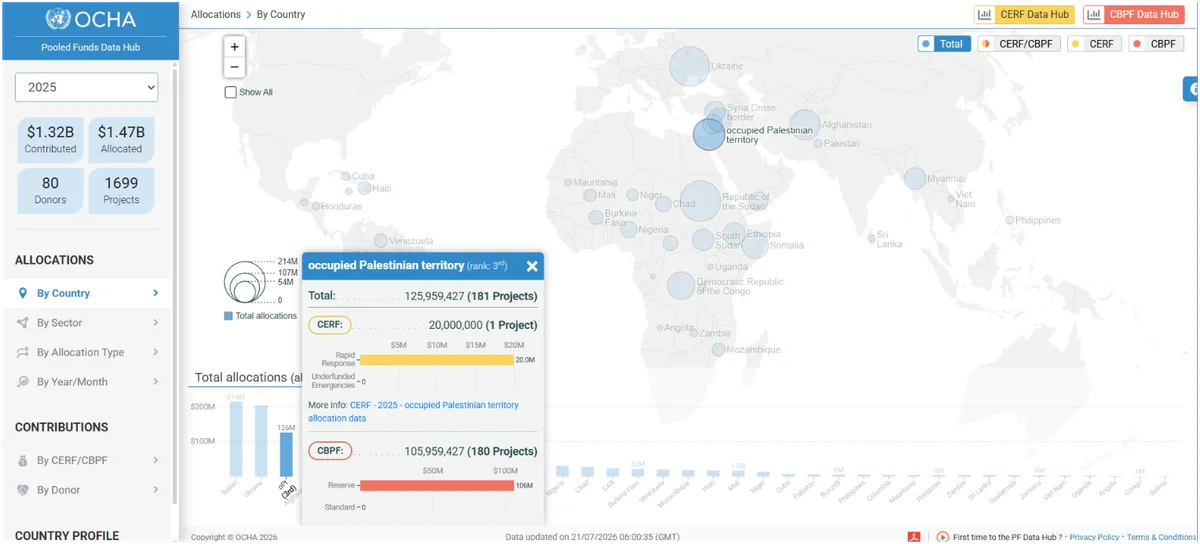
Table comparing UN OCHA daily summaries for Sudan/DRC, Venezuela, and Palestinian Territories on July 17, 2026
Image credit: UN OCHA

In contrast, the Palestinian section of the same update focused on civic maintenance: daily drinking water delivery, pest control, and solid waste removal. Critics note this focus on municipal services, compared to mass-casualty events elsewhere, creates a skewed hierarchy of global suffering.

This disparity sparks criticism, given that areas like Gaza previously boasted luxury developments and organized civic events, amenities rare in regions like North Kivu or post-earthquake La Guaira. Observers argue that treating Palestinian territory as a primary aid beneficiary, irrespective of relative wealth or compared to sudden mass-casualty disasters, distorts global aid priorities.

From UN Releases to YouTube: Misinformation Amplified

A significant driver of misinformation in modern conflicts is the rapid feedback loop between ambiguous bureaucratic reporting and social media amplification. Travel influencers often absorb and broadcast official UN press releases without scrutinizing the underlying methodology.

For example, OCHA reports on the West Bank cited over "1,000 settler attacks" causing "casualties OR property damage." Influencers, like Harry Jaggard, then amplified this as "1,000+ attacks" to millions, implying lethal massacres.

OCHA's definition of "casualties" includes non-fatal injuries and property damage, ranging from broken windows to uprooted olive trees. When influencers repeat "1,000 attacks," the critical distinction between non-lethal property damage and lethal violence is erased, distorting public understanding. The impact of such amplification on global narratives is substantial.

Gaza Case Study: UN Statistical Revisions Gaza Casualty Data

A similar dynamic played out in the UN's tracking of casualties during the Israel-Hamas conflict. For months, UN OCHA relied heavily on data from the Hamas-run Government Media Office (GMO) in Gaza.

Early reports claimed approximately 70% of those killed in Gaza were women and children. This figure was widely cited across social media and major news networks.

In May 2024, OCHA updated its casualty snapshot, shifting its demographic breakdown from the Hamas media office to identified bodies from the Gaza Ministry of Health. Within 48 hours, the reported number of women killed dropped from over 9,500 to 4,959, and children from over 14,500 to 7,797.

While the overall fatality estimate remained high, the proportion of women and children fell overnight from approximately 69% to 52%. This shift in the UN statistical revisions Gaza casualty data highlights the perils of uncritical data reliance.

Structural Flaws in Transmitted Data

  • Gaza authorities did not distinguish between civilian casualties and active combatants.
  • Baseline natural mortality rates (~5,000 deaths annually) and fatalities from misfired rockets were folded into overall conflict totals.
  • Data scientists noted anomalies, such as fixed daily percentages of women and children, suggesting arbitrary extrapolation rather than direct counts.

The Institutional and Creator Blindspot: Omitting Internal Violence

Critics point to a glaring blindspot in both international body reporting and influencer-led vlogs: the omission of internal criminal violence. While OCHA and vloggers focus on military operations and political violence, they consistently ignore domestic criminal violence within Palestinian and Israeli-Arab society, a major component of civilian risk.

Local media and watchdogs, like the Times of Israel and Abraham Initiatives, track all homicides and violent crime, offering a comprehensive view of public safety. In 2025, 252 Arab citizens and residents were killed in criminal violence in Israel, over 80% of all nationwide homicides, despite Arabs comprising ~20% of the population. This violence is driven by organized crime, arms trafficking, and clan feuds, with low police solve rates.

When an influencer focuses solely on political conflict, ignoring the overwhelming internal crime crisis, they present a distorted narrative to millions, suggesting political conflict is the sole threat to civilian life.

Historical Precedents of Flawed Data

The weaponization or careless handling of figures by authoritative bodies and media has repeatedly caused catastrophic real-world fallout.

  • 1990 "Incubator Allegations" (Gulf War): Unverified claims of Iraqi soldiers removing infants from incubators in Kuwait were cited by the UN Security Council, building a case for war. Investigations later proved the claim fabricated.
  • 1994 Rwandan Genocide Undercounts: Early UN estimates severely undercounted killings, framing the genocide as a "breakdown in a ceasefire." This underreporting provided diplomatic cover to delay intervention, while hundreds of thousands perished.
  • 2003 Iraq War "WMD" Intelligence: Quantitative intelligence presented to the UN Security Council regarding Iraq's alleged WMD stockpiles was asserted as definitive fact, leading to an invasion that cost hundreds of thousands of lives.

Measuring casualties and human need in crisis zones is complex. However, there is a fundamental difference between acknowledging data limitations and uncritically broadcasting figures supplied by combatant factions, presenting compound metrics as sensational headlines, or ignoring massive humanitarian disasters elsewhere in favor of politically charged optics.

For both global bodies and digital influencers, maintaining strict verification protocols, nuanced framing, and factual integrity is a critical responsibility. Carelessly handled statistics deepen conflict, mislead the public, and obscure the true reality of global human suffering.

Furthermore, UN OCHA Pooled Funds dashboard data for 2025 highlights stark global priorities. The occupied Palestinian territory received the third-highest allocation worldwide, over $125.9 million across 181 projects.

When comparing a population of roughly 5 million to massive, underfunded global crises, where millions of displaced refugees face active mass-casualty conflicts or catastrophic natural disasters without anywhere near this level of per-capita aid, serious questions arise about international humanitarian resource prioritization.

Why does aid flow so heavily to one specific area while other severe, life-threatening crises around the world struggle for basic attention and funding?

© 2026 StartupHub.ai. All rights reserved. Do not enter, scrape, copy, reproduce, or republish this article in whole or in part. Use as input to AI training, fine-tuning, retrieval-augmented generation, or any machine-learning system is prohibited without written license. Substantially-similar derivative works will be pursued to the fullest extent of applicable copyright, database, and computer-misuse laws. See our terms.