

• StartupHub.ai
    StartupHub.aiAI Intelligence
Discover
  • Home
  • Search
  • Trending
  • News
Intelligence
  • Market Analysis
  • Comparison
  • Market Map
Workspace
  • Email Validator
  • Pricing
Company
  • About
  • Editorial
  • Terms
  • Privacy
  • v1.0.0
  1. Home
  2. News
  3. This Is Why Meta Acquired Manus Ai
Back to News
Ai video

This is Why Meta Acquired Manus AI

The central challenge currently facing the burgeoning AI agent ecosystem is not theoretical capability but operational scalability.

S
StartupHub Team
Jan 1 at 5:55 PM4 min read
This is Why Meta Acquired Manus AI

The central challenge currently facing the burgeoning AI agent ecosystem is not theoretical capability but operational scalability. Building an agent that performs a complex task once is achievable; building a system that is reliable, fast, and maintainable across millions of daily conversations is an entirely different engineering hurdle. This was the core theme of the presentation given by Ivan Leo, representing Manus AI (now Meta Superintelligence), at the AI Engineer Code Summit 2025 in New York City, detailing the technical architecture and philosophy behind the new Manus API.
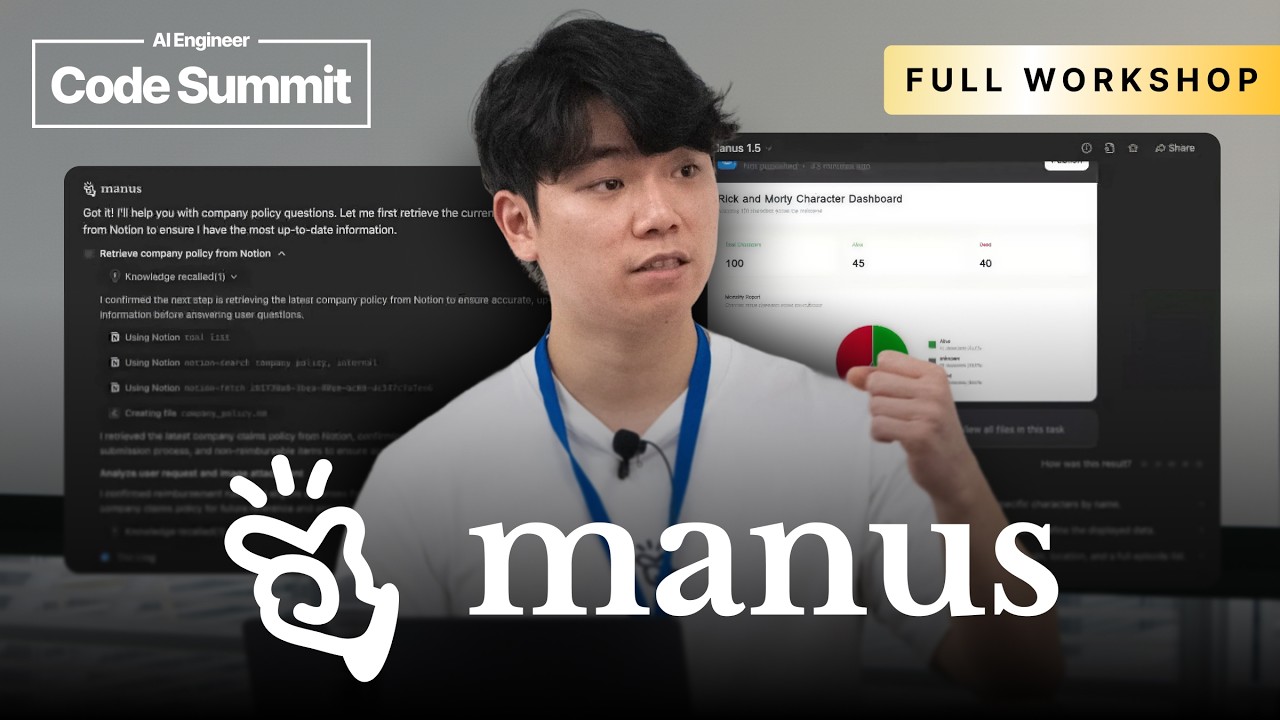
Leo spoke with the audience of founders and engineers about the intensive infrastructure requirements that often derail smaller teams aiming for enterprise-grade deployment. Traditional approaches, he noted, "require you to manage infrastructure, handle state persistence, orchestrate complex tool chains, and debug failures across distributed systems." These are not merely coding tasks; they represent months of complex, undifferentiated heavy lifting before a team can even begin addressing its actual business problem. Manus was designed from the ground up to eliminate this foundational friction.

Manus is positioning itself as "the action engine that goes beyond answers to execute tasks, automate workflows, and extend your human reach." This definition highlights the shift from large language models (LLMs) as mere conversational interfaces to autonomous agents capable of performing multi-step, real-world operations. The platform offers multiple ways to integrate, including a dedicated web application, Slack and Microsoft 365 integrations, a browser operator for persistent login tasks, and the newly launched API for custom, enterprise-grade deployments.

The platform’s performance gains underscore its technical re-architecture. The new Manus 1.5 agent architecture delivers tasks "nearly four times faster performance—tasks that once took 15 minutes now complete in under four minutes—while achieving 15% better task quality and 8% higher user satisfaction." This speed and quality improvement is critical for production environments where latency directly impacts user experience and operational cost. Manus offers two main models: the full-featured Manus 1.5 for complex reasoning and the streamlined Manus 1.5 Lite, optimized for cost-efficient performance in high-volume operations.

The platform is designed to meet users where they are. This commitment extends to integrating Manus directly into email, Slack, and even Microsoft 365 environments.

Leo demonstrated several complex workflows built entirely through natural language prompts and simple API calls. One impressive example involved scraping the entire schedule of the AI Engineer Code Summit website, loading all session data into a vector database, and building a searchable timeline with Google Calendar export functionality. This entire process—which traditionally would involve complex web scraping, database setup, and custom frontend development—was executed seamlessly using Manus. The key differentiation here is that the Manus platform abstracts the full technology stack. Leo emphasized that building a simple MVP requires handling "authentication, file handling, webhook infrastructure, database integration, and monitoring—before you even start solving your actual business problem." Manus handles all these backend complexities, allowing engineers to focus solely on the agent logic.

For complex, asynchronous tasks, Manus provides robust solutions beyond simple polling. The platform supports webhooks, enabling a serverless, event-driven architecture that notifies an application instantly when a task is completed or requires attention (a "pending" state). This eliminates the need for constant, inefficient API calls, drastically reducing network traffic and server load—a crucial efficiency gain for scaling applications.

Security and data lifecycle management are also built into the API fundamentals. Recognizing that agents often handle sensitive information, any files uploaded via the Manus Files API are automatically deleted after 48 hours, ensuring data is not stored indefinitely and cannot be referenced in future tasks. For immediate data deletion, users can simply delete the session, which removes all associated files and leaves no trace in the Manus system. This commitment to enterprise-grade data privacy and security is a key selling point for organizations handling proprietary or sensitive data. The ability to seamlessly integrate external tools like Notion and Gmail via pre-configured connectors further streamlines operational workflows, reinforcing Manus’s position as a cohesive, production-ready environment for intelligent agent development.

#Acquisition
#AI
#AI Agents
#API Economy
#LLMs
#Manus AI
#Meta
#Workflow Automation

AI Daily Digest

Get the most important AI news daily.

GoogleSequoiaOpenAIa16z
+40k readers