

If 2023 and 2024 were the years of the Chatbot, 2025 is undeniably the year of the AI Agent. As the frontier shifts from Large Language Models (LLMs) that simply talk to "action-oriented" agents that execute complex workflows, the startup ecosystem is scrambling to understand user behavior.
Until now, data on how people actually use these autonomous tools has been scarce. However, a new research paper titled "The Adoption and Usage of AI Agents: Early Evidence from Perplexity" provides the first large-scale field study on the topic. Analyzing hundreds of millions of interactions via Perplexity’s "Comet" browser and "Comet Assistant," the researchers offer a roadmap for the future of work.
Here is deep dive into AI agent adoption trends and what they mean for founders and innovators.
1. The "Who": Demographics of the Power User
The study reveals that AI agent adoption is not evenly distributed. Usage intensity correlates strongly with economic and educational factors.
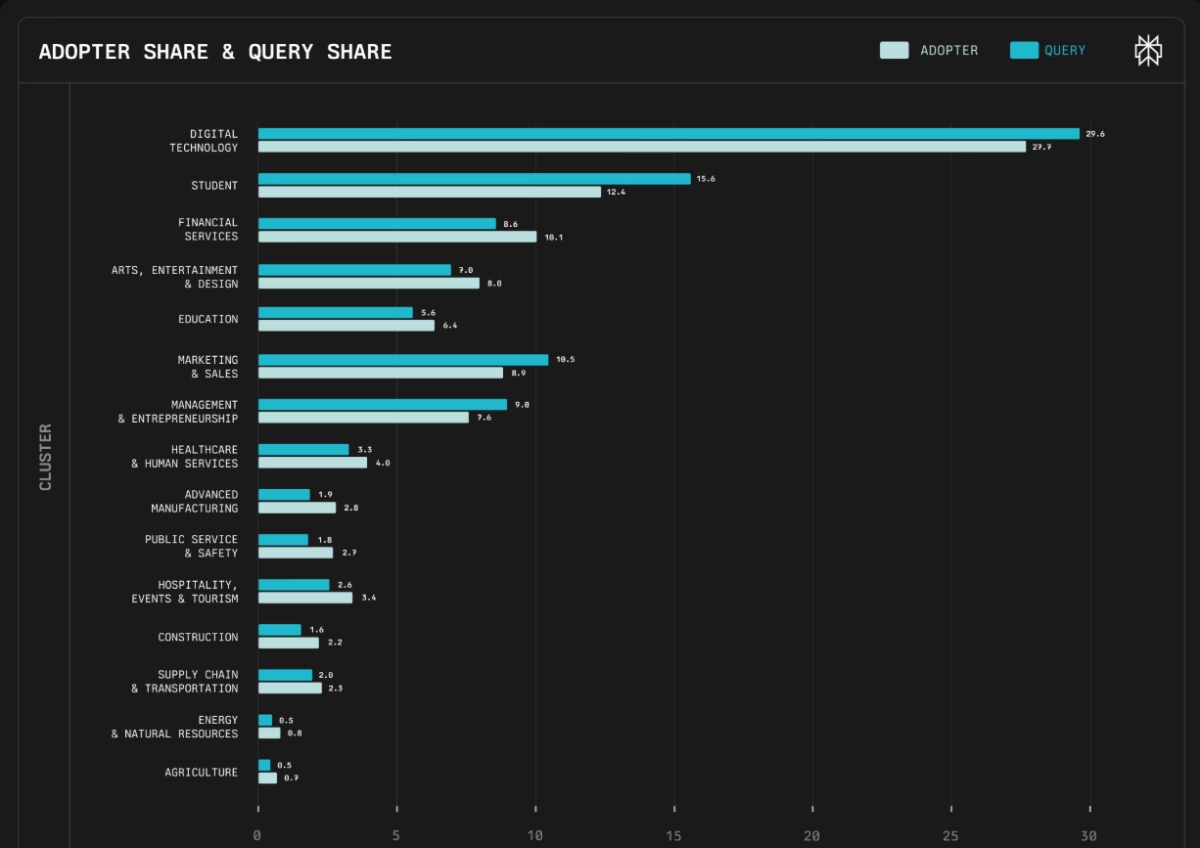
According to the data, adoption is significantly higher in countries with higher GDP per capita and higher average years of education. But the most telling data comes from occupational clusters. The early adopters are overwhelmingly knowledge workers:
- Digital Technology: The largest cluster, accounting for 28% of adopters and 30% of total queries.
- Academia & Education: High adoption rates among students and researchers.
- Finance & Marketing: Significant usage intensity for data analysis and content scaling.
Startup Takeaway: The immediate market for B2B agentic solutions lies in high-skill sectors. Tools targeting software engineers (Comet's largest user subcluster), financial analysts, and marketers will see faster uptake than those targeting physical industries like construction or hospitality.
2. The "What": A New Taxonomy of Use Cases
Perplexity’s researchers developed a hierarchical taxonomy to categorize what users are actually asking agents to do. The results show that users are moving beyond casual chat into distinct "Jobs to be Done."
The two dominant topics account for 57% of all agentic queries:
- Productivity & Workflow (36%): This is the king of use cases. It includes document editing, email management, and account configuration.
- Learning & Research (21%): Users are leveraging agents to navigate courses, summarize papers, and assist with exercises.
Following these are Media & Entertainment (16%) and Shopping (10%).
Startup Takeaway: The "Productivity" category is the battleground. With tasks like "Document & Form Editing" comprising 21.5% of the productivity queries, there is a massive opportunity for startups building specialized agents that integrate deeply with tools like Google Docs and Notion.
3. The "Where": The Battle for the Browser Environment
An AI agent needs an environment—a website or app—to perform its tasks. The study highlights the "Top Environments" where agents are currently deployed.
The top 10 environments account for 63% of all queries, indicating a heavy consolidation on major platforms:
- Docs.google.com: 11.97% of all queries (Dominated by educational and professional use).
- Email Services: 11.23% combined.
- LinkedIn: 9.42% (The dominant environment for career and networking tasks).
- YouTube: 7.03% (Heavily used for research and learning summaries).
Startup Takeaway: If you are building an agent, it must play nice with the giants. The data shows that "Email Management" and "LinkedIn Networking" are killer apps for professional users.
4. Usage Context: Personal vs. Professional
Contrary to the belief that agents are purely enterprise tools, the study found that Personal Use constitutes 55% of queries. Professional use follows at 30%, with Educational use at 16%.
However, the type of usage varies by context:
- Personal: Heavily skewed toward Shopping for Goods (15.6% of personal queries) and Social Media.
- Professional: Dominated by Document Editing (13.3%) and Professional Networking (12.5%).
- Educational: Almost entirely focused on Courses (83.9% of educational queries).
5. The Evolution of User Trust (Stickiness)
Perhaps the most encouraging finding for the industry is how user behavior evolves over time. The study analyzed the trajectory of users from their first query onward.
Initially, users may test the agent with lower-stakes tasks (Travel or Media). However, over time, usage shifts toward more cognitively oriented topics like Productivity, Learning, and Career. Furthermore, usage is "sticky"—once a user begins a session in a productivity workflow, they rarely switch context, suggesting agents are successfully maintaining long-horizon tasks.
The Era of Action
The Perplexity research confirms that AI agent adoption is no longer theoretical—it is measurable and growing. The post-General Availability (GA) period of Comet accounted for 60% of adopters, signaling that mainstream interest is spiking.
For the startup ecosystem, the message is clear: The winners of the next cycle will not just be those who build better LLMs, but those who build agents capable of executing specific, high-value tasks within the environments where knowledge workers spend their day.


