

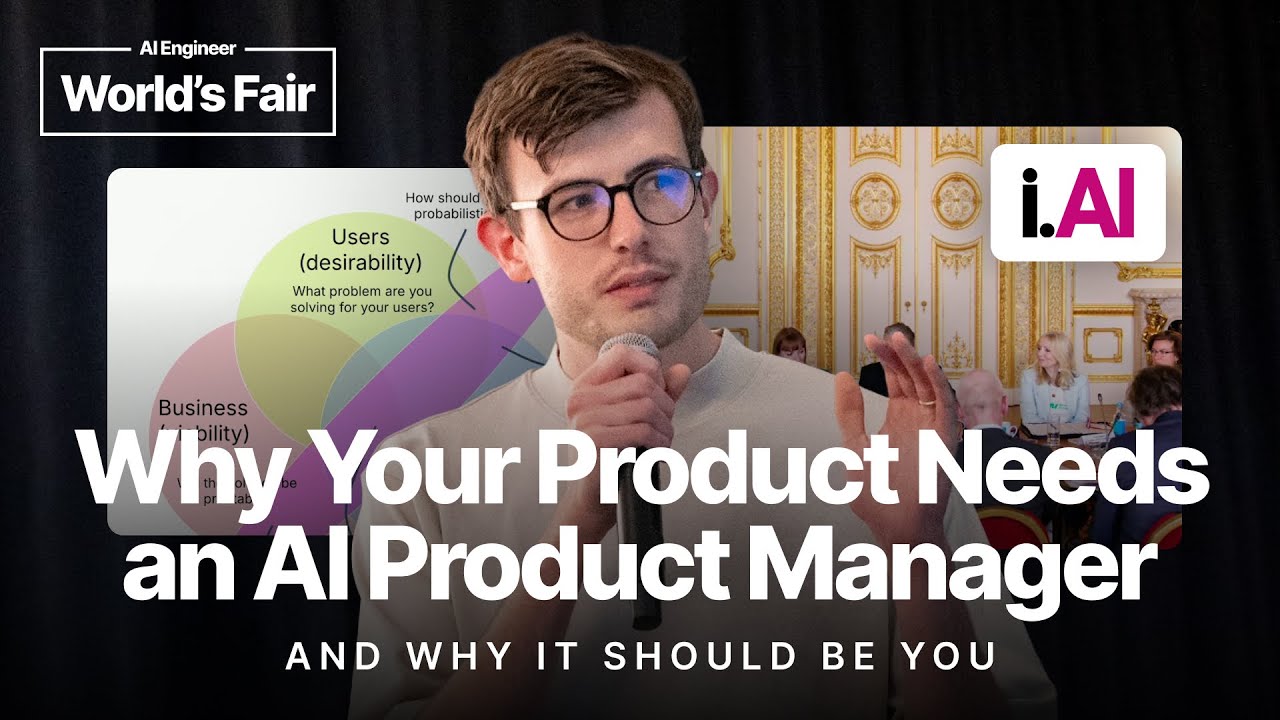
"Writing software, especially prototypes, is becoming cheaper. This will lead to increased demand for people who can decide what to build. AI Product Management has a bright future!" This assertion from Andrew Ng sets the stage for James Lowe, Head of AI Engineering at i.AI, who spoke at the AI Engineer World's Fair in San Francisco about the critical need for a new breed of product manager in the artificial intelligence landscape. Lowe contended that AI's inherent uncertainties demand a distinct approach to product development, one uniquely suited for individuals with deep technical AI expertise.
Lowe highlighted that traditional product management balances user desirability, business viability, and technological feasibility. AI, however, introduces a new, pervasive layer of complexity that intersects with all three. Questions arise: how does a business factor in the higher experimentation and failure rates of AI products? How does one evaluate and monitor the probabilistic nature of AI models for users? Is the proposed AI solution even technically possible? These unique challenges underscore the need for a specialized AI product manager.
The first hard-won lesson from i.AI, the UK Government's Incubator for Artificial Intelligence, emphasizes the importance of evaluating AI capabilities early. Their "Consult" project, aimed at analyzing large volumes of public consultation responses, initially struggled by rushing into product building. The outputs were inaccurate and inconsistent. By pivoting to prioritize early AI capability evaluation and testing with real users, they developed "ThemeFinder," a tool that proved "1,000 times faster and 400 times cheaper than humans." This early validation not only avoided wasted effort on an impossible solution but also steered the product toward a genuinely impactful one.
A second crucial lesson is to experiment broadly with new features on real users, then strategically cut back. i.AI’s "Minute" AI transcription tool initially offered a wide array of features, made possible by rapid prototyping with AI coding assistants. However, user feedback revealed an overly complicated and overwhelming experience. Leveraging the low emotional attachment to AI-generated code, the team streamlined the application, focusing on high-impact features like those for probation services, resulting in "Justice Transcribe." This iterative process of expansive experimentation followed by rigorous pruning ensures focus on true user value.
Finally, Lowe stressed the imperative to pivot harder and faster than ever before. The "Redbox" project, initially conceived to digitize the physical red boxes carried by UK government ministers, underwent significant transformations. What began as a digitization effort quickly pivoted to provide the easiest and cheapest way for civil servants to securely chat with a large language model. Then, with the emergence of new model context protocols, Redbox evolved again, becoming a client to access i.AI's broader suite of tools and data. This constant evolution, driven by shifts in the commercial landscape and technological advancements, highlights that static roadmaps are a liability in AI. The core takeaway is that while product management fundamentals remain, AI introduces a dynamic, unpredictable element that necessitates unparalleled agility and a profound technical understanding to navigate.