

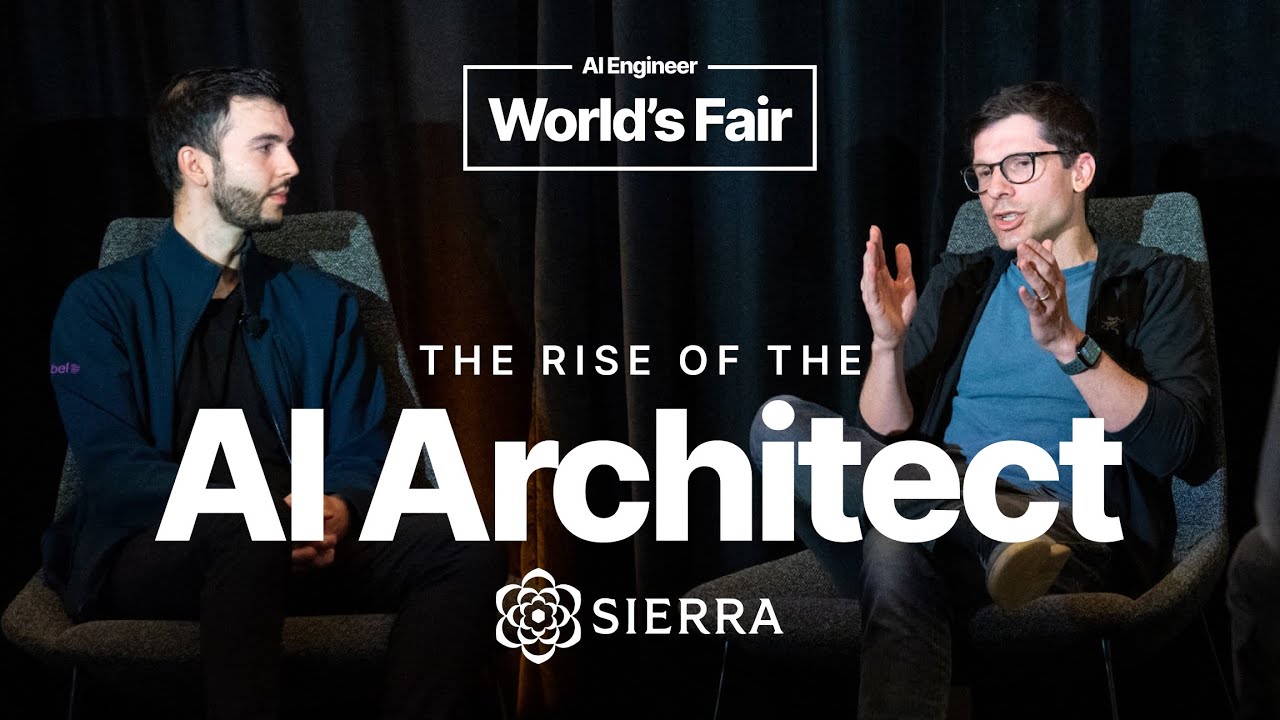
The burgeoning landscape of artificial intelligence has ushered in a critical new role: the AI Architect. This emergent position is pivotal in shaping how businesses harness AI for customer interaction and beyond. At the AI Engineer World's Fair, Clay Bavor, Cofounder of Sierra, spoke with Alessio Fanelli, co-host of Latent Space, about this transformative role and Sierra's mission to revolutionize customer experience through AI. Bavor articulated Sierra's core objective: to "help businesses build better, more human customer experiences with AI," bridging the age-old chasm between desired service quality and its prohibitive cost.
The AI Architect, Bavor explained, embodies a unique blend of technical acumen, brand sensibility, and business foresight. It is a role that has "emerged organically across a set of our customers," focusing on defining, managing, and evolving a company's AI agent experiences. This encompasses understanding the underlying technology, shaping the agent's persona and tone—like Chubbie's "Duncan Smothers" who tells "irreverent, bro-y jokes"—and ultimately, driving tangible business outcomes. Bavor emphasized that "I think the AI Architect, I would say, is kind of the AI era and AI agent version of the webmaster," highlighting its foundational importance in the digital storefront of the future.
Successful AI Architects, Bavor noted, possess a spirit of exploration and a willingness to embrace risk. They prioritize solving "concrete, valuable problems," even seemingly narrow ones like processing a single return, over chasing abstract AI strategies. This pragmatic approach counters a common pitfall. As Bavor quipped, "It's funny, we have a slide, we call it the agent iceberg, where I think technical teams think, 'Oh, awesome, we're going to choose our language model...'" This refers to the tendency to overlook the vast complexities of regression testing, model migration, and compliance that lie beneath the surface of seemingly simple AI implementations.
The iterative nature of AI development necessitates a new "Agent Development Lifecycle," where continuous learning and refinement are paramount. AI solutions often demand "more AI" for improvement, driving an upward spiral of performance and capability. This continuous evolution means that "if you feel like things are changing faster than they ever have before, it's because they are." Staying ahead requires not just understanding current capabilities, but anticipating future advancements.
Looking ahead, Bavor envisions a future where AI interactions transcend current text and voice interfaces. He predicts AI agents will become "shapeshifters" capable of summoning text, voice, video, and imagery, integrating seamlessly into our lives through wearables like glasses. This omnipresent, omni-capable AI assistant will eventually feel like an "extension of ourselves," assisting in navigating the world, leading healthier lives, and being smarter than we are on our own. The most successful enterprises are not just adopting AI; they are fundamentally re-architecting their approach to customer engagement, empowered by individuals who can anticipate the evolving frontier of AI capabilities.

