

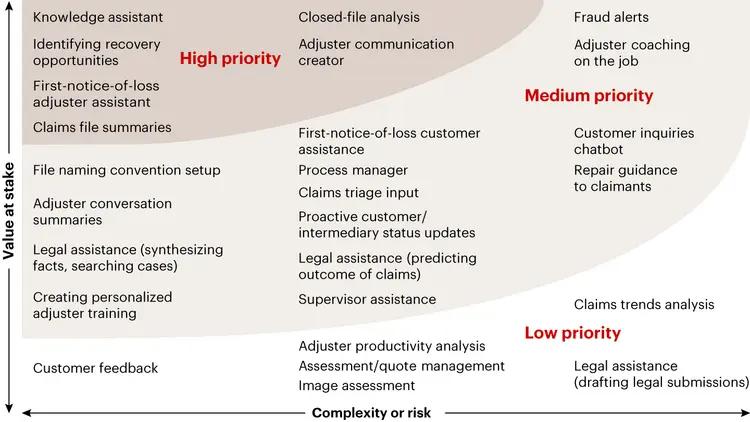
Generative AI is having a profound impact on the property and casualty insurance (P&C) world, promising to save insurers up to $100 billion by cutting claims handling costs and reducing costly "leakage", when what’s paid out doesn’t match what’s contractually owed. Bain & Company estimates AI could lower loss-adjusting expenses by 20-25% and reduce leakage by a hefty 30-50%. But scaling up successful AI pilots will be key to unlocking this potential, requiring insurers to revamp workflows and adopt fresh tech capabilities.
Insurance market, from StartupHub data
Figures below are published StartupHub profiles tagged Insurance.
| Company | What they do | Funding / valuation |
|---|---|---|
| Nu (Nubank) | Largest independent digital bank in Latin America, offering credit cards, accounts, loans, and insurance via a mobile app. | $41.5B |
| New York Life Insurance Company | A leading mutual life insurance company offering a wide range of financial security and investment solutions. | $4.1B |
| AXA XL | Global P&C and specialty risk division of AXA, providing insurance and reinsurance solutions. | $3.8B |
| Fortitude Reinsurance Company Ltd. | A global leader in reinsurance solutions, specializing in life and annuity reinsurance and providing capital management solutions to insurance companies worldwide. | $1.1B |
| Prismic Life Holding Company | A reinsurance company backed by Prudential Financial and Warburg Pincus. | $1.9B |
| iA Groupe financier | A financial services group committed to innovation and community. | $15.7B |
Claims processing is the core of an insurer’s operations and the biggest cost center too. With inflation, supply chain issues, and climate impacts pushing up expenses, insurers are looking for ways to cut through the chaos. And Generative AI could do just that, by improving payout accuracy, reducing time spent on admin tasks, and even helping adjusters make quick decisions on litigation based on historical case data. A few big players are already testing the waters: Zurich, for instance, is using six years of claims data to refine underwriting with AI, while a South American insurer reports a 50% productivity boost and a potential 40% drop in leakage through AI-powered claims management.
The potential impact of AI spans from customer experience to employee productivity. For example, AI-powered virtual assistants can handle simple customer inquiries, freeing up human agents for trickier cases. AI also enables more accurate payouts by speeding up coverage verification and investigations, reducing manual errors that drive up costs. And for adjusters? AI tools can summarize complex documents in seconds, cutting time spent on mundane tasks and letting them focus on helping customers.
But AI isn’t a silver bullet, and insurers need to tread carefully, cautions the consulting firm.
Accuracy, fairness, transparency, and data privacy are major concerns, especially as AI begins to make more critical decisions.