

For years, the promise of truly autonomous AI agents capable of navigating our digital lives has felt just out of reach. We’ve seen impressive demos, but the reality of an AI seamlessly jumping between a web browser, a desktop app, and a mobile interface remained a fragmented dream. Now, H Company, a name increasingly synonymous with ambitious AI, is making a compelling case that the future is here with Surfer 2.
Unveiled today, Surfer 2 is pitched as the "next generation of cross-platform computer-use agents." It’s a bold claim, but the underlying technology and benchmark results suggest H Company might just be onto something genuinely transformative. Unlike many prior systems that rely on environment-specific hooks like DOM parsers for web or accessibility trees for mobile, Surfer 2 operates purely from visual observations. Think of it as an AI that sees your screen exactly as you do, then figures out what to do next.
This "unified architecture" is designed to run seamlessly across desktop, web, and mobile environments. H Company isn't shy about its performance, stating that Surfer 2 "surpasses existing state-of-the-art agents on four major agentic benchmarks spanning multiple platforms, outperforming systems developed by other leading AI labs, such as OpenAI, Anthropic, and Google." That’s a direct challenge to the biggest players in the AI space.
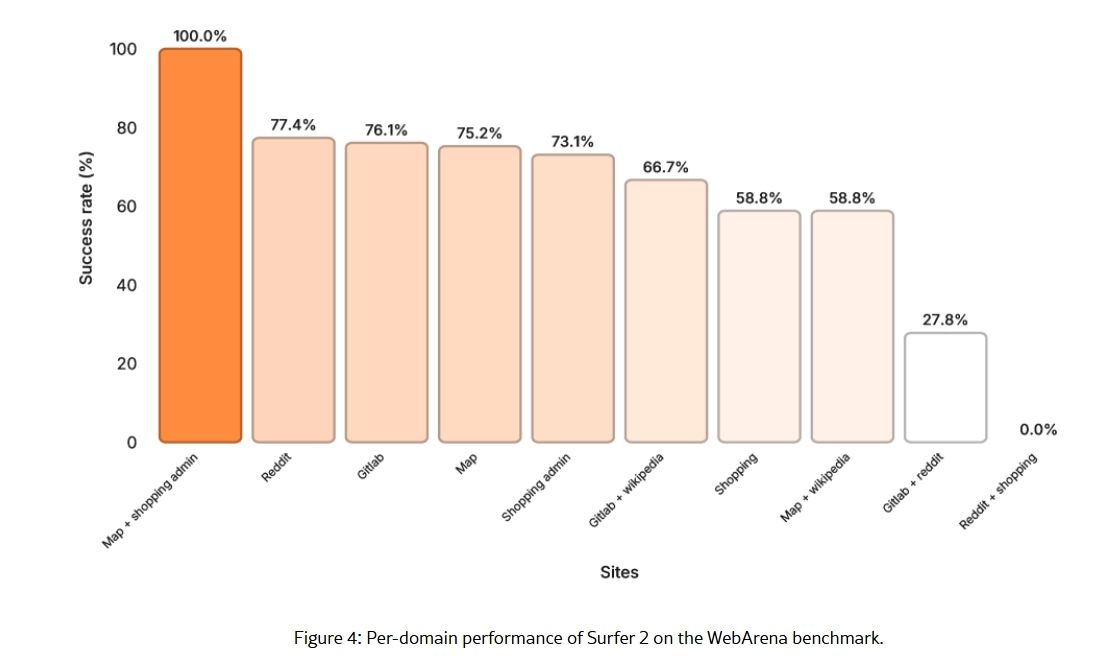
The benchmarks back up the bravado. On OSWorld, which evaluates desktop control on Ubuntu, Surfer 2 achieves a pass@1 of 60.1% and a pass@10 of 77.0%, notably surpassing the human baseline of 72.4%. For web tasks, it hits 97.1% on WebVoyager (outperforming Magnitude's 93.9%) and 69.6% on WebArena. On the mobile front, AndroidWorld sees Surfer 2 achieve an 87.1% success rate, again exceeding the human baseline of 80.0% in visual interaction. These aren't incremental gains; they represent a significant leap in general-purpose digital interaction.
At the heart of Surfer 2's design is a clever separation of concerns. An "Orchestrator" module handles high-level strategic planning, breaking down complex goals into manageable sub-tasks. These sub-tasks are then delegated to "sub-agents" (or a "Navigator" in the paper's terminology) that execute actions across interfaces. A "Validator" module provides crucial feedback, assessing task success and enabling self-correction, ensuring reliability over long task horizons. This ReAct (reason+act) loop, combined with dedicated components for visual grounding (powered by H Company’s Holo1.5 models), task validation, and failure recovery, is what makes Surfer 2 so resilient. It’s less about a single, monolithic AI and more about an intelligently coordinated system.