


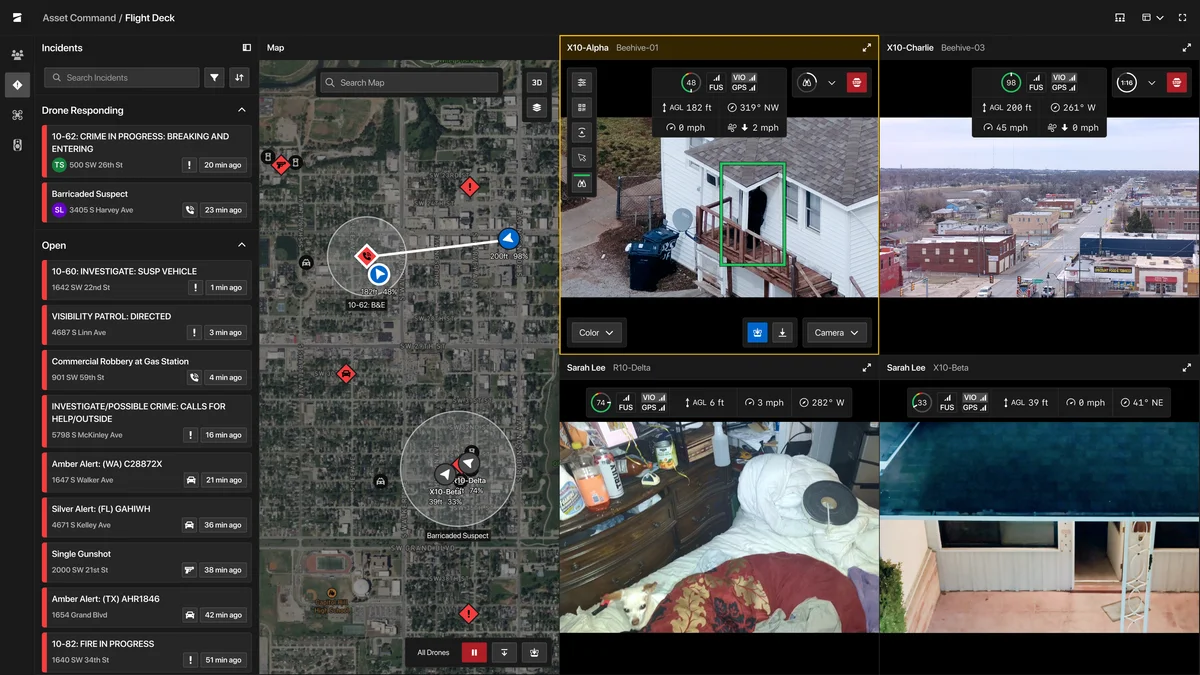
Skydio is pushing the envelope for Drone as First Responder (DFR) programs with its announcement of a new phase focused on multi-drone operations. This advancement moves beyond the initial breakthrough of simply getting a single drone to a scene faster, addressing the critical need for scalability in real-world demand. The company highlights that while remote and beyond visual line of sight (BVLOS) operations revolutionized initial response times, most programs remain constrained by a one-drone, one-pilot model. This limitation becomes apparent during overlapping incidents or extended operations where one aircraft cannot cover multiple needs or sustain continuous coverage without interruption.
Multi-drone operations, supported by regulatory approvals and Skydio's autonomy platform, aim to solve this concurrency problem. Agencies can now coordinate multiple aircraft to maintain coverage on a priority call, relieve an aircraft on scene, or respond to secondary incidents. This is not about simply increasing the number of drones in the air, but about ensuring aerial intelligence is available when and where it is needed most, especially as DFR programs transition from pilot phases to daily operations.
StartupHub.ai data indicates a growing demand for autonomous systems in public safety and defense. Companies like Skydio, which focus on advanced autonomy and operational efficiency, are well-positioned. Skydio's emphasis on autonomy for managing complex multi-drone scenarios directly addresses a key challenge for scaling these operations. This contrasts with competitors who may rely more heavily on manual piloting for complex tasks, potentially limiting scalability.
Skydio's approach centers on trained personnel supervising multiple aircraft within defined parameters, with autonomy handling routine flight execution, obstacle avoidance, and deconfliction. This allows remote pilots to focus on the incident rather than managing individual aircraft movements. The company cites over 4,500 automated deconfliction events recorded in live operations through February 2026 with no reported failures, underscoring the reliability of their autonomy system for reducing risk in multi-drone environments.
The announcement is particularly relevant for defense technology startups and established players grappling with scaling autonomous systems. For instance, Anduril, a company that has raised over $2.4 billion according to StartupHub.ai data, is heavily invested in autonomous defense capabilities. Skydio's progress in multi-drone DFR operations scaling suggests a pathway for integrating more complex autonomous swarms into tactical and security operations, potentially influencing how companies like Anduril approach their multi-domain operations.