

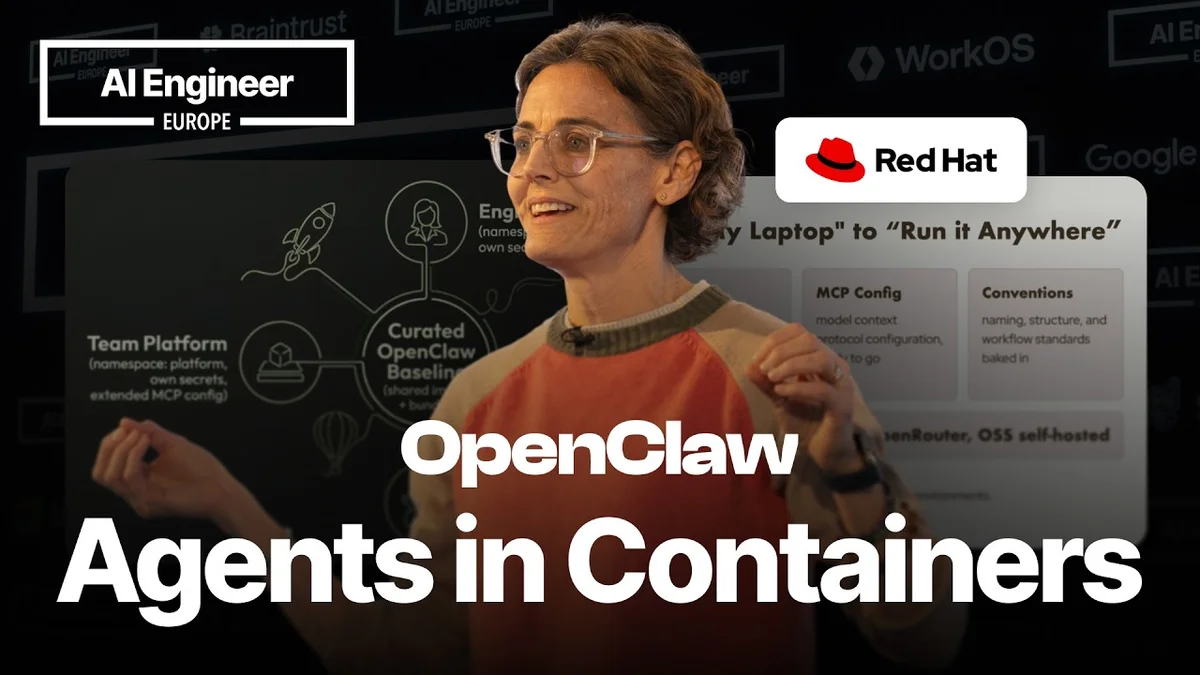
Sally Ann O'Malley on OpenClaw in Containers

Sally Ann O'Malley from Red Hat discusses how OpenClaw agents can be containerized for reproducible, secure, and portable AI development from local machines to Kubernetes.

Sally Ann O'Malley presenting on OpenClaw in Containers
AI Engineer
Visual TL;DR
AI Agent Setup IssuesDriver
local setups fail to reproduce or deploy elsewhere easily
From the article 3 mentionsBy providing a curated, reproducible baseline, new engineers can onboard faster and contribute effectively without getting bogged down in environment-specific setup issues.
OpenClaw AgentsCore
AI agents for reproducible, secure, and portable development
From the article 9+ mentionsThe "Lobster Trap" methodology aims to solve this by packaging OpenClaw agents and their dependencies into containers.
Lobster Trap PhilosophyContext
methodology for consistent agent environments from local to K8s
From the article 2 mentionsSally Ann O'Malley, a Principal Software Engineer at Red Hat, presented "Lobster Trap: OpenClaw in Containers from Local to K8s and Back" at AI Engineer Europe.
ContainerizationContext
packaging agents and dependencies into isolated environments
From the articleThe presentation concluded with a demonstration of the OpenClaw installer, showcasing how easily agents can be deployed locally or to Kubernetes, highlighting the flexibility and power of containerization in the AI development workflow.
Reproducible EnvironmentsEffect
From the article 8 mentionsReproducible Environments: Using the same container image ensures that all agents operate in identical conditions, regardless of the underlying infrastructure.
Secure & Portable AIEffect
enhances security and portability across different platforms
Local to KubernetesOutcome
seamless deployment from local machines to K8s clusters
From the article 8 mentionsPortability Across Infrastructure: Containers can be easily moved between different environments, from a local machine to a virtual machine, or a Kubernetes cluster, with minimal changes.
Team-Wide AdoptionOutcome
facilitates easier sharing and collaboration among teams
Contents(5)

Sally Ann O'Malley, a Principal Software Engineer at Red Hat, presented "Lobster Trap: OpenClaw in Containers from Local to K8s and Back" at AI Engineer Europe. O'Malley discussed the advantages of running AI agents within containers, emphasizing how this approach enhances reproducibility, security, and portability.

Sally Ann O'Malley on OpenClaw in Containers - AI Engineer
Sally Ann O'Malley on OpenClaw in Containers, AI Engineer

From Local Setup to Kubernetes

O'Malley highlighted the common challenge of AI agent setups that work on a developer's local machine but are difficult to reproduce or deploy elsewhere. The "Lobster Trap" methodology aims to solve this by packaging OpenClaw agents and their dependencies into containers. This allows for a consistent and isolated environment, whether running locally via Podman or deploying to a Kubernetes cluster.

Key Benefits of containerized AI agents

O'Malley detailed the core advantages of this container-centric approach:

  • Reproducible Environments: Using the same container image ensures that all agents operate in identical conditions, regardless of the underlying infrastructure.
  • Secrets Isolation: Secrets, such as API keys, are managed securely within the container's environment, preventing them from being exposed to the host system.
  • Portability Across Infrastructure: Containers can be easily moved between different environments, from a local machine to a virtual machine, or a Kubernetes cluster, with minimal changes.
  • Volume-backed Persistence: Runtime state and data are persisted on volumes, ensuring that agent progress is maintained even if the container is restarted or moved.
  • Security Boundaries: Containers provide a natural security boundary, isolating the agent's execution and preventing potential interference with the host system.

Secrets Management and Inference Providers

A crucial aspect of the presentation was secrets management. O'Malley explained that OpenClaw uses a SecretRef abstraction, allowing for different secret injection mechanisms depending on the environment. For local development with Podman, secrets are typically injected via environment variables. In Kubernetes, secrets are managed through Kubernetes Secrets. The system supports various inference providers, including OpenRouter, Anthropic, and Google, allowing users to choose their preferred models and manage API keys securely within the containerized setup.

Team-Wide Adoption and Reproducibility

O'Malley emphasized that this container-based approach is not just about individual productivity but also about fostering team collaboration and standardization. By providing a curated, reproducible baseline, new engineers can onboard faster and contribute effectively without getting bogged down in environment-specific setup issues. This also ensures that team standards for skills and model choices are shared, moving away from tribal knowledge.

The "Lobster Trap" Philosophy

The core idea, as O'Malley presented, is to "start local, curate, and reuse." This involves initially setting up agents locally, curating the necessary components and configurations, and then easily deploying and reusing this setup across different environments, including Kubernetes. This methodology transforms hard-won knowledge into a team asset, making the development and deployment of AI agents more efficient and reliable.

The presentation concluded with a demonstration of the OpenClaw installer, showcasing how easily agents can be deployed locally or to Kubernetes, highlighting the flexibility and power of containerization in the AI development workflow.

© 2026 StartupHub.ai. All rights reserved. You may not republish this article in full without a license. Search engines and AI research tools may crawl and summarize for reference. Bulk reproduction or model training requires a license. See our terms.
Daniel Singer

Written by

Daniel Singer

Editor, StartupHub.ai

Daniel Singer is the editor of StartupHub.ai, a technology expert and thought leader on AI and its applications across sectors, from fintech and healthcare to developer tooling and consumer software. He writes and tests the tools covered here thoroughly and regularly, and built StartupHub.ai to give founders, operators and buyers a clearer read on what they are actually being sold.