

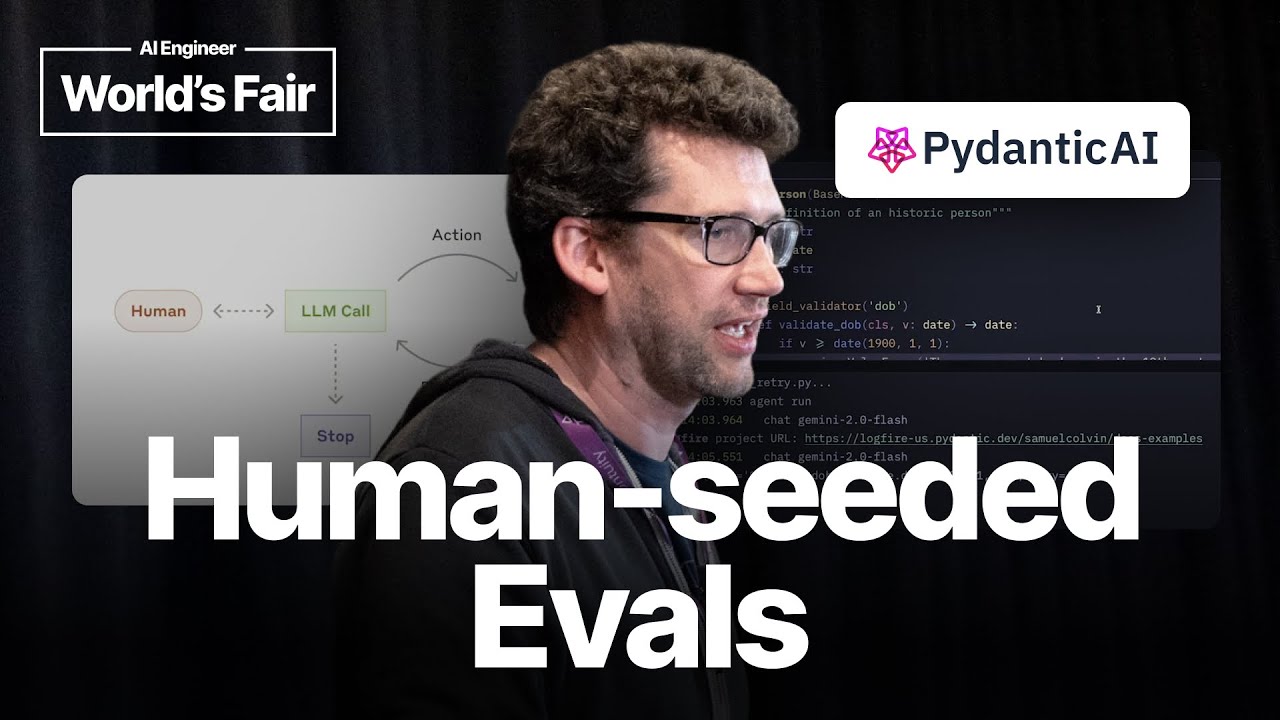
At the AI Engineer World's Fair, Samuel Colvin, the creator of Pydantic, delivered a compelling presentation on building reliable and scalable AI applications, emphasizing what he terms "the Pydantic way." Colvin's talk, titled "Human-seeded Evals," delved into the critical role of strong engineering principles, particularly type safety, in navigating the rapidly evolving landscape of generative AI development.
Colvin highlighted that while the AI frontier is expanding at an unprecedented pace, fundamental software engineering challenges persist. "Everything is changing really fast... Actually some things are not changing: people still want to build reliable, scalable applications, and that is still hard." He posited that the inherent unpredictability of large language models (LLMs) often makes building robust AI applications even more challenging than traditional software. A core insight he shared was the paramount importance of type safety, not merely for avoiding bugs in production but also for enabling confident refactoring during development. As he noted, "No one starts off building an AI application knowing what it's going to look like. So you are going to have to end up refactoring your application multiple times."
He then addressed the prevalent concept of AI "agents," defining them as "models using tools in a loop." This seemingly straightforward definition, however, masks a significant practical hurdle: determining when such an agent should conclude its task. As Colvin pointed out about common agent pseudo-code, "there is no exit from that loop."
PydanticAI, coupled with Pydantic Logfire, offers a robust solution to these challenges. PydanticAI allows developers to define structured output types for LLMs, ensuring that the model's responses adhere to a predefined schema. This enables a powerful "agentic loop" where validation errors from the structured output can be fed back to the LLM, prompting it to self-correct. Colvin demonstrated this by intentionally introducing a validation error, showing how the system automatically returned the error to the LLM, which then successfully "fix[ed] the errors and tr[ied] again."
This continuous feedback loop, powered by Pydantic's data validation capabilities and Logfire's observability, provides crucial transparency and debugging insights. Logfire offers detailed tracing of LLM calls, tool executions, and validation outcomes, allowing developers to precisely understand agent behavior and pinpoint issues. Furthermore, PydanticAI extends type safety to tool dependencies, ensuring that agents interact with their environment and external services with guaranteed data integrity. This meticulous approach to typing, as Colvin explained, makes it "incredibly easy to go and refactor your code." By prioritizing structured data, explicit validation, and comprehensive observability, Pydantic offers a pragmatic framework for building dependable and maintainable AI systems, essential for any serious deployment.