

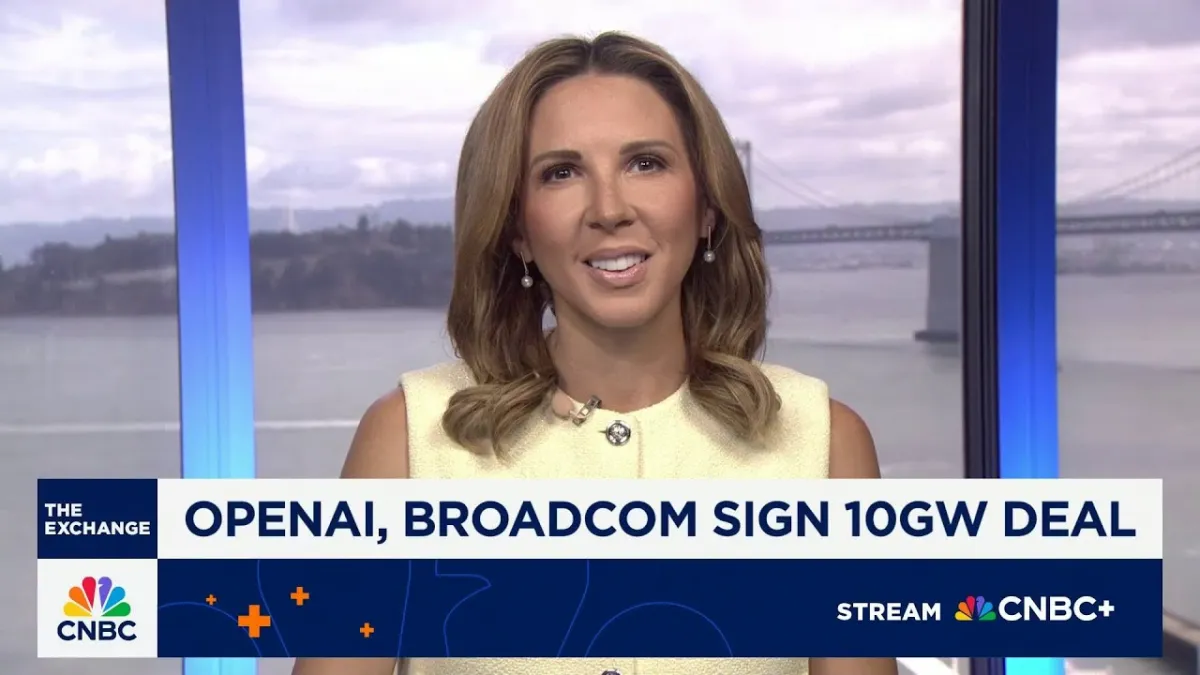
OpenAI's recent collaboration with Broadcom, unveiled in a CNBC report by MacKenzie Sigalos, marks a pivotal moment in the artificial intelligence landscape, signaling the company's aggressive pivot towards vertical integration. This isn't merely a partnership for increased compute; it is, as Sigalos aptly characterized it, "OpenAI's Apple moment: control the silicon, control the experience." This strategic maneuver positions OpenAI not just as a leader in large language models (LLMs) but as an emerging hyperscaler, directly challenging established giants like Google and shifting the competitive dynamics within the burgeoning AI infrastructure market.
On CNBC's "Tech Check," MacKenzie Sigalos reported on news regarding OpenAI and Broadcom, detailing a deal that underscores a significant shift in OpenAI's long-term strategy. The agreement involves OpenAI deploying 10 gigawatts of custom AI accelerators, developed in conjunction with Broadcom over an intensive 18-month period. These inference-optimized chips, designed specifically for OpenAI's models, are projected to be approximately "30% cheaper than current GPU options," a critical cost advantage in an industry ravenous for compute power.
This move is a direct echo of Google's strategy years ago when it vertically integrated by building its own Tensor Processing Units (TPUs) with Broadcom. OpenAI's decision to follow suit highlights a crucial insight: in the race for AI dominance, controlling the underlying hardware is becoming as important as developing groundbreaking models. The technical parity of many LLMs, which largely share the same "transformer" architecture and train on similar public datasets, means that competitive advantage increasingly lies in the efficiency and cost-effectiveness of the infrastructure. By controlling "everything from design to full rack deployment," OpenAI aims to achieve a tighter integration and optimized performance that off-the-shelf solutions cannot match.
The core insight here is that the future of AI leadership hinges on a robust, custom-built infrastructure. OpenAI is consciously building a multi-layered moat, not primarily at the model level where breakthroughs can be rapidly replicated, but around its hardware, infrastructure, and developer ecosystem. While the initial "transformer" breakthrough democratized LLM development to some extent, the ability to scale and optimize these models economically requires proprietary hardware. This strategic play ensures OpenAI can sustain its innovation pace and offer more competitive pricing for its services, further entrenching its market position against rivals.
Beyond hardware, OpenAI's strategy extends to fostering a vibrant developer ecosystem. By enabling developers to build on its models and sell software through a built-in GPT app store, OpenAI aims to deepen lock-in across both enterprise and consumer markets. This mirrors Microsoft's historical strategy with the PC, where the operating system and its ecosystem of applications created an almost unassailable lead. The objective is to make it incredibly difficult and costly for developers and users to switch to competing platforms, thereby solidifying its market dominance through network effects and sticky integrations.
Related Reading
- OpenAI's Infrastructure Gambit: Custom Chips and Strategic Moats
- OpenAI and Broadcom Unite to Redefine AI Compute
- OpenAI and Broadcom Forge Custom Chip Alliance Amidst AI's "Avalanche of Demand"
The implications for the broader AI and semiconductor industries are profound. While Nvidia and AMD remain dominant players in GPU manufacturing, OpenAI's deal with Broadcom signifies a growing trend among leading AI firms to customize their silicon. This diversification reduces reliance on a single vendor and introduces new competitive pressures, forcing traditional chipmakers to innovate further or risk losing market share to bespoke solutions. MacKenzie Sigalos noted that these "blockbuster deals aren't just about adding compute; they're also being viewed here in Silicon Valley as a show of force meant to intimidate." This aggressive posture suggests OpenAI is not content to merely license technology but intends to shape the entire AI value chain.
Interestingly, despite Microsoft being OpenAI's chief investor and primary cloud partner via Azure, this deal with Broadcom and other partnerships with Oracle suggest a calculated move towards greater independence. OpenAI is actively diversifying its supply chain and compute partners, building out new infrastructure that does not exist today, rather than solely relying on Microsoft's existing cloud offerings. This suggests a desire to mitigate vendor lock-in and secure a more resilient, diversified compute foundation for its ambitious future projects, even from its closest ally.



