OpenAI just dropped a pair of open-source models that could fundamentally change how developers handle content moderation. The new models, dubbed gpt-oss-safeguard, aren’t your typical safety classifiers. Instead of being a black box trained on a mountain of pre-labeled data, they’re designed to reason based on a custom safety policy you write yourself.
Available on Hugging Face in 120-billion and 20-billion parameter sizes, gpt-oss-safeguard operates on a simple but powerful premise. A developer feeds the model two things at once: the content they want to check (a user comment, a full chat log, etc.) and a specific policy (e.g., “No posts that reveal spoilers for the latest season of *House of the Dragon*”). The model then uses a chain-of-thought process to reason about whether the content violates that specific rule, outputting not just a yes/no decision but also its rationale.
Traditional tools, like OpenAI’s own Moderation API, are trained to infer what’s bad based on patterns in data they’ve already seen. If you want to change the rules, you typically have to retrain the entire model, a costly and time-consuming process. With gpt-oss-safeguard, developers can iterate on their policies on the fly, simply by editing the text prompt they provide at inference.
The potential applications are broad. A video game forum could use it to specifically target and classify discussions about cheating. A product review site could write a nuanced policy to flag reviews that seem astroturfed or fake. It’s a move from a one-size-fits-all moderation hammer to a set of surgical, user-defined tools. According to OpenAI, this reasoning-based approach is particularly effective for dealing with emerging harms, highly nuanced domains, or situations where a developer lacks the massive datasets needed to train a traditional classifier.
A peek inside OpenAI's safety playbook
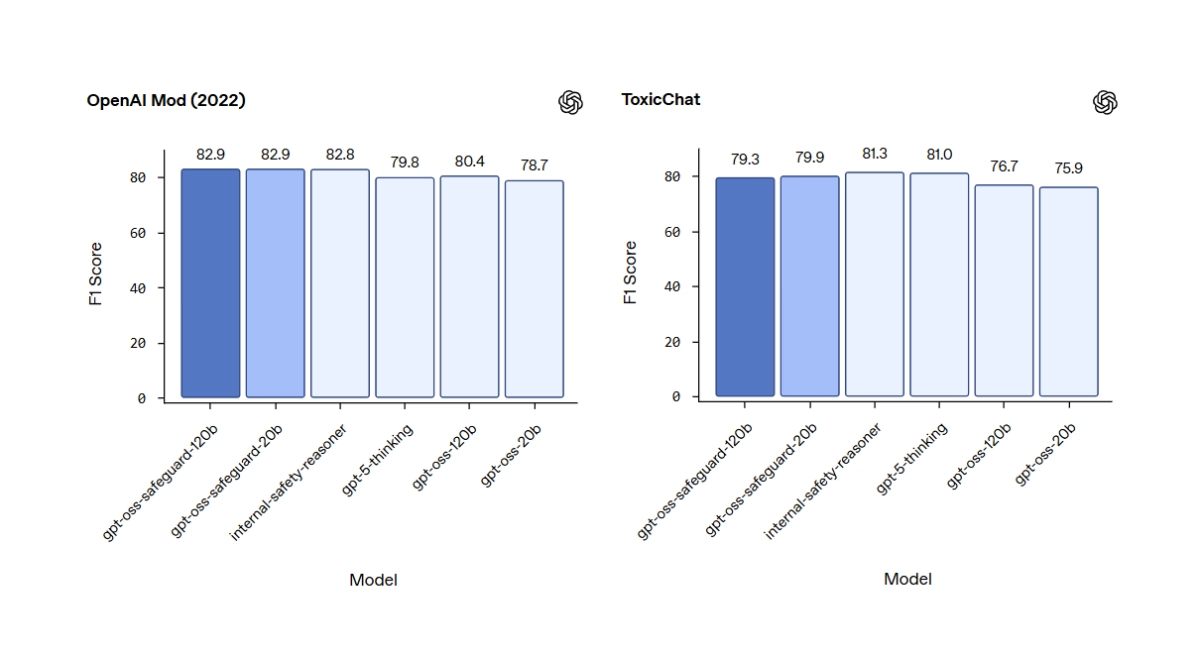
Gpt-oss-safeguard is an open-weight version of an internal tool called “Safety Reasoner” that has become a core component of OpenAI’s own safety stack. The company uses this exact methodology to police its most advanced systems, including the image generator Sora 2 and the upcoming GPT-5.