

OpenAI's Yuguang on ChatGPT Images 2.0 Capabilities

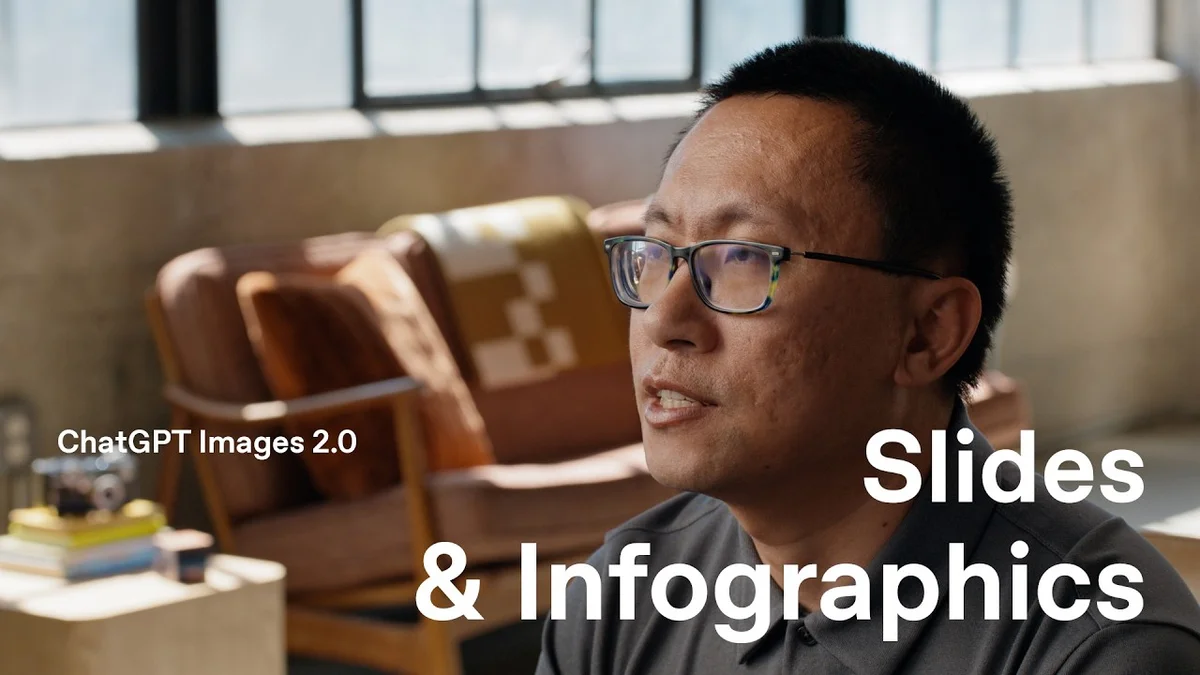
OpenAI researcher Yuguang demonstrates ChatGPT Images 2.0, showcasing its ability to create complex infographics and convert PDFs into visual assets.

4 min read
Close-up of a professional cinema camera with a small monitor displaying a person.
Image credit: StartupHub.ai· OpenAI Youtube

OpenAI researcher Yuguang unveiled the capabilities of ChatGPT Images 2.0, highlighting its advanced ability to generate high-fidelity and complex infographics. This new iteration of OpenAI's image generation technology promises to transform how users can visualize and communicate data and information. The demonstration showcased the tool's capacity to take complex textual information and render it into easily digestible visual formats, a significant step forward for AI-driven content creation.

Introducing Yuguang and the Image Generation Initiative

Yuguang, a researcher on the image generation team at OpenAI, presented the latest advancements. His work focuses on making AI tools more accessible and powerful for a wide range of creative and analytical tasks. The development of ChatGPT Images 2.0 is a testament to OpenAI's ongoing efforts to expand the multimodal capabilities of its AI models, bridging the gap between text and visual content generation.

The full discussion can be found on OpenAI Youtube's YouTube channel.
Related startups

Slides & Infographics with ChatGPT Images 2.0 - OpenAI Youtube
Slides & Infographics with ChatGPT Images 2.0 — from OpenAI Youtube

Generating Complex Infographics with ChatGPT Images 2.0

A key feature demonstrated was the ability of ChatGPT Images 2.0 to follow very long and detailed instructions. Yuguang showcased how the AI could interpret a complex prompt, including specific design requirements and content elements, to produce a sophisticated infographic. The process involved selecting the 'Thinking' model within ChatGPT, indicating its suitability for complex queries, and then feeding it a detailed prompt that outlined the desired output.

The prompt specified a clean, modern flat-vector style with crisp lines and legible sans-serif typography, along with a clear hierarchy for titles, subtitles, and section headers. It also emphasized consistent padding and color-coding for different elements. Yuguang demonstrated how the AI could adhere to these granular instructions, ensuring a visually coherent and informative final product. This level of control over stylistic and structural elements is crucial for creating professional-grade visual content.

PDF to Visuals: A New Workflow

Another significant capability highlighted was the transformation of existing documents into visual formats. Yuguang showed how a PDF file could be uploaded to ChatGPT, which then generated a series of slide-style images or a single poster based on the document's content. This workflow allows users to quickly convert lengthy reports, research papers, or other text-based documents into engaging visual summaries.

For instance, a PDF was processed to create a series of up to seven slide-style images, each capturing key information from the document. This feature is particularly valuable for presentations, educational materials, or marketing content, where distilling complex information into a visual narrative is essential. The AI's ability to maintain the essence of the original text while adapting it to a visual medium is a powerful asset.

From Text to High-Quality Visuals

The demonstration included an example where a PDF was used to generate a visually appealing portrait poster. Yuguang provided a prompt asking for a poster based on a provided URL, instructing the AI to include important chart diagrams from the source. This showcases the AI's capability to not only extract information but also to interpret and integrate specific visual elements from external sources into its generated output.

The output was described as a visually appealing poster that looked as if it were created by a human collaborator. This emphasizes the high quality and natural feel of the generated images, moving beyond simple text-to-image generation to more sophisticated content synthesis. The ability to generate a poster from a URL or a PDF means that users can quickly create polished visual assets for a variety of purposes, saving significant time and effort.

Understanding the Underlying Technology

The video also provided glimpses into the underlying principles of advanced language models, referencing the 'Language Models are Few-Shot Learners' paper by Brown et al. (2020) from OpenAI. This paper highlighted how scaling up language models to 175 billion parameters unlocks strong task-agnostic in-context learning, allowing models to perform tasks with few examples without gradient updates. This fundamental research underpins the advanced capabilities seen in ChatGPT Images 2.0, enabling it to understand and generate complex visual information based on textual prompts and data.

The demonstration of generating a poster based on a web link and then translating complex information into visual formats underscores the practical application of these advanced AI capabilities. ChatGPT Images 2.0 represents a significant advancement in making AI a more versatile tool for content creation, data analysis, and communication, enabling users to effectively convey complex ideas through compelling visuals.

© 2026 StartupHub.ai. All rights reserved. Do not enter, scrape, copy, reproduce, or republish this article in whole or in part. Use as input to AI training, fine-tuning, retrieval-augmented generation, or any machine-learning system is prohibited without written license. Substantially-similar derivative works will be pursued to the fullest extent of applicable copyright, database, and computer-misuse laws. See our terms.