

OpenAI's Image Generation Evolves with ChatGPT

OpenAI researcher Ayaan demonstrates how ChatGPT's image generation capabilities have evolved, enabling complex research, content creation, and trend analysis.

5 min read
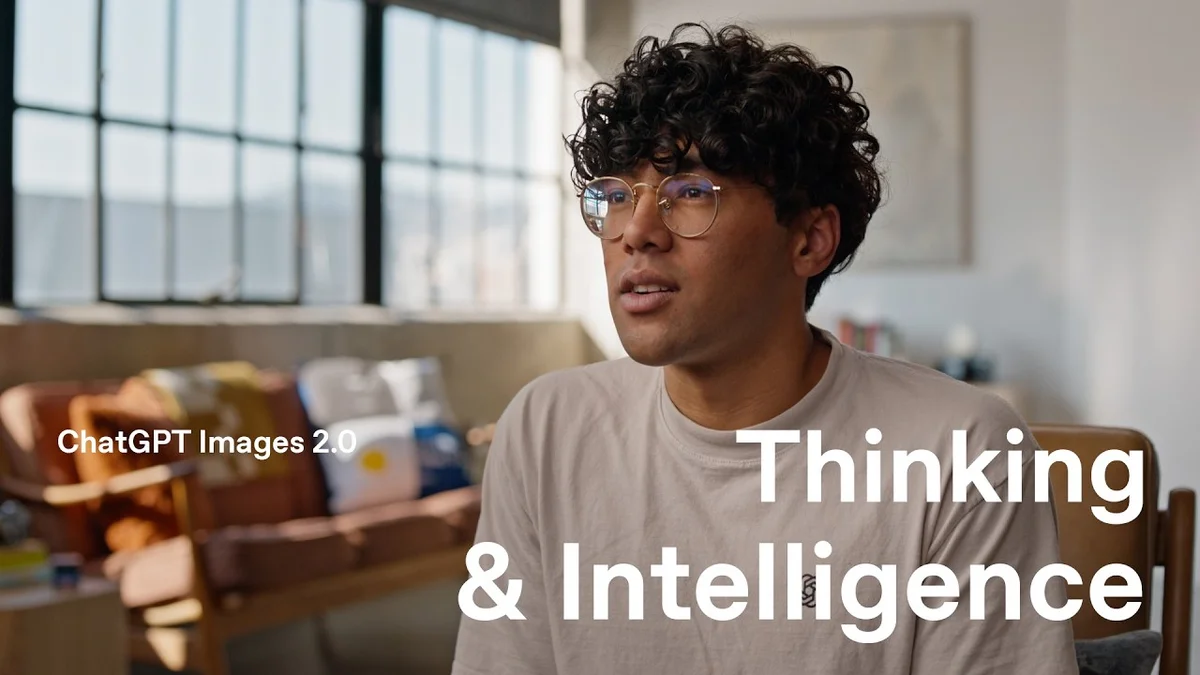
Ayaan, an OpenAI researcher, demonstrates ChatGPT's image generation capabilities on a laptop.
Image credit: StartupHub.ai· OpenAI Youtube

Ayaan, a researcher on OpenAI's image team, recently showcased the enhanced capabilities of ChatGPT's image generation features. The demonstration highlighted how the AI can now tackle more sophisticated tasks, moving beyond simple image creation to become a more versatile tool for research, content synthesis, and creative exploration.

Introducing ChatGPT Image Generation 2.0

Ayaan explained that previous versions of image generation models often struggled with tasks requiring deep world knowledge or specific expertise. However, the latest iteration of ChatGPT, particularly when utilizing its 'Thinking' mode, demonstrates a significant leap forward. This mode allows the AI to perform research, analyze information, and synthesize it into coherent outputs, including detailed image generations.

The full discussion can be found on OpenAI Youtube's YouTube channel.
Related startups

Thinking & Intelligence with ChatGPT Images 2.0 - OpenAI Youtube
Thinking & Intelligence with ChatGPT Images 2.0 — from OpenAI Youtube

"The intelligence of image generation model can research, collect information, find references, and synthesize all of this into its output. Hi, I'm Ayaan. I'm a researcher here on the image team at OpenAI. Today I really wanted to demonstrate the intelligence of image generation model and some of the agentic capabilities," Ayaan stated. He elaborated on the limitations of earlier models: "Previously if you asked the image model, it didn't have the world knowledge or didn't have the expertise on all these topics. Now I think it can actually execute the full task. It can perform the research first, it can look at images, figure out what's common between them all, and it's able to generate multiple outputs that are all consistent and together help tell a story."

Showcasing Advanced Use Cases

Ayaan then presented two compelling examples of ChatGPT's advanced image generation capabilities. The first demonstrated the AI's ability to act as a marketing and research assistant.

OpenAI Rare Drops Advertisement

For the first example, Ayaan prompted ChatGPT to create an advertisement for recent OpenAI merchandise drops. The prompt specifically requested research into rare items and their estimated collector value, along with a mockup ad including images of the merchandise. ChatGPT not only generated a visually appealing ad for "OpenAI Rare Drops" featuring items like a folding chair, football, jersey, keychain, and cap, but it also provided estimated values for each item. The AI conducted research on supply.openai.com and re-sell prices online to determine these estimates, showcasing its capacity for data synthesis and presentation.

"For the first example, I want to create a product advertisement for the most recent OpenAI merch drops," Ayaan explained. "Please search for the most rare items, create a nice mockup ad including images of the merch. Please do some research on what the price value of these might be. I think it will work pretty well." The generated ad featured striking visuals and estimated values such as $80-$140 for a folding chair and $60-$120 for a ChatGPT football.

Newtonian Physics Infographic Series

The second use case highlighted ChatGPT's potential for educational content creation. Ayaan tasked the AI with creating a series of college-level infographic pages summarizing and demonstrating Isaac Newton's major mathematical and scientific contributions. The AI successfully generated multiple pages, each focusing on different aspects of Newton's work, including his laws of motion, universal gravitation, and optics. The output was structured and visually informative, akin to textbook material.

"Another use case that I want to demonstrate is how ImageGen 2 has tons of world knowledge and can go out and find correct facts and then summarize them in a nice way," Ayaan said. "It can really unlock new use cases for teachers and students. If they want to create notes or cheat sheets or even textbook renderings for their students." This example underscores the AI's ability to process complex academic subjects and present them in an accessible, visual format.

Social Media Trend Analysis

A third example showcased ChatGPT's analytical capabilities. Ayaan prompted the AI to research social media photo aesthetics and trends between 2006, 2016, and 2026, synthesizing the findings into separate pages. The AI produced a detailed trend forecast, dividing the analysis into "The Beginning" (2006), "The Curation" (2016), and "The Evolution" (2026). Each section included key words, visual styles, cultural drivers, moods, and color palettes, effectively capturing the shifts in social media aesthetics over time and projecting future trends.

"The last example I want to show is ImageGen being useful for productivity work," Ayaan noted. "So let's say I was a strategist who wanted to research social media trends between 2006 and 2026. Synthesize your findings into separate pages." The AI's output provided a clear visual and textual breakdown of aesthetic shifts, demonstrating its power in synthesizing complex data into digestible formats for strategic analysis.

The Evolution of AI as a Creative Partner

Ayaan concluded by emphasizing the evolution of AI from a simple tool to a more collaborative partner. "ImageGen 2 can really answer prompts in one shot. It can, you know, think longer, spend a lot of time to answer your prompts, and it's more of a partner now as opposed to just a tool," he stated. This shift signifies a move towards AI systems that can not only generate content but also engage in complex reasoning, research, and synthesis, opening up new possibilities for creativity and knowledge work.

© 2026 StartupHub.ai. All rights reserved. Do not enter, scrape, copy, reproduce, or republish this article in whole or in part. Use as input to AI training, fine-tuning, retrieval-augmented generation, or any machine-learning system is prohibited without written license. Substantially-similar derivative works will be pursued to the fullest extent of applicable copyright, database, and computer-misuse laws. See our terms.