

OpenAI is rolling out GPT-5.1, an incremental but critical update to its flagship model series that’s less about raw intelligence and more about a pragmatic focus on speed, efficiency, and developer tooling. Announced today in a company blog post, the new model, now available in the API, is engineered to make building complex AI agents and coding assistants faster and more cost-effective.
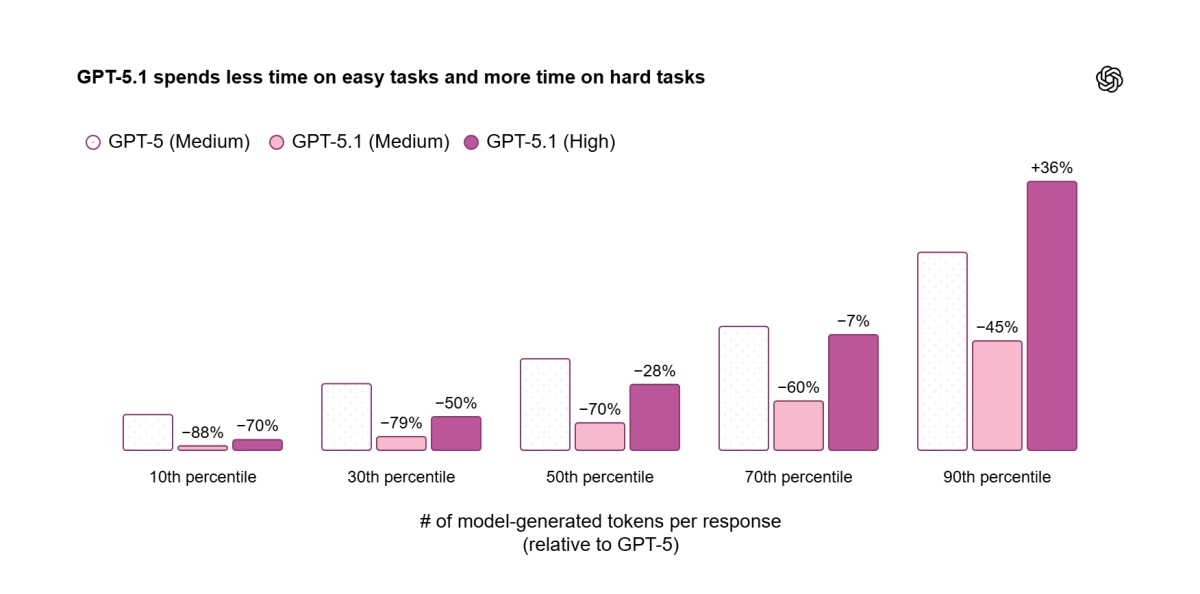
The headline feature is what OpenAI calls “adaptive reasoning.” GPT-5.1 can now dynamically adjust the computational effort, or “thinking time”, it dedicates to a given task. For simple requests, like fetching a shell command, the model spends significantly fewer tokens, resulting in responses that are up to 5x faster than its predecessor, GPT-5. For more complex problems, it can still engage in deep, persistent reasoning to ensure accuracy.
This is a direct answer to one of the biggest complaints from developers using high-end models: latency and cost. By spending less on easy tasks, OpenAI is making its top-tier model more viable for everyday, interactive applications. According to OpenAI, partners like Balyasny Asset Management found GPT-5.1 ran 2-3x faster than GPT-5 while using about half the tokens of competitors on tool-heavy tasks.
The Agentic Developer
Beyond raw speed, OpenAI GPT-5.1 is being positioned as a more practical tool for building AI agents. A new “no reasoning” mode allows developers to essentially turn off the model’s complex thought process for latency-sensitive use cases, behaving more like a traditional, fast API while retaining its underlying intelligence and tool-calling capabilities.
Furthering its push into the developer workspace, OpenAI is introducing two powerful new native tools. An `apply_patch` tool allows the model to directly suggest and apply structured code edits, moving beyond simple code generation to active participation in the development lifecycle. More significantly, a new `shell` tool gives the model the ability to propose and run shell commands on a local machine, with developer oversight. This creates a direct plan-and-execute loop, a foundational component for building truly autonomous agents that can interact with file systems and local environments.