

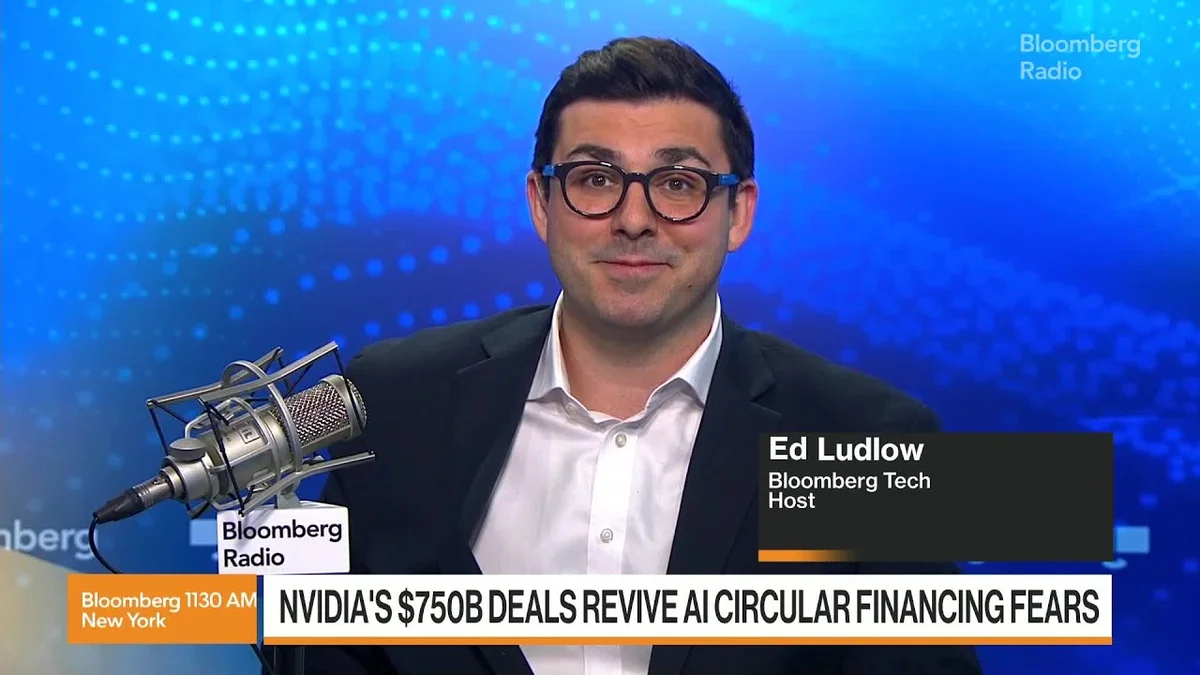
Nvidia's $750B Deals Spark Circular AI Financing Debate

Nvidia's massive $750B in deals, particularly with SK Hynix, are raising questions about the transparency and nature of AI financing.

Ed Ludlow, Bloomberg Tech Host, discusses Nvidia's large deals and AI financing.
Bloomberg Podcast
Visual TL;DR
Nvidia's $750B DealsDriver
massive deals, including reported $500B with SK Hynix, spark debate
From the article 2 mentionsRecent announcements from Nvidia regarding massive deals, including a reported $500 billion agreement with SK Hynix, have reignited concerns about circular financing in the artificial intelligence sector.
Transparency QuestionsDriver
Bloomberg Tech Host Ed Ludlow highlights the ambiguity surrounding these figures
From the articleThis lack of transparency has led to debate about whether these deals represent genuine new capital or a complex web of financial arrangements that primarily benefit the companies involved.
Ambiguous Big NumbersDriver
lack of clear explanation for what large dollar figures actually represent
Circular AI FinancingContext
concerns reignited about complex financial arrangements primarily benefiting involved companies
From the article 3 mentionsRecent announcements from Nvidia regarding massive deals, including a reported $500 billion agreement with SK Hynix, have reignited concerns about circular financing in the artificial intelligence sector.
SK Hynix Deal DetailsContext
encompasses Nvidia's chip purchases, SK Group's AI infrastructure spending, co-investment
From the article 2 mentionsHe referenced a conversation with Jensen Huang, CEO of Nvidia, regarding the SK Hynix deal.
Genuine Capital DebateOutcome
From the articleThis lack of transparency has led to debate about whether these deals represent genuine new capital or a complex web of financial arrangements that primarily benefit the companies involved.
Jensen Huang ExplanationCore
Nvidia CEO explains deal includes chip purchases, infrastructure, and co-investment
From the article 2 mentionsLudlow acknowledged that Nvidia, under Jensen Huang, is known for announcing large, round numbers, which can sometimes obscure the granular details of their business dealings.
Contents(6)

Recent announcements from Nvidia regarding massive deals, including a reported $500 billion agreement with SK Hynix, have reignited concerns about circular financing in the artificial intelligence sector. Bloomberg Tech Host Ed Ludlow highlighted the ambiguity surrounding these figures, noting that the precise nature of the financial transactions is often not clearly explained. This lack of transparency has led to debate about whether these deals represent genuine new capital or a complex web of financial arrangements that primarily benefit the companies involved.

The Ambiguity of Big Numbers

Ludlow pointed out that a significant reason for the debate is the absence of a clear explanation for what these large dollar figures actually represent. He referenced a conversation with Jensen Huang, CEO of Nvidia, regarding the SK Hynix deal. Huang explained the number encompasses Nvidia's purchase of memory chips from SK Hynix, SK Group's spending on its own AI infrastructure, and co-investments between the two entities. However, the directional flow of these funds, who is paying whom and how it all balances out, remains opaque. This ambiguity makes it difficult for observers to understand the true economic impact and financial health implications of these partnerships.

OpenAI vs. SK Hynix: A Tale of Two Deals

The situation with OpenAI is presented as more transparent. In that case, Nvidia's role in guaranteeing, backstopping, and financing AI data centers is described as more explicit. These data centers, by definition, utilize Nvidia's technology, creating a clear, albeit circular, flow of value. In contrast, the specifics of the SK Hynix agreement are less defined. While Nvidia is a major buyer of SK Hynix's high-bandwidth memory chips, and SK Group is a significant deployer of data center capacity that purchases Nvidia's servers, the exact financial mechanisms and the ultimate beneficiaries of the $500 billion figure are not fully elucidated.

The full discussion can be found on Bloomberg Podcast's YouTube channel.

Nvidia’s $750 Billion in Deals Reignite Circular AI Fears - Bloomberg Podcast
Nvidia’s $750 Billion in Deals Reignite Circular AI Fears, from Bloomberg Podcast

Execution and Transparency

The conversation also touched upon whether these grand plans actually come to fruition. While the SK Hynix agreement is described as a multi-year commitment that won't appear in any single company's annual financials, the lack of a set deadline or timeframe adds to the uncertainty. Ludlow acknowledged that Nvidia, under Jensen Huang, is known for announcing large, round numbers, which can sometimes obscure the granular details of their business dealings. This practice, while perhaps effective for signaling intent or market position, can also breed skepticism and concern about the underlying financial realities.

StartupHub.ai data indicates that Nvidia holds a strong position in the semiconductor market with a score of 82/100. Competitors such as Celestial AI (85/100) and Intel Corporation (85/100) are also highly rated in this space.

The Critics: From Michael Burry to AMD

The circular financing concern gained new voices after NPR reported in August 2026 that Michael Burry, the investor who famously predicted the 2008 mortgage crisis, is among those flagging interlocking AI relationships as a systemic contagion risk. The concern: any demand shortfall at one node could trigger cascading failures across the entire ecosystem.

The structure is not unique to Nvidia. NPR also cited the AMD and Anthropic relationship as a parallel example: AMD invested $5 billion in Anthropic, which then committed to deploying AMD chips, creating the same closed loop that critics describe as "investing and juicing sales," a phrase Jensen Huang himself used while pushing back on the circular financing label (NPR, August 2, 2026). Huang maintained Nvidia is not literally financing its own customers, but acknowledged the deal structures create interlocking dependencies.

The OpenAI deal adds another layer. Nvidia is reported to be in discussions to guarantee up to $250 billion to help OpenAI lease compute from US data center projects. Those data centers would, by definition, be filled with Nvidia hardware, making the revenue loop explicit.

Nvidia Earnings Confirm Real Demand: Q2 FY2027 Results

The circular financing debate received an emphatic data point on August 26, 2026, when Nvidia reported fiscal second-quarter results that silenced near-term bubble fears. Revenue hit $96.2 billion, up 106% year-over-year, with earnings per share of $2.22 more than doubling the prior-year figure (Nvidia Newsroom, August 26, 2026). Third-quarter guidance of $107 to $108 billion topped the Wall Street consensus of $104 billion. The results suggest that whatever the structural concerns about deal circularity, end-customer AI compute demand is genuine and accelerating.

StartupHub.ai tracks the AI chip ecosystem across infrastructure providers and enterprise customers. Among the AI hardware companies we follow, compute spend commitments have continued to grow in H2 2026 despite the circular financing headlines, with hyperscaler and enterprise buyers alike maintaining expansion plans for data center build-outs anchored on Nvidia silicon.

Frequently Asked Questions

What is circular AI financing?

Circular AI financing refers to arrangements where a company finances or invests in another entity that is simultaneously one of its largest customers. The concern is that revenue figures can look inflated because money flows in a loop rather than representing genuinely new demand. In Nvidia's case, critics point to deals where Nvidia stakes or finances AI companies that then buy Nvidia chips.

What is Nvidia's $750B deal figure based on?

The $750 billion figure aggregates multiple announced agreements, including a reported $500 billion partnership with SK Group and SK Hynix encompassing chip purchases, AI infrastructure investment, and co-investment, and a reported $250 billion in discussions to guarantee compute leases for OpenAI. Bloomberg reported the deals are not single transactions but multi-year, multi-party arrangements whose financial flows are not clearly explained.

Did Jensen Huang deny circular financing?

Yes, partly. Huang pushed back on the "circular financing" label, stating Nvidia is not literally funding its own sales. However, he acknowledged the company is "investing and juicing sales," and that the deal structures create interlocking dependencies across the AI sector. The SK Hynix deal specifically includes Nvidia chip purchases, SK Group's AI data center spending, and co-investments between the parties.

Is this a sign of an AI bubble?

Critics including Michael Burry argue the interlocking dependencies represent systemic contagion risk: a demand shortfall at one point could cascade through the ecosystem. Proponents counter that the underlying AI infrastructure build-out is real and the demand for compute is not manufactured. The debate centers on whether the announced figures represent committed spend or aspirational projections.

Last updated: August 2026

© 2026 StartupHub.ai. All rights reserved. You may not republish this article in full without a license. Search engines and AI research tools may crawl and summarize for reference. Bulk reproduction or model training requires a license. See our terms.
Daniel Singer

Written by

Daniel Singer

Editor, StartupHub.ai

Daniel Singer is the editor of StartupHub.ai, a technology expert and thought leader on AI and its applications across sectors, from fintech and healthcare to developer tooling and consumer software. He writes and tests the tools covered here thoroughly and regularly, and built StartupHub.ai to give founders, operators and buyers a clearer read on what they are actually being sold.

More from Daniel Singer