


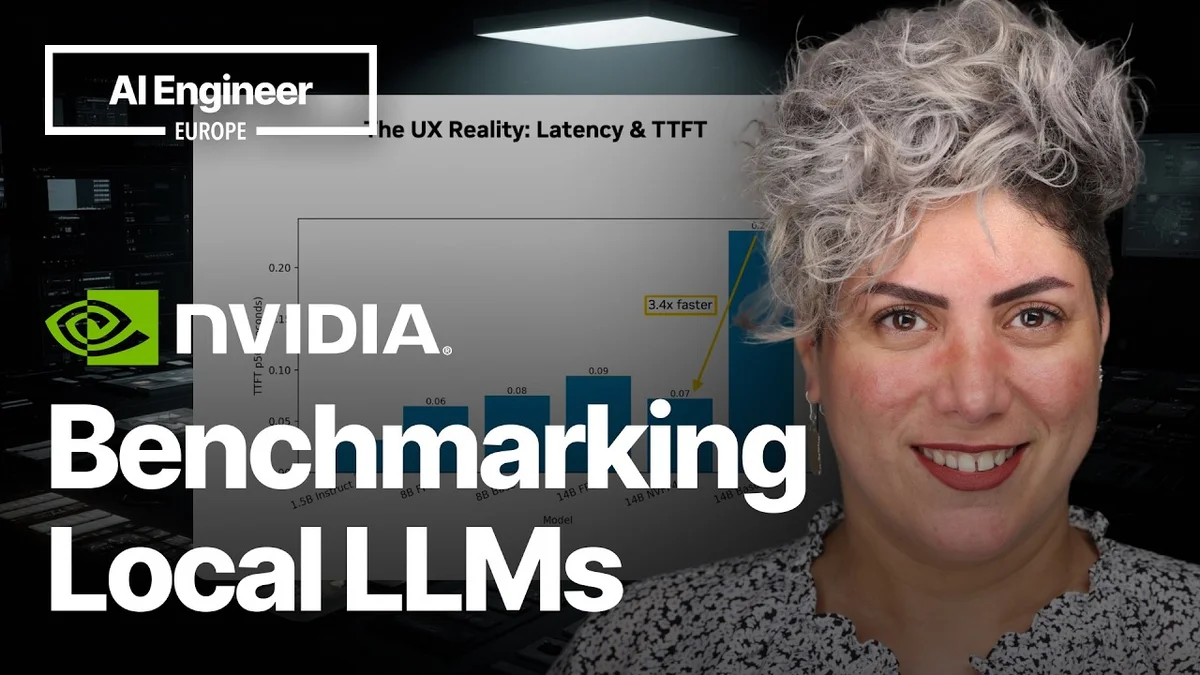
NVIDIA's latest presentation, featuring Developer Relations Manager Mozhgan Kabiri Chimeh, offers a deep dive into running Large Language Models (LLMs) locally and achieving practical performance on their DGX Spark platform. The session highlights the challenges and solutions for developers aiming to build and deploy AI applications efficiently, emphasizing the importance of hardware, software, and performance metrics.
Understanding Local AI Development Challenges
The presentation begins by outlining the common hurdles developers face when working with AI workloads locally. These challenges primarily stem from insufficient system resources, such as memory, or the lack of a compatible software stack. When local systems fall short, the typical solution is to offload the work to cloud or datacenter environments. However, this often introduces complexities related to cost, data residency, and scheduling conflicts, especially as LLMs grow in size and demand.
Introducing the DGX Spark
NVIDIA's DGX Spark is presented as a solution designed to bridge this gap. It's positioned as a powerful, yet compact, system built for developing and running AI. Key features include substantial local memory, support for NVIDIA's comprehensive AI software stack, and a power-efficient form factor. The DGX Spark can be configured as a standalone unit or a network-connected compute resource, offering flexibility for various deployment scenarios. At its core, the DGX Spark is powered by the NVIDIA GB10 Grace Blackwell Superchip, a formidable piece of hardware.
The NVIDIA GB10 Grace Blackwell Superchip
The GB10 Grace Blackwell Superchip is the engine driving the DGX Spark's capabilities. It integrates a Blackwell GPU, designed for FP4 data formats and capable of delivering up to 1 petaFLOP of AI performance. The chip also features a 20-core Arm CPU, split into high-performance and efficiency cores, and utilizes NVIDIA's NVLink C2C interface for high-speed communication between CPU and GPU. With a massive 128GB of LPDDR5x Coherent Unified Memory, the GPU and CPU can share memory seamlessly, a crucial aspect for handling large LLMs. This architecture allows developers to run models with up to 200 billion parameters locally, on a system that can fit on a desktop.
Methodology: The Reproducible Harness
To demonstrate the practical performance of LLMs on the DGX Spark, a reproducible benchmarking methodology was employed. The process involves setting up an environment, saving initial metrics, and then running models using a consistent protocol. Scripts are used to manage GPU logging, capture performance data, and ensure that each run is isolated and reproducible. This systematic approach allows for accurate measurement of model performance across different configurations and parameters. The benchmark script captures essential metrics like throughput and time-to-first-token (TTFT), providing a clear picture of the system's capabilities.