

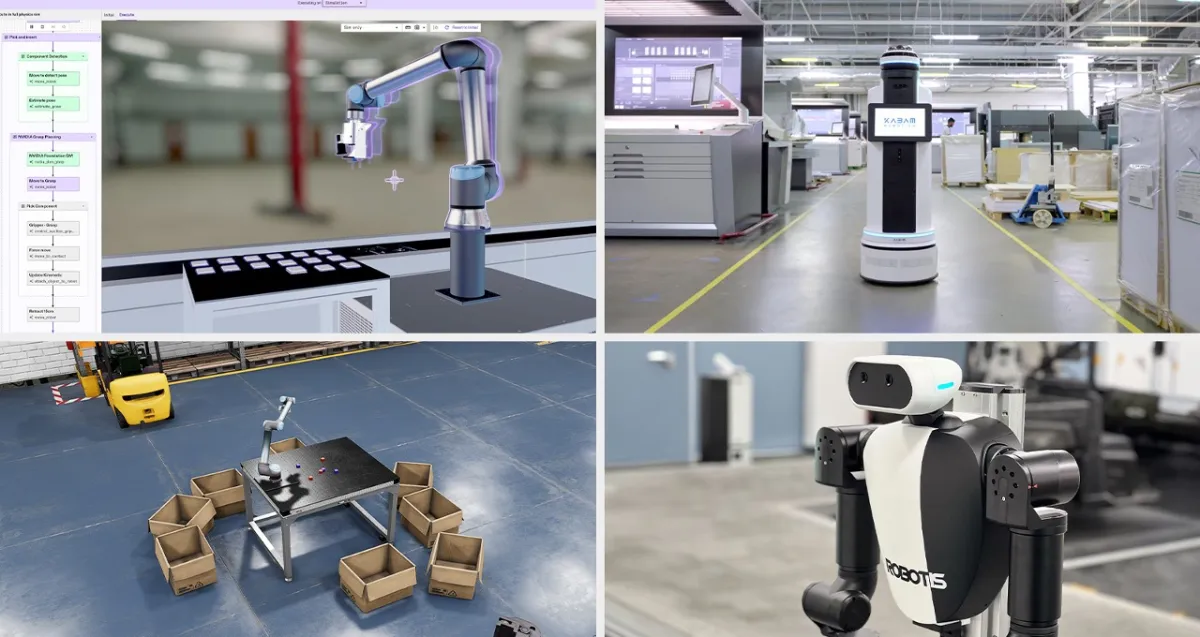
NVIDIA is deepening its commitment to open-source robotics, unveiling significant contributions at ROSCon. The company announced collaborations and new software designed to advance open standards and accelerate next-generation robotics development. This push aims to solidify ROS 2 as the go-to framework for real-world NVIDIA physical AI robotics applications.
According to the announcement, NVIDIA is actively supporting the Open Source Robotics Alliance's (OSRA) new Physical AI Special Interest Group. This initiative targets real-time robot control, accelerated AI processing, and enhanced tools for autonomous behavior. Crucially, NVIDIA is integrating GPU-aware abstractions directly into ROS 2, enabling the framework to efficiently manage diverse processors and maintain high-speed performance.
To further empower developers, NVIDIA is open-sourcing Greenwave Monitor, a utility for pinpointing performance bottlenecks in robot systems. Concurrently, NVIDIA Isaac ROS 4.0, a suite of GPU-accelerated libraries and AI models, is now accessible on the NVIDIA Jetson Thor platform. This provides a robust foundation for deploying advanced NVIDIA physical AI robotics capabilities, from manipulation to mobility.
Industry Momentum for Physical AI
The industry's adoption of NVIDIA's open-source contributions is already evident. Companies like AgileX Robotics leverage Jetson modules for AI autonomy, while Intrinsic integrates Isaac foundation models and Omniverse for advanced grasping and digital twin visualization. Partners such as ROBOTIS are deploying NVIDIA physical AI robotics solutions like the AI Worker, powered by the Isaac GR00T N1.5 model, for scalable edge AI.
NVIDIA's strategic contributions to ROS 2 and its ecosystem underscore a clear vision: to establish an open, high-performance platform for the future of physical AI. By providing core software, powerful simulation tools, and production-ready hardware, NVIDIA is positioning itself as a pivotal enabler for the next wave of autonomous systems. This move will significantly impact how developers build and deploy sophisticated robots.