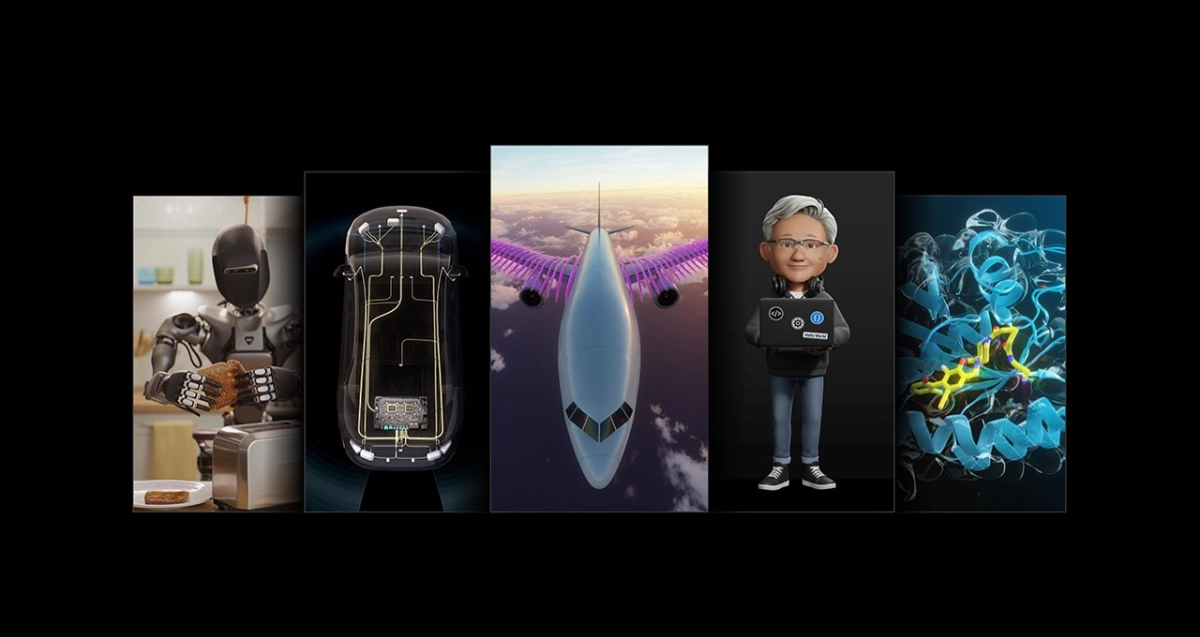
NVIDIA has unveiled Apollo, a new family of open AI physics models designed to dramatically accelerate industrial and computational engineering. Introduced at the SC25 conference, these models promise to integrate real-time capabilities into simulation software across a vast array of industries. This move signals a significant shift in how complex scientific and engineering problems will be tackled, moving beyond traditional, time-intensive methods.
The NVIDIA Apollo AI physics family encompasses specialized models optimized for scalability, performance, and accuracy across critical fields. This includes electronic device automation, structural mechanics, weather and climate forecasting, computational fluid dynamics, electromagnetics, and multiphysics simulations like nuclear fusion. According to the announcement, these models leverage cutting-edge machine learning architectures such as neural operators, transformers, and diffusion methods, infused with deep domain-specific knowledge. Developers will gain access to pretrained checkpoints and reference workflows, enabling seamless integration and customization for their specific needs.
Apollo's core value proposition lies in its ability to generate surrogate models. These AI models, trained on data from conventional simulations, can predict new cases in mere seconds, a stark contrast to the hours or days required by traditional methods. This near real-time capability fundamentally changes the design and optimization loop, allowing engineers to explore thousands of design iterations in record time. The implications for accelerating product development cycles and reducing time to market are profound.
Industry Adopts NVIDIA Apollo AI Physics
Leading companies are already integrating NVIDIA Apollo AI physics into their workflows, demonstrating its immediate impact. Applied Materials, for instance, has achieved up to 35x acceleration in modules of its ACE+ multi-physics software, using AI models for near real-time flow, plasma, and thermal modeling in semiconductor manufacturing. Cadence utilized Apollo to create a real-time digital twin of a full aircraft, showcasing rapid simulation previously unattainable. Siemens is integrating these AI physics capabilities into its flagship fluid simulation tools like Simcenter STAR-CCM+, enabling designers to blend high-fidelity first-principles simulations with high-speed AI surrogates for orders of magnitude faster design exploration.
The widespread adoption by industry giants like LAM Research, KLA, Northrop Grumman, PhysicsX, Rescale, and Synopsys underscores the transformative potential of NVIDIA Apollo AI physics. These companies are leveraging the open models to accelerate everything from plasma reactor simulation and spacecraft thruster nozzle design to computational lithography and defect detection. The availability of Apollo models on build.nvidia.com, HuggingFace, and as NVIDIA NIM microservices will further democratize access to these advanced simulation capabilities, fostering innovation across the engineering landscape.