

New GPT Transcription Models Launched

New GPT transcription models, gpt-transcribe and gpt-live-transcribe, offer enhanced accuracy for accents, multilingual speech, and custom vocabularies.

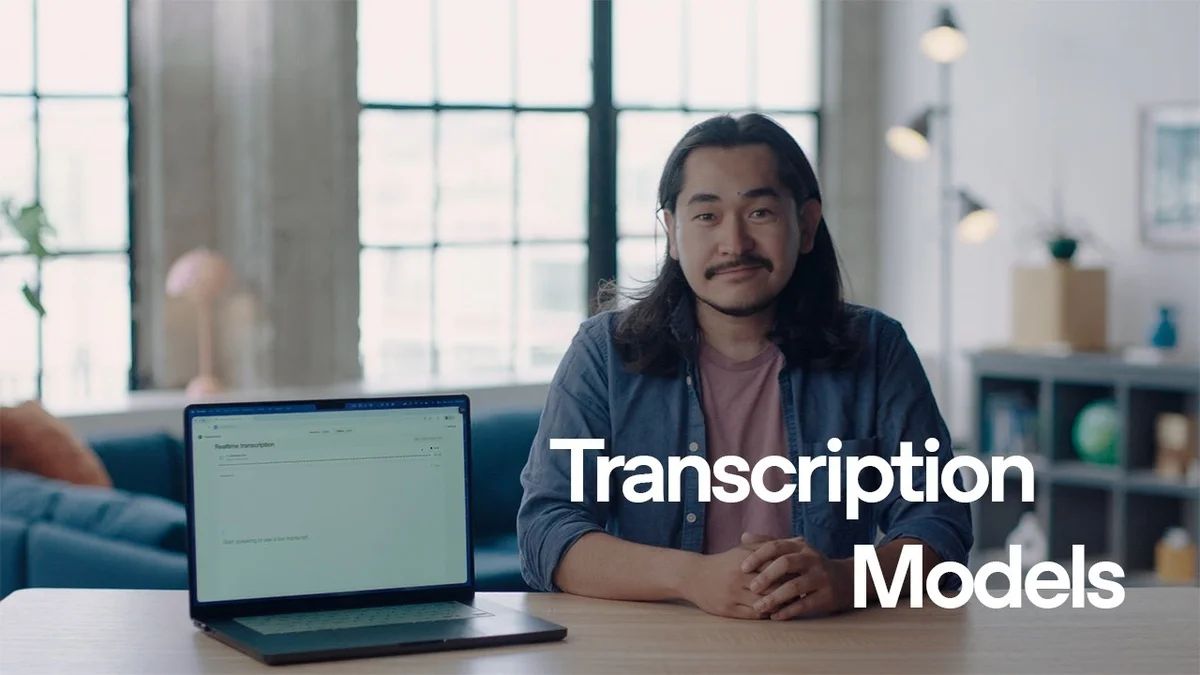
Person presenting new GPT transcription models on a laptop screen.
OpenAI Youtube
Visual TL;DR
New GPT ModelsCore
gpt-transcribe and gpt-live-transcribe launched for enhanced audio-to-text conversion
From the article 9+ mentionsA new advancement in AI-powered transcription has arrived with the introduction of two distinct models: gpt-transcribe and gpt-live-transcribe.
Enhanced AccuracyEffect
improved performance for accents, multilingual speech, and custom vocabularies
From the article 4 mentionsThis enhanced accuracy is a direct result of the models' advanced architecture and training data.
gpt-transcribeContext
processes completed audio files, ideal for podcasts, meetings, and large batch jobs
From the article 4 mentionsThe core innovation lies in offering two different approaches to transcription. gpt-transcribe is designed for processing completed audio files, delivering a full transcript once the analysis is complete.
gpt-live-transcribeContext
operates on a streaming basis, maintaining a live, open connection for real-time transcription
From the article 3 mentionsIn contrast, gpt-live-transcribe operates on a streaming basis.
Customization OptionsEffect
developers can tailor models for specific needs, improving precision in diverse contexts
Developer BenefitsOutcome
From the article 3 mentionsThese models aim to provide developers with more flexible and accurate tools for converting audio into text, addressing common challenges that have historically plagued transcription services.
Practical ApplicationsOutcome
enables better archiving, real-time captioning, and improved voice assistant interactions
From the article 3 mentionsThis real-time capability makes it suitable for applications requiring immediate transcription, such as live captioning for videos, dictation software, and voice interfaces where low latency is crucial for a seamless user experience.

Contents(5)

A new advancement in AI-powered transcription has arrived with the introduction of two distinct models: gpt-transcribe and gpt-live-transcribe. These models aim to provide developers with more flexible and accurate tools for converting audio into text, addressing common challenges that have historically plagued transcription services.

StartupHub data

Companies working on this

Profiles of the companies named in this story, with funding and a one-liner from our database.

OpenAI
Private / $100B+ est
OpenAI is an AI research and deployment company dedicated to ensuring that artificial general intelligence benefits all of humanity.

Understanding the New Models

The core innovation lies in offering two different approaches to transcription. gpt-transcribe is designed for processing completed audio files, delivering a full transcript once the analysis is complete. This model is ideal for tasks like archiving meeting recordings, transcribing podcasts, or handling large batch jobs where processing time is less critical than overall accuracy and throughput.

The full discussion can be found on OpenAI Youtube's YouTube channel.

Introducing gpt-transcribe and gpt-live-transcribe - OpenAI Youtube
Introducing gpt-transcribe and gpt-live-transcribe, from OpenAI Youtube

In contrast, gpt-live-transcribe operates on a streaming basis. It maintains a live, open connection, returning text as the audio is received. This real-time capability makes it suitable for applications requiring immediate transcription, such as live captioning for videos, dictation software, and voice interfaces where low latency is crucial for a seamless user experience.


Enhanced Accuracy and Language Support

Both gpt-transcribe and gpt-live-transcribe boast significant improvements in accuracy, particularly in areas that often prove challenging for existing systems. The models demonstrate superior performance with accented speech, multilingual audio, very short answers, proper nouns like names, and numerical data. This enhanced accuracy is a direct result of the models' advanced architecture and training data.

Furthermore, these new models support a broad range of 57 languages. A key feature is their ability to automatically handle multilingual speech within a single session. This means users can switch between languages, such as English and Spanish, and the transcription will follow these changes in real-time without interruption or a need to reconfigure settings.

Customization for Precision

To further refine transcription accuracy, developers can provide the models with a custom vocabulary. This allows for the inclusion of specific words, proper nouns, or technical terms, such as those found in cybersecurity, sales, or healthcare domains, that are critical for precise transcription. For instance, terms like "phishing," "ARR," and "A1C" can be easily missed by general transcription models but are handled with greater reliability when explicitly provided.

The models are also significantly better at filtering out background noise. Whether recording in a busy cafe, a crowded conference hall, or near a talkative coworker, the transcription is less likely to be cluttered with extraneous sounds like side conversations or ambient music, ensuring the output focuses on the intended speech.

Practical Applications and Developer Benefits

The introduction of these models offers a clear advantage for developers building applications that rely on speech-to-text technology. For example, processing a half-hour meeting recording with gpt-transcribe takes less than a minute, providing a transcript ready for immediate use in generating summaries, action items, or for integration into other applications.

StartupHub.ai data indicates that the AI transcription market is growing, with companies like OpenAI, which has a StartupHub score of 84/100, leading the charge. While OpenAI is a dominant player, new tools like these contribute to a competitive and rapidly evolving field. With its verified funding of $80M in Series A in 2023, the company behind these models is positioned to further innovate in this space.

The flexibility offered by both models caters to a wide array of use cases, from simple audio archiving to complex real-time interactive systems, ultimately aiming to make voice data more accessible and actionable.

© 2026 StartupHub.ai. All rights reserved. You may not republish this article in full without a license. Search engines and AI research tools may crawl and summarize for reference. Bulk reproduction or model training requires a license. See our terms.
Daniel Singer

Written by

Daniel Singer

Editor, StartupHub.ai

Daniel Singer is the editor of StartupHub.ai, a technology expert and thought leader on AI and its applications across sectors, from fintech and healthcare to developer tooling and consumer software. He writes and tests the tools covered here thoroughly and regularly, and built StartupHub.ai to give founders, operators and buyers a clearer read on what they are actually being sold.

More from Daniel Singer