

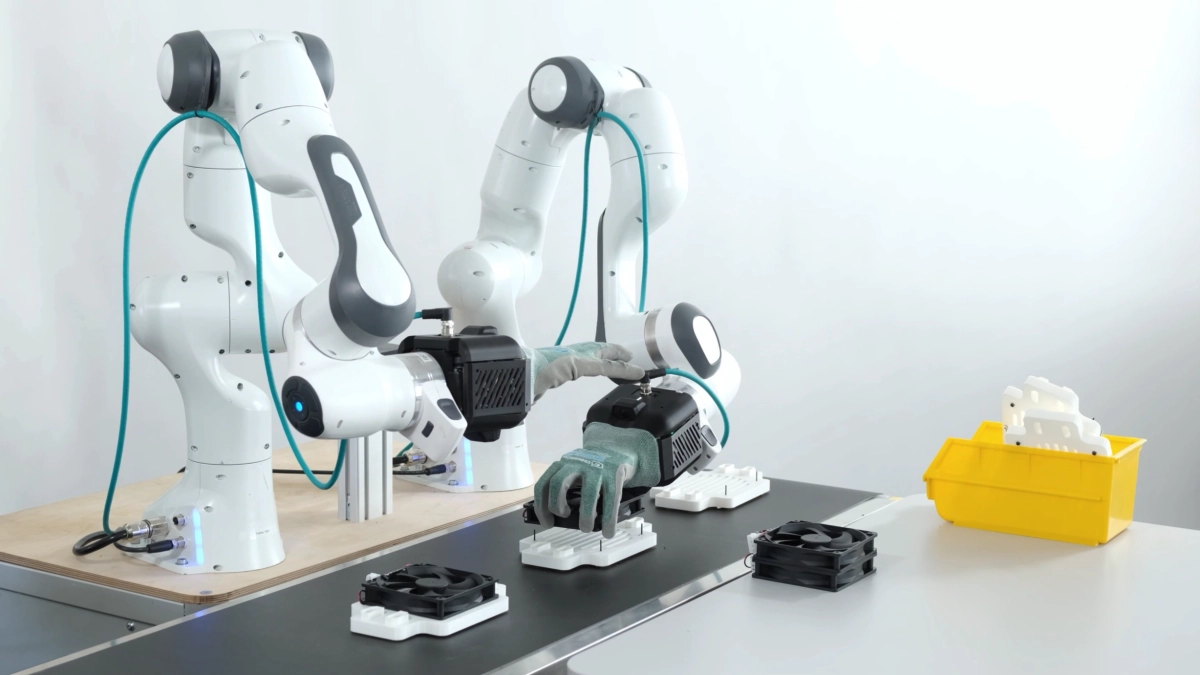
While the tech world remains captivated by the promise of full-body humanoid robots, one Swiss startup is making a pragmatic, $16 million bet that the real revolution in automation is all in the hands. Zurich-based mimic just closed a heavily oversubscribed seed round to scale its "frontier physical AI," which powers dexterous robotic hands designed to tackle the complex factory tasks that have stumped traditional automation for decades.
The funding, led by Elaia and Speedinvest, brings mimic’s total raised to over $20 million. The company is positioning itself as a leading European player in a field largely dominated by high-profile, capital-intensive efforts in the US and China. But instead of building a complete bipedal robot, mimic is focusing on the most critical component for industrial work: human-like dexterity.
On factory floors and in logistics centers, millions of tasks involving intricate assembly, delicate handling, or component insertion still require a human touch. Traditional robots are powerful but clumsy, locked into repetitive motions and requiring expensive, custom programming for every new task. The dream of a general-purpose humanoid that can just walk up and start working remains distant, hampered by high costs, safety concerns, and still-limited capabilities.
mimic argues that for most industrial scenarios, the legs are irrelevant. “Humanoids are exciting, but there aren’t many industrial scenarios where the full-body form factor truly adds value,” says Stephan-Daniel Gravert, mimic’s co-founder and CPO. “Our approach pairs AI-driven dexterous robotic hands with proven, off-the-shelf robot arms to deliver the same capabilities in a way that is much simpler, more reliable and rapidly deployable.”
This strategy allows mimic to bypass the immense engineering challenges of locomotion and balance, focusing its resources on solving the manipulation problem. The new capital is earmarked to accelerate the development of its core AI foundation model and its proprietary robotic hands, as well as to expand deployments with its existing pilot customers, which it says include Fortune 500 manufacturers and global automotive brands.
A hands-on approach to AI
The secret sauce isn't just the hardware; it's how mimic teaches its robots. The company has developed a novel data-gathering system to overcome the notorious data scarcity problem in robotics. Instead of relying on simulated data or constrained lab environments, mimic goes directly to the source.
Skilled factory operators wear mimic’s proprietary data collection devices while performing their normal jobs. These wearables capture the nuanced, detailed movements of human hands in live production settings, all without disrupting operations. This real-world data is then fed into mimic’s AI models, which use imitation learning to teach the robotic hands how to reproduce human techniques with remarkable fidelity.
According to the company, this allows its robots to not only perform complex tasks but also to adapt on the fly. The AI models enable the system to react to slight changes in the position or orientation of objects, handle unexpected disturbances, and self-correct its actions—a crucial capability for operating in dynamic, human-centric environments.
“Our general purpose AI models allow us to automate manual labour in a way that simply was not possible before,” says Elvis Nava, co-founder and CTO. “Thanks to our unique focus on human-like dexterity and human data, we are competitive at the robot foundation model layer as well as the application layer.”
The timing is critical. Industrial economies are facing a perfect storm of aging workforces, rising production costs, and a strategic push to reshore manufacturing. This has created immense pressure to automate, with analysts projecting the dexterous robotics market could hit $38 billion by 2035.
Investors see mimic’s focused approach as a key advantage. “The world-class team at mimic is addressing one of the most challenging problems in physical AI: dexterous manipulation,” said Clément Vanden Driessche, Partner at lead investor Elaia. Andreas Schwarzenbrunner, General Partner at Speedinvest, framed it as a strategic move for the continent: “This is the moment Europe steps forward to compete and lead in the new era of AI and robotics.”
Founded in 2024 as a spin-off from the prestigious ETH Zurich, mimic is making a clear statement. While others chase the sci-fi vision of a complete humanoid, mimic is focused on delivering a deployable, high-impact solution today. “We make dexterity deployable at scale,” says CEO Stefan Weirich, “closing the gap between what AI can do in the lab and what factories actually need.” It’s a bet that the quickest path to the future of robotics is by giving the machines we already have a much smarter pair of hands.


