

Microsoft's Orchard AI Framework

Microsoft Research's Orchard framework offers an open, scalable environment for agentic AI research, enabling small models to achieve strong results on complex tasks.

8 min read
Diagram illustrating the Orchard framework, showing Orchard Env connecting task environments and domains.
Microsoft Reesarch

Visual TL;DR. Agentic AI bottleneck solves Microsoft Orchard. Microsoft Orchard includes Orchard Env service. Microsoft Orchard enables Democratize AI research. Democratize AI research leading to Small models powerful. Democratize AI research helps Accelerate AI research. Small models powerful advances Next AI frontier.

  1. Agentic AI bottleneck: reliance on proprietary infrastructure limits accessibility for many researchers and developers
  2. Microsoft Orchard: an open, scalable environment for agentic AI research and development
  3. Orchard Env service: reusable environment service supports training and evaluating AI agents across diverse tasks
  4. Democratize AI research: unified infrastructure supports various agent systems and task types without modification
  5. Small models powerful: enables small models to achieve strong results on complex tasks like fixing code
  6. Next AI frontier: systems that can plan, reason, and act autonomously beyond static question-answering
  7. Accelerate AI research: designed to accelerate research in agentic AI by removing infrastructure barriers
Visual TL;DR
Visual TL;DR, startuphub.ai Agentic AI bottleneck solves Microsoft Orchard. Microsoft Orchard enables Democratize AI research. Democratize AI research leading to Small models powerful. Democratize AI research helps Accelerate AI research solves enables leading to helps Agentic AI bottleneck Microsoft Orchard Democratize AI research Small models powerful Accelerate AI research From startuphub.ai · The publishers behind this format
Visual TL;DR, startuphub.ai Agentic AI bottleneck solves Microsoft Orchard. Microsoft Orchard enables Democratize AI research. Democratize AI research leading to Small models powerful. Democratize AI research helps Accelerate AI research solves enables leading to helps Agentic AIbottleneck Microsoft Orchard Democratize AIresearch Small modelspowerful Accelerate AIresearch From startuphub.ai · The publishers behind this format
Visual TL;DR, startuphub.ai Agentic AI bottleneck solves Microsoft Orchard. Microsoft Orchard enables Democratize AI research. Democratize AI research leading to Small models powerful. Democratize AI research helps Accelerate AI research solves enables leading to helps Agentic AI bottleneck reliance on proprietary infrastructurelimits accessibility for many researchersand developers Microsoft Orchard an open, scalable environment for agenticAI research and development Democratize AI research unified infrastructure supports variousagent systems and task types withoutmodification Small models powerful enables small models to achieve strongresults on complex tasks like fixing code Accelerate AI research designed to accelerate research in agenticAI by removing infrastructure barriers From startuphub.ai · The publishers behind this format
Visual TL;DR, startuphub.ai Agentic AI bottleneck solves Microsoft Orchard. Microsoft Orchard enables Democratize AI research. Democratize AI research leading to Small models powerful. Democratize AI research helps Accelerate AI research solves enables leading to helps Agentic AIbottleneck reliance onproprietaryinfrastructure… Microsoft Orchard an open, scalableenvironment foragentic AI research… Democratize AIresearch unifiedinfrastructuresupports various… Small modelspowerful enables smallmodels to achievestrong results on… Accelerate AIresearch designed toaccelerate researchin agentic AI by… From startuphub.ai · The publishers behind this format
Visual TL;DR, startuphub.ai Agentic AI bottleneck solves Microsoft Orchard. Microsoft Orchard includes Orchard Env service. Microsoft Orchard enables Democratize AI research. Democratize AI research leading to Small models powerful. Democratize AI research helps Accelerate AI research. Small models powerful advances Next AI frontier solves includes enables leading to helps advances Agentic AI bottleneck reliance on proprietary infrastructurelimits accessibility for many researchersand developers Microsoft Orchard an open, scalable environment for agenticAI research and development Orchard Env service reusable environment service supportstraining and evaluating AI agents acrossdiverse tasks Democratize AI research unified infrastructure supports variousagent systems and task types withoutmodification Small models powerful enables small models to achieve strongresults on complex tasks like fixing code Next AI frontier systems that can plan, reason, and actautonomously beyond staticquestion-answering Accelerate AI research designed to accelerate research in agenticAI by removing infrastructure barriers From startuphub.ai · The publishers behind this format
Visual TL;DR, startuphub.ai Agentic AI bottleneck solves Microsoft Orchard. Microsoft Orchard includes Orchard Env service. Microsoft Orchard enables Democratize AI research. Democratize AI research leading to Small models powerful. Democratize AI research helps Accelerate AI research. Small models powerful advances Next AI frontier solves includes enables leading to helps advances Agentic AIbottleneck reliance onproprietaryinfrastructure… Microsoft Orchard an open, scalableenvironment foragentic AI research… Orchard Envservice reusableenvironment servicesupports training… Democratize AIresearch unifiedinfrastructuresupports various… Small modelspowerful enables smallmodels to achievestrong results on… Next AI frontier systems that canplan, reason, andact autonomously… Accelerate AIresearch designed toaccelerate researchin agentic AI by… From startuphub.ai · The publishers behind this format

Microsoft Research has unveiled Orchard, an open-source framework designed to accelerate research in agentic AI. The project tackles a significant bottleneck in the field: the reliance on proprietary infrastructure that limits accessibility for many researchers and developers. Orchard provides a reusable environment service, dubbed Orchard Env, which supports training and evaluating AI agents across diverse task domains, from fixing code to navigating the web. You can learn more about this initiative on the Microsoft Research blog.

Agentic AI, systems that can plan, reason, and act autonomously, represents the next frontier beyond static question-answering models. However, building these sophisticated agents typically requires custom sandboxes, closed training pipelines, and proprietary datasets. Orchard aims to democratize this space by offering a unified infrastructure that supports various agent systems and task types without modification. This means the same core environment can be used for software engineering agents, web browsing agents, and personal assistant agents.

A Scalable Environment for Agent Training

At the heart of Orchard is Orchard Env, a Kubernetes-native service. It manages thousands of isolated components in parallel, facilitating everything from data collection to reinforcement learning rollouts and final evaluations. This flexible design allows teams to introduce new benchmarks or training algorithms without rebuilding the underlying infrastructure from scratch. A key innovation is Orchard's ability to train agents directly within real deployment harnesses, such as Codex or OpenClaw. This addresses a common mismatch where models trained in simplified environments fail to perform as expected when deployed in complex, stateful systems.

Demonstrating Power with Small Models

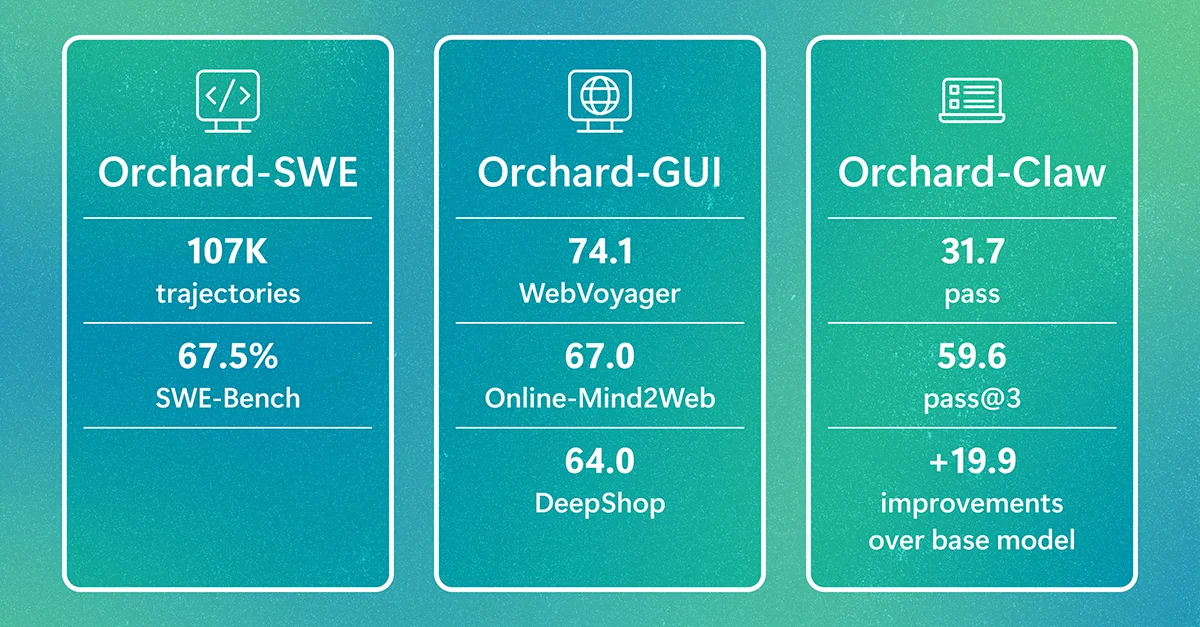
Microsoft Research has released three specific training recipes to showcase Orchard's capabilities: Orchard-SWE for software engineering, Orchard-GUI for web navigation, and Orchard-Claw for personal assistant tasks. These examples highlight that relatively small open-weight models can achieve remarkable results. Orchard-SWE, for instance, reached 69.7% on the SWE-bench Verified benchmark, a significant achievement for a model with only about 3 billion active parameters. With value-model reranking, it climbed to 73.0%, approaching the performance of frontier systems that use more than ten times the parameters. This competitive performance from smaller models is a significant development in the drive for more efficient AI.

Similarly, Orchard-GUI, a vision-language model with 4 billion parameters, achieved an average of 68.4% across several web navigation benchmarks. This makes it a leading open-source GUI agent, competitive with larger proprietary systems. The data efficiency demonstrated by Orchard-GUI is particularly noteworthy, suggesting that complex web agents can be trained effectively with limited supervision.

Orchard-Claw, trained on just 200 synthetic tasks, demonstrated strong performance in personal productivity workflows, reaching 73.9% success when paired with the ZeroClaw agent system. Training these agents directly within real deployment harnesses, like Codex, substantially improved reliability, boosting success rates from 18.6% to 51.5% for an untrained model after Orchard training.

Why This Matters for AI Development

The Orchard framework addresses a critical need for accessible and scalable tools in agentic AI research. By open-sourcing the infrastructure, Microsoft is lowering the barrier to entry for researchers and startups. This move could accelerate the pace of innovation in agentic AI, much like how open-source frameworks have transformed other areas of AI development. The focus on training smaller models effectively also has implications for cost-efficiency and accessibility, potentially enabling more organizations to develop and deploy sophisticated AI agents.

For founders in the agentic AI space, Orchard offers a foundational layer that can reduce development overhead. Instead of building bespoke training environments, they can potentially integrate their agent designs with Orchard Env. This could lead to faster iteration cycles and quicker time to market for new AI-powered applications. Investors might see this as a positive development, as it lowers the technical risk for early-stage companies exploring agentic AI solutions.

The release also includes training data and evaluation methods, further supporting the community. The emphasis on reusing training experience, treating trajectories as persistent assets, points toward a future of cumulative agent learning. This approach could lead to agents that continuously improve and build upon the knowledge of their predecessors, a significant step towards more generalized AI capabilities. While the framework is released, the long-term impact will depend on community adoption and the development of novel agents built upon it.

© 2026 StartupHub.ai. All rights reserved. Do not enter, scrape, copy, reproduce, or republish this article in whole or in part. Use as input to AI training, fine-tuning, retrieval-augmented generation, or any machine-learning system is prohibited without written license. Substantially-similar derivative works will be pursued to the fullest extent of applicable copyright, database, and computer-misuse laws. See our terms.