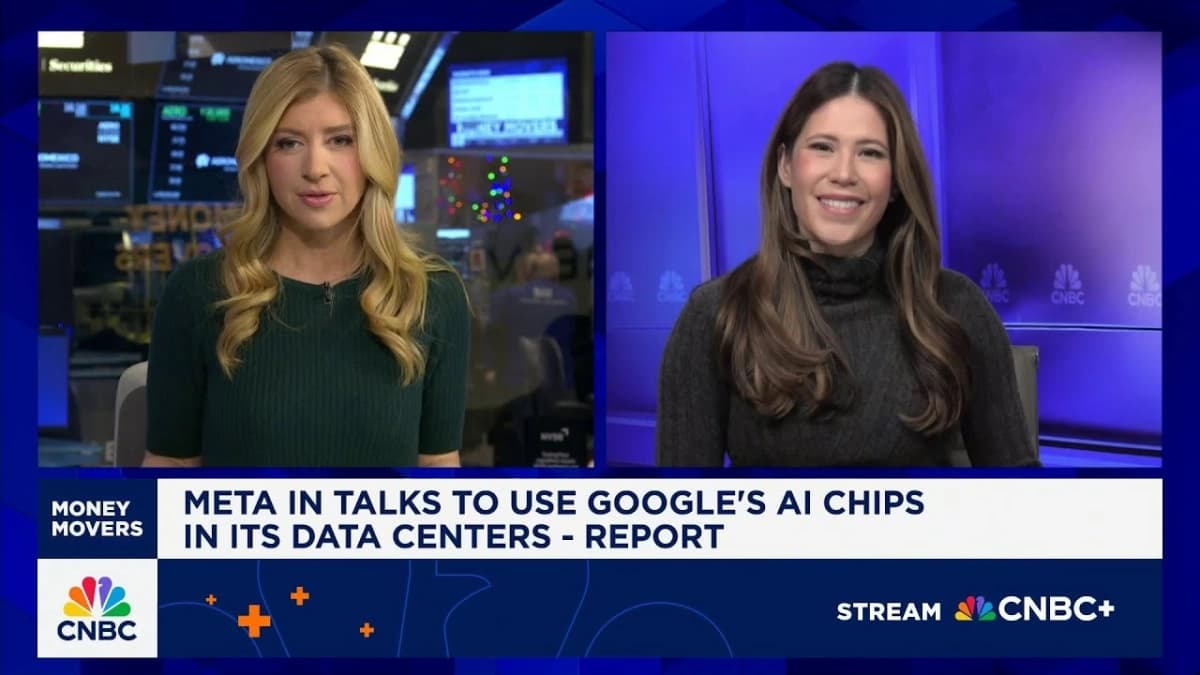
The reported discussions between Meta and Google regarding the adoption of Google’s custom AI chips, Tensor Processing Units (TPUs), for Meta’s data centers signal a significant pivot in the fiercely competitive AI infrastructure landscape. This potential multi-billion dollar deal, highlighted by CNBC’s Deirdre Bosa, represents not merely a transaction but a profound strategic validation for Google Cloud and its vertically integrated AI stack. It forces a re-evaluation of the long-term dynamics between hyperscale cloud providers, chip manufacturers, and the major AI developers.
Deirdre Bosa, CNBC Business News TechCheck Anchor, spoke with Aaron Ginn, Co-Founder & CEO of Hydra Host, on "Squawk on the Street" about the implications of Meta’s exploration into Google’s AI chips. Their discussion delved into the strategic advantages for Google Cloud, the differing philosophies of AI hardware deployment (vertical integration versus modularity), and the inherently volatile nature of leadership in the rapidly evolving artificial intelligence domain.
For Google, securing Meta as a TPU customer would be a substantial victory. Meta is recognized as one of the largest GPU buyers globally, making its consideration of Google’s custom silicon a powerful endorsement of the technology’s capabilities and efficiency. Bosa emphasized this point, stating, “If it is exploring billions of dollars worth of TPUs, Google's custom chips, that is technical validation. It's also a major win for Google Cloud because Meta would have to run every TPU inside of Google Cloud.” This arrangement guarantees new revenue and a long-term lock-in for Google Cloud Platform (GCP), offering an "AI-native advantage" that competitors like Amazon AWS and Microsoft Azure, despite their own custom chip efforts, currently do not fully possess in the same integrated manner.
TPUs have historically provided Google with considerable efficiency gains for its internal AI workloads. The potential expansion of their use by a major external entity like Meta underscores the growing confidence in Google's in-house silicon strategy. Furthermore, AI research firm Anthropic has already committed to expanding its usage of TPUs, indicating a broader trend of adoption among leading AI innovators.
However, the narrative suggesting TPUs are poised to universally overtake Nvidia across the enterprise demands careful consideration from investors and industry leaders. Aaron Ginn articulated a crucial distinction that shapes enterprise adoption. The fundamental question, he noted, is whether an enterprise desires "a fully integrated solution or do they want a modular solution?" Google's offering with TPUs is inherently a fully vertical solution, accessible exclusively through Google Cloud. This contrasts sharply with Nvidia's GPUs, which provide a horizontal product that "works out of the box" and can be deployed across various cloud providers or on-premise infrastructure.
Enterprises, Ginn contended, are generally drawn to the modular approach. The ability to plug into different hardware vendors—be it Nvidia, AMD, or whatever new innovations emerge—offers critical optionality. Being locked into a single cloud provider, particularly in a domain as dynamic as AI, is not always the optimal strategy. The rapid pace of innovation means that today's leading solution might quickly be surpassed.
Related Reading
- Amazon's Indiana Bet: The Physical Core of AI Infrastructure
- Alphabet's Vertical AI Dominance Threatens Nvidia-OpenAI Ecosystem
- Agents are Robots Too: The Infrastructure Imperative for Next-Gen AI
Bosa echoed this sentiment, highlighting the fluidity of the AI landscape. She observed that the "AI leaderboard, it changes extremely fast." Narratives, she added, "can swing harder than the fundamentals." Google itself experienced this volatility, transitioning from being perceived as "broken to beloved in a matter of months" in the market's eyes, even though its underlying business and long-term investment in TPUs had remained consistent for over a decade. The recent release of Anthropic's Claude Opus 4.5, which reportedly outperformed Google's Gemini on several benchmarks just days after its launch, serves as a stark reminder of how quickly competitive positions can shift. This constant state of flux means that while Google might be on top today, complacency is a luxury no player in the AI space can afford.
The Meta-Google talks underscore a pivotal moment in AI infrastructure. Companies must weigh the potential for specialized performance and cost efficiencies offered by vertically integrated solutions against the strategic flexibility and risk mitigation provided by modular, multi-vendor approaches. The decision will not only shape individual corporate strategies but also determine the future power dynamics of the global AI ecosystem.