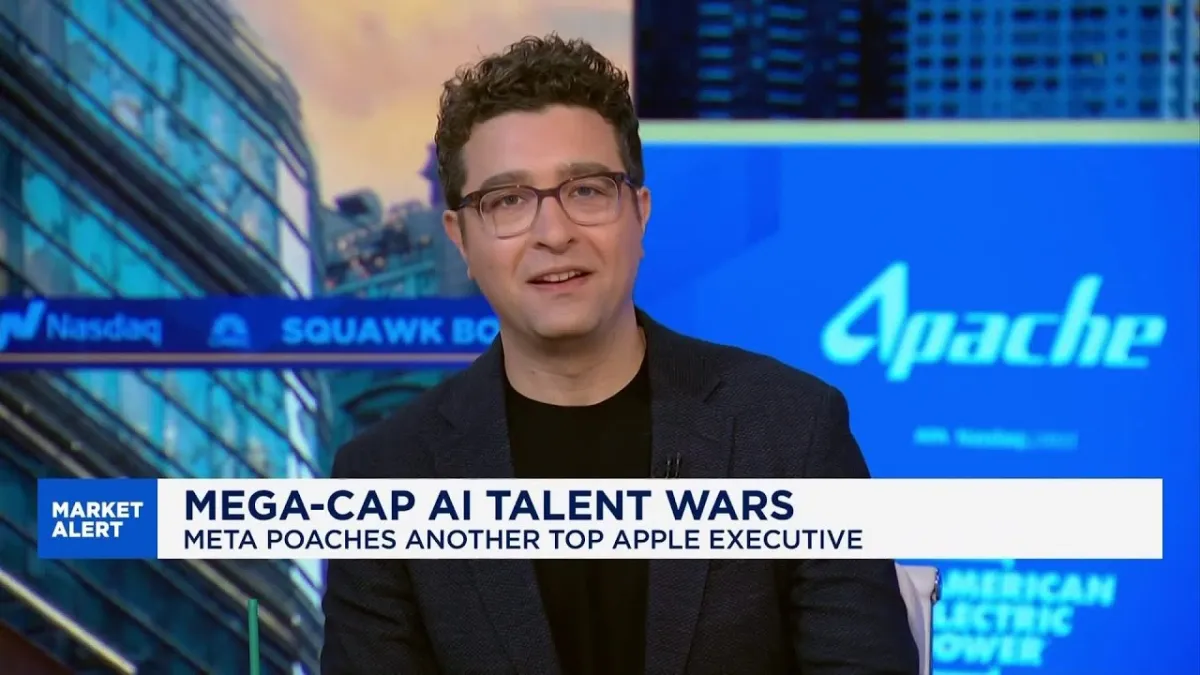
The ongoing "Mega-Cap AI talent wars" have once again underscored the fierce competition for artificial intelligence expertise, with Meta Platforms recently poaching Keyang, a pivotal AI executive, from Apple. This latest departure, highlighted by CNBC’s Steve Kovach on "Squawk Box," is not an isolated incident but rather a symptom of Apple's broader challenges in the generative AI landscape. Kovach, speaking with the Squawk Box hosts, detailed how this talent drain, particularly from Apple's AI search division, intensifies the pressure on the Cupertino giant to deliver a breakthrough AI experience on its flagship products.
Apple's position in the burgeoning AI space has been characterized by a notable lag compared to its peers. For years, its virtual assistant, Siri, has struggled to match the sophistication and utility offered by competitors. As Kovach bluntly stated, "After 14 years, Siri is still pretty bad at getting you that right answer to your questions." This persistent underperformance is not merely an inconvenience for users; it represents a significant strategic vulnerability for a company that prides itself on seamless user experience and cutting-edge innovation. The delay in delivering substantial AI updates, including a significant overhaul to Siri that was pushed from this spring to next year, signals internal hurdles and a potential struggle to keep pace with the rapid advancements seen elsewhere in the industry.
The aggressive talent acquisition strategies employed by companies like Meta further exacerbate Apple's predicament. Meta, with its deep pockets and clear mandate to dominate the metaverse and AI, has been offering "enormous sums" to attract top-tier AI researchers and engineers. This financial incentive creates a significant challenge for Apple, which, according to Kovach, "clearly not counter-offering" at the same scale. The swift exit of an executive like Keyang, who had only recently been promoted to lead Apple’s AI search, illustrates the fluidity of the AI talent market and the premium placed on expertise. Such rapid turnover in critical leadership roles can disrupt long-term development roadmaps and hinder innovation, especially when a company is already playing catch-up.
Apple's historical approach of tightly integrating hardware and software, often building capabilities in-house, might be proving to be a double-edged sword in the fast-evolving AI domain. While this strategy has enabled unparalleled user experiences in other areas, the sheer pace and resource demands of generative AI development necessitate a different approach. The current environment calls for agility, rapid iteration, and, potentially, strategic partnerships. Apple's vast ecosystem, boasting over a billion iPhone users, offers an unparalleled advantage, a massive user base that can provide invaluable data and a ready market for new AI features. This inherent strength could be leveraged to forge alliances rather than attempting to build every component from scratch.
Related Reading
- AI Startups Thrive in Complementary Ecosystem, Attracting Rapid VC Funding
- GE Aerospace CEO Larry Culp on AI's Role in Augmenting, Not Replacing, the Aerospace Workforce
- AI's Phase Shift: Navigating the Supercycle's Creative Destruction
Kovach elaborated on this potential strategic pivot, suggesting that Apple now has "the green light to go ahead and do this following Google's antitrust case. They can partner with Google or someone else to make AI actually work instead of building it themselves." This proposition, while potentially counter to Apple's traditional closed-system philosophy, could be a pragmatic path forward. Partnering with established AI leaders like Google, or even smaller, innovative AI startups, could accelerate Apple's AI roadmap, allowing it to integrate advanced AI capabilities without bearing the full burden of foundational research and development. The alternative, continuing to lag, carries immense risks.