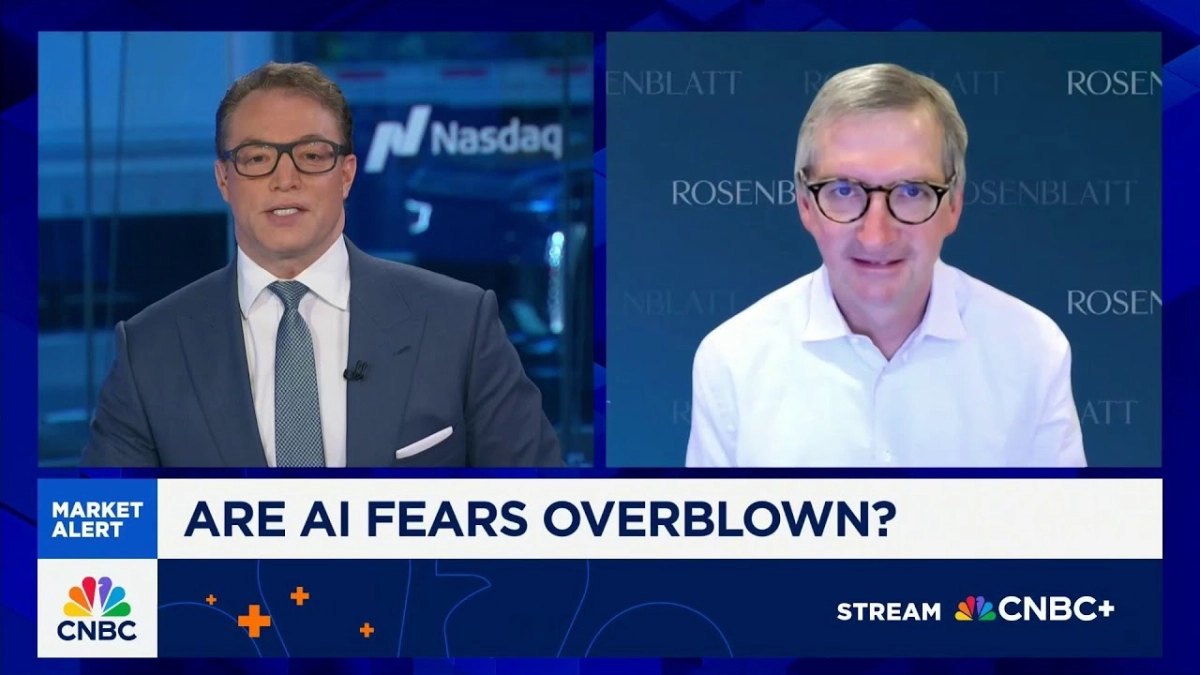
The prevailing narrative around artificial intelligence often oscillates between existential fears and a "winner-take-all" market frenzy. However, in a recent appearance on CNBC’s 'Squawk Box,' Barton Crockett, a Senior Research Analyst at Rosenblatt Securities, offered a more nuanced and financially grounded perspective, particularly highlighting Meta Platforms' visible return on its substantial AI investments. Crockett engaged with the CNBC host, discussing the competitive dynamics of large language models (LLMs) and the tangible economic benefits AI is already delivering to major tech players.
Crockett began by challenging the market's tendency to prematurely crown a single victor in the LLM race, noting that "the LLM benchmark horse race is likely to be a horse race." This insight pushes back against the notion that one company, like OpenAI or Google, will dominate the entire AI landscape, much like Google did with search. Instead, he suggests that the sheer volume of capital and expertise being marshaled by multiple players, including Meta and Anthropic, means that leadership in AI advancements will likely be fluid, with different entities achieving breakthroughs at various times. Google's recent Gemini 3 success, for instance, is not indicative of an everyday win, as other formidable contenders are consistently innovating.
This competitive environment, far from being a deterrent, is actually fueling significant, measurable returns for some of the biggest tech companies. Crockett pointed directly to Meta as a prime example. He argued that it is "hard to find a company that has a clearer ROIC [Return on Invested Capital] on AI spend argument than Meta." This assertion is critical for founders and VCs who are scrutinizing AI investments for concrete financial outcomes rather than just speculative potential.
Meta's AI spending has visibly accelerated its ad growth, pushing it into the impressive 20-25% range. Furthermore, Crockett revealed that Meta has cited "60 billion dollars of annualized recurring revenue from their end-to-end AI performance ad tools." This figure is substantial, suggesting that the company’s heavy investment in AI infrastructure and talent is not merely a cost center but a powerful revenue driver. This revenue, he emphasizes, is largely margin, effectively covering the considerable capital expenditures Meta is making in its AI initiatives.
The interviewer raised a pertinent question regarding Meta's substantial capital expenditure, projected to soar from $40 billion in 2024 to over $100 billion next year, alongside executive and talent turnover in its AI division. Crockett confidently countered that the incremental revenue generated by AI performance tools is rapidly offsetting these costs. He also underscored AI's role in enhancing user engagement across Meta's platforms, which indirectly contributes to its advertising efficacy.
This financial success for Meta, according to Crockett, is not merely a reallocation of existing advertising dollars but represents a fundamental shift in the broader advertising landscape. He described it as a "clear megatrend" where ad spending is migrating from "legacy media, linear television" towards "performance media," a segment where Meta has established a dominant position. The AI enhancements have allowed Meta to capture a significant portion of this new spending, boosting its ad growth "well above what the AI's done for Google." This highlights AI's capacity to create entirely new market opportunities and revenue streams, rather than just optimizing existing ones.
Related Reading
- AI's Enduring Rally: Navigating Growth and Diversification in a Broadening Market
- AI Shifts from Build-Out to Utilization: A New Investment Landscape
- Cramer: AI Investment Demands Conviction, Not Fear
Beyond Meta, Crockett also noted Amazon as another beneficiary of this AI-driven surge, particularly within its Amazon Web Services (AWS) division. AWS has secured significant new deals with government entities and even OpenAI, demonstrating the enterprise demand for robust AI infrastructure and services. Additionally, Amazon’s e-commerce business is set to benefit from AI-powered assistant tools like "Rufus," which are expected to enhance the consumer shopping experience and drive further growth, outpacing traditional retail.
In essence, Crockett’s analysis provides a grounded perspective on AI's impact. It moves beyond the hype to demonstrate that AI is not just a technological marvel but a powerful economic engine, visibly driving substantial returns on investment for companies like Meta and Amazon. The market, in its initial zeal, may have oversimplified the competitive landscape, but the tangible financial results speak volumes about the transformative power of AI when strategically deployed.