

Jennifer Doudna on CRISPR's Non-Permanent Gene Editing

Jennifer Doudna discusses Scribe Therapeutics' non-permanent gene editing tech, its potential for common diseases, and the role of AI in science.

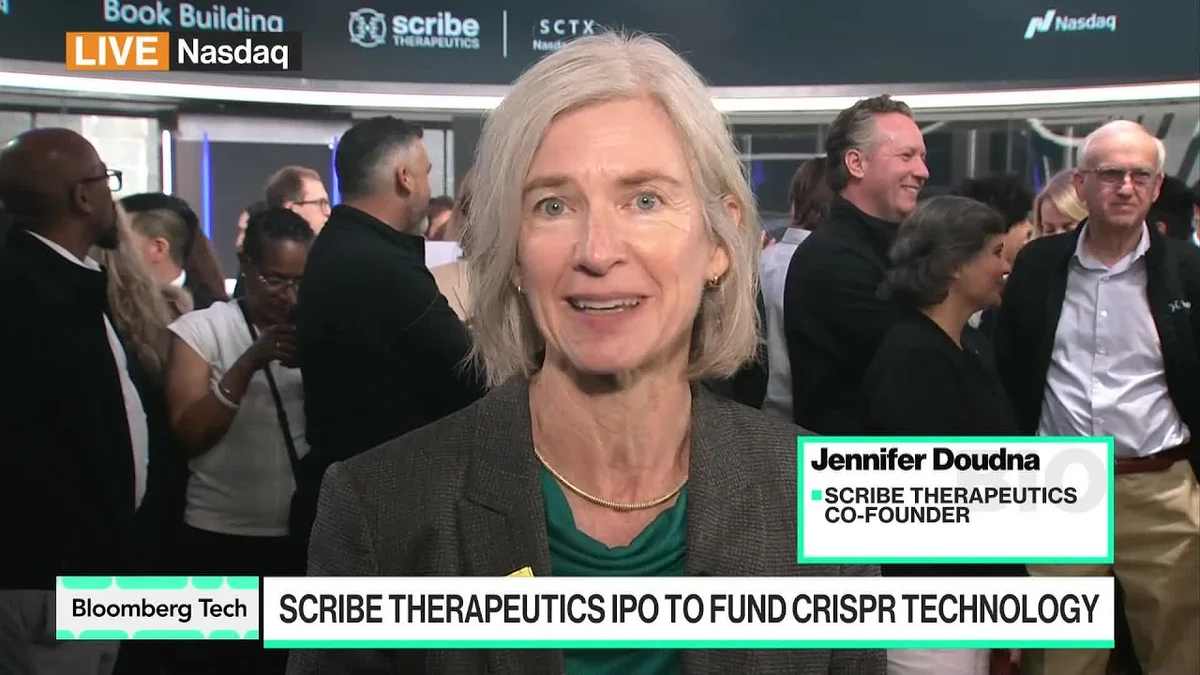
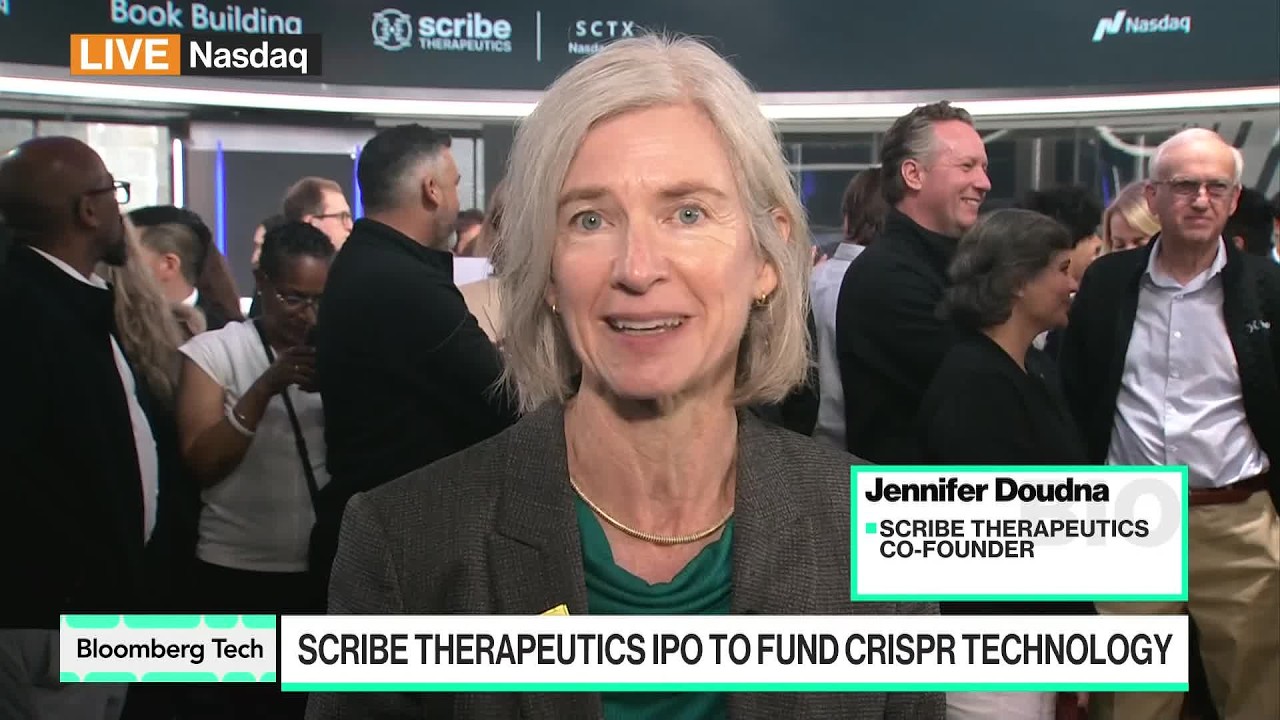
Jennifer Doudna speaking on a Bloomberg Tech segment.
Bloomberg Technology
Visual TL;DR
CRISPR Gene EditingCore
Jennifer Doudna discusses Scribe Therapeutics' non-permanent gene editing technology
From the articleThis non-permanent modification is seen as a significant advancement over earlier gene editing approaches, potentially easing regulatory hurdles and increasing patient safety.
Epi-Editing MethodContext
From the article 2 mentionsScribe's lead therapy targets LDL cholesterol reduction with a single treatment, distinguishing itself through a method called "epi-editing." This technique modifies protein production without permanently altering a patient's DNA, a crucial safety feature that Doudna believes will enable broader application for common diseases.
AI in Drug DiscoveryContext
AI is a tool, not a replacement, for accelerating scientific discovery
From the articleWhen asked about the role of artificial intelligence in drug discovery, Doudna shared her perspective, which she had previously discussed with Bloomberg's Emily Chang.
Non-Permanent ChangesEffect
crucial safety feature enabling broader application for common diseases
From the article 2 mentionsDoudna elaborated on the importance of epi-editing, explaining that it involves making changes to DNA that are not permanent but effectively alter protein production.
Scribe Therapeutics IPOOutcome
From the article 3 mentionsJennifer Doudna, co-founder and scientific advisor at Scribe Therapeutics, discussed the company's innovative approach to gene therapy and its recent IPO on Bloomberg Tech.
Treat Common DiseasesEffect
safely and effectively use this therapy for widespread health issues
From the article 2 mentions"We think this is an incredibly important moment in the field because it means we can now use this therapy safely and effectively for common disease," she stated.
LDL Cholesterol TargetOutcome
From the articleScribe's lead therapy targets LDL cholesterol reduction with a single treatment, distinguishing itself through a method called "epi-editing." This technique modifies protein production without permanently altering a patient's DNA, a crucial safety feature that Doudna believes will enable broader application for common diseases.
Contents(5)

Jennifer Doudna, co-founder and scientific advisor at Scribe Therapeutics, discussed the company's innovative approach to gene therapy and its recent IPO on Bloomberg Tech. Scribe's lead therapy targets LDL cholesterol reduction with a single treatment, distinguishing itself through a method called "epi-editing." This technique modifies protein production without permanently altering a patient's DNA, a crucial safety feature that Doudna believes will enable broader application for common diseases.

The Significance of Epi-Editing

Doudna elaborated on the importance of epi-editing, explaining that it involves making changes to DNA that are not permanent but effectively alter protein production. "We think this is an incredibly important moment in the field because it means we can now use this therapy safely and effectively for common disease," she stated. This non-permanent modification is seen as a significant advancement over earlier gene editing approaches, potentially easing regulatory hurdles and increasing patient safety.

The full discussion can be found on Bloomberg Technology's YouTube channel.

Jennifer Doudna: "AI Doesn't Replace Scientists" - Bloomberg Technology
Jennifer Doudna: "AI Doesn't Replace Scientists", from Bloomberg Technology

Scribe Therapeutics' Clinical Stage and IPO

Scribe Therapeutics is currently a clinical-stage company, with its first indication already in a Phase One trial. Doudna confirmed that the funds raised from the IPO will be instrumental in advancing these therapies and expanding their reach. The company's strategy is built on robust science and a commitment to safety and efficacy, aiming to provide treatments that are both powerful and broadly accessible.

Patient Behavior and One-Time Treatments

The conversation also touched upon the practical implications of Scribe's single-treatment approach, contrasting it with daily medications like statins for heart disease. Doudna highlighted the potential benefit for patients: "I think it's very interesting to think about a way of treating or preventing disease that doesn't require taking a pill every day, that is really effectively a one or few time treatment." This could alleviate the burden of adherence and potential side effects associated with daily medication regimens.

AI in Drug Discovery: A Tool, Not a Replacement

When asked about the role of artificial intelligence in drug discovery, Doudna shared her perspective, which she had previously discussed with Bloomberg's Emily Chang. She acknowledged AI as an "incredible tool" that can accelerate scientific work but stressed that it does not replace human scientists. "We still need innovators. We still need creative people. We still need the new ideas that come out of left field, and we don't see that with AI," Doudna remarked. She views AI as a valuable partner that enhances, rather than supplants, human ingenuity in scientific research.

Market Reception and Investor Confidence

The IPO saw Scribe Therapeutics priced at $15 per share, with indications that it would open around $29. Notably, approximately 75% of the shares were allocated to just 10 investors. Doudna interpreted this strong investor reception as a sign that the market understands the distinctiveness of Scribe's technology, the quality of its team, and its dedication to scientific rigor. "That's what we're seeing, I think, reflected in the marketplace," she concluded.

© 2026 StartupHub.ai. All rights reserved. You may not republish this article in full without a license. Search engines and AI research tools may crawl and summarize for reference. Bulk reproduction or model training requires a license. See our terms.
Daniel Singer

Written by

Daniel Singer

Editor, StartupHub.ai

Daniel Singer is the editor of StartupHub.ai, a technology expert and thought leader on AI and its applications across sectors, from fintech and healthcare to developer tooling and consumer software. He writes and tests the tools covered here thoroughly and regularly, and built StartupHub.ai to give founders, operators and buyers a clearer read on what they are actually being sold.