

GPT-5.6 Models Launched: Sol, Terra, and Luna Arrive

OpenAI announces the release of its new GPT-5.6 family of models: Sol, Terra, and Luna, already being tested for diverse applications.

4 min read
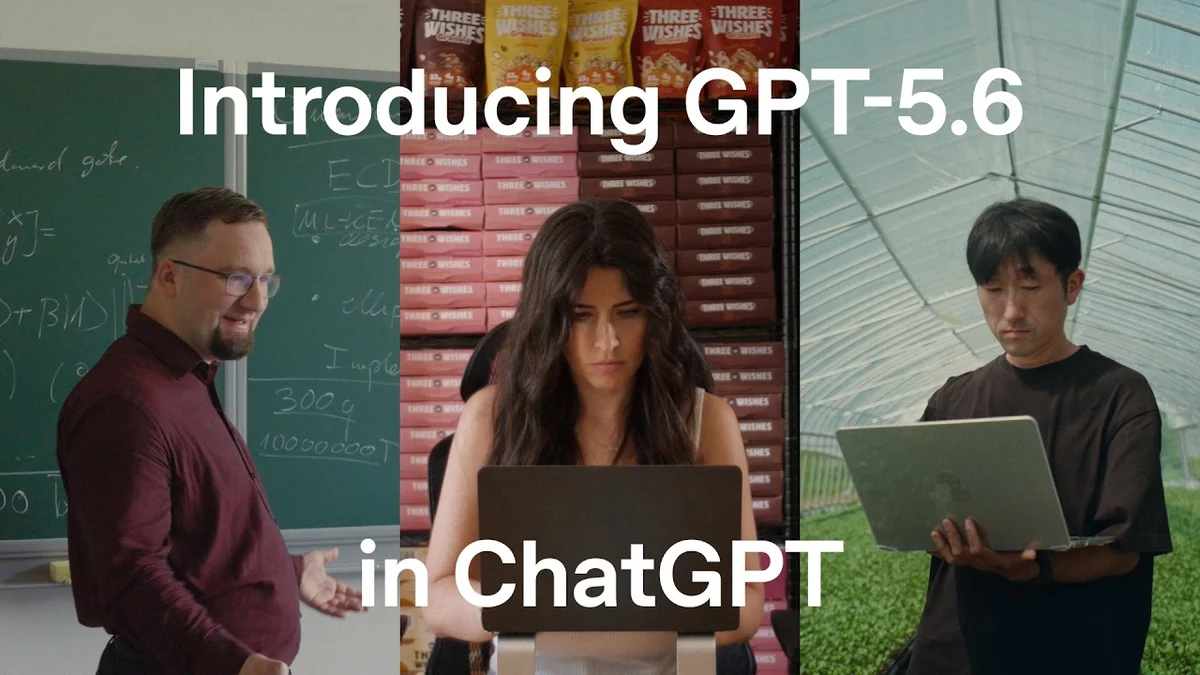
A split image showing diverse applications of AI: a farmer in a greenhouse, a team working on a business dashboard, and a researcher at a whiteboard.
OpenAI Youtube
Visual TL;DR
GPT-5.6 Models LaunchedCore
OpenAI announces new GPT-5.6 family of models
From the article 3 mentionsThe AI landscape is constantly evolving, and today marks a significant advancement with the introduction of the GPT-5.6 family of models.
Global TestingContext
Users around the world already testing models
From the article 2 mentionsThe ongoing testing and application development by users worldwide will undoubtedly reveal the full scope of these new models' capabilities.
Sol, Terra, LunaContext
Three new models: Sol, Terra, and Luna
From the article 3 mentionsNamed Sol, Terra, and Luna, these new iterations promise to enhance capabilities across a wide range of applications.
Enhanced CapabilitiesEffect
Promise to enhance capabilities across wide applications
From the article 3 mentionsThis could mean enhanced performance in areas such as coding, creative writing, or complex problem-solving, catering to a diverse user base.
Industry TransformationEffect
Transforming industries from agriculture to scientific research
Research AdvancementEffect
Advancing research and discovery
From the article 3 mentionsUsers around the world have already begun testing these models, showcasing their potential to transform industries from agriculture to scientific research.
Leap ForwardOutcome
From the articleWhile the specific technical details of each model are not fully elaborated in the provided description, their collective arrival suggests a leap forward in natural language processing and understanding.
The AI landscape is constantly evolving, and today marks a significant advancement with the introduction of the GPT-5.6 family of models. Named Sol, Terra, and Luna, these new iterations promise to enhance capabilities across a wide range of applications. Users around the world have already begun testing these models, showcasing their potential to transform industries from agriculture to scientific research.

Transforming Industries with GPT-5.6

The release of Sol, Terra, and Luna signifies OpenAI's continued push in developing more powerful and versatile language models. While the specific technical details of each model are not fully elaborated in the provided description, their collective arrival suggests a leap forward in natural language processing and understanding.

The full discussion can be found on OpenAI Youtube's YouTube channel.

Sol, Terra, and Luna, our GPT‑5.6 family of models are here. - OpenAI Youtube
Sol, Terra, and Luna, our GPT‑5.6 family of models are here., from OpenAI Youtube

Early glimpses into their application highlight their ability to streamline complex tasks and unlock new possibilities. In agriculture, users are employing GPT-5.6 to automate greenhouse operations, manage resources more efficiently, and even optimize crop yields. This demonstrates the model's capacity to understand and interact with the physical world through automation.

Beyond agriculture, the GPT-5.6 models are proving invaluable in the business realm. Small businesses are finding new ways to manage operations, analyze data, and even develop marketing strategies with the assistance of these advanced AI tools. The ability to process and synthesize large amounts of information allows for more informed decision-making and improved efficiency.

Advancing Research and Discovery

The impact of GPT-5.6 extends to the scientific community as well. Researchers are utilizing the models to accelerate discovery, analyze complex datasets, and even tackle long-standing unsolved problems. The capacity of these models to process and generate human-like text can significantly speed up the research cycle, from hypothesis generation to data interpretation.

The introduction of Sol, Terra, and Luna as a family of models suggests a modular approach, potentially allowing for specialized applications or different strengths within the GPT-5.6 architecture. This could mean enhanced performance in areas such as coding, creative writing, or complex problem-solving, catering to a diverse user base.

The ongoing testing and application development by users worldwide will undoubtedly reveal the full scope of these new models' capabilities. As AI continues to integrate into various facets of our lives, the GPT-5.6 family represents a crucial step in making AI more accessible, powerful, and impactful.

© 2026 StartupHub.ai. All rights reserved. Do not enter, scrape, copy, reproduce, or republish this article in whole or in part. Use as input to AI training, fine-tuning, retrieval-augmented generation, or any machine-learning system is prohibited without written license. Substantially-similar derivative works will be pursued to the fullest extent of applicable copyright, database, and computer-misuse laws. See our terms.