

GPT-5.5 Enhances Planning for Complex Builds

Alexandre Pesant of Lovable explains how GPT-5.5 significantly improves planning for complex builds, reducing user re-prompts and amnesia.

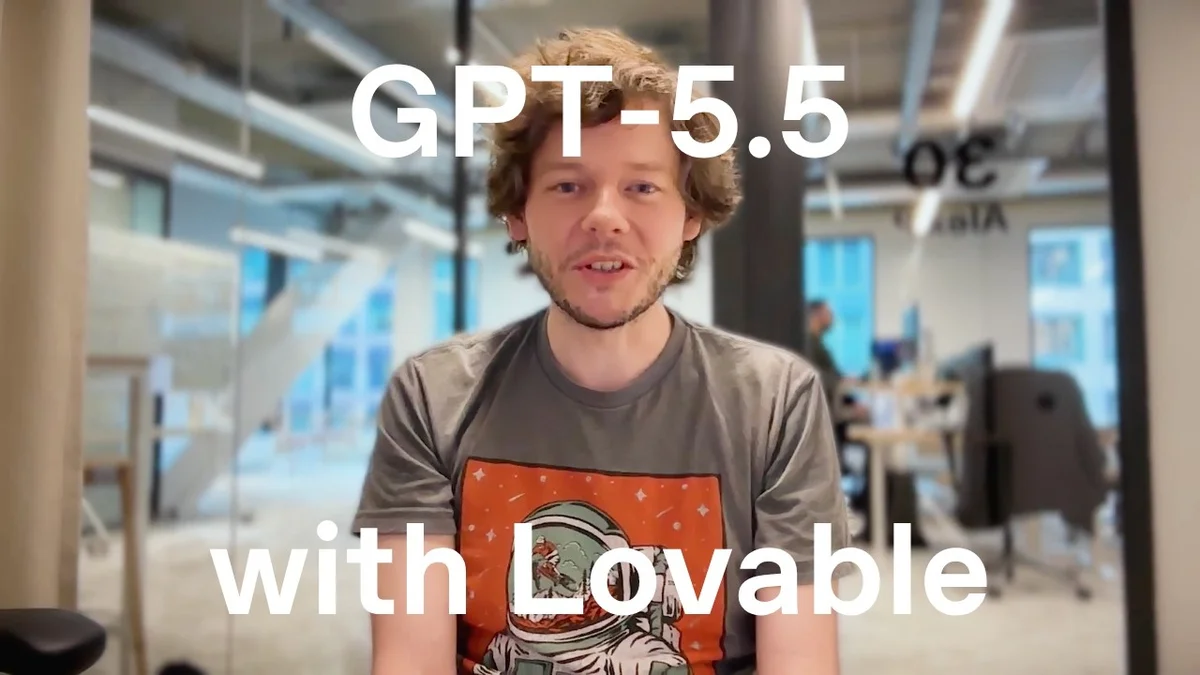
Alexandre Pesant of Lovable speaking about GPT-5.5's planning capabilities.
OpenAI Youtube
Visual TL;DR
Complex Build PlanningDriver
Challenges in planning intricate application builds
From the article 3 mentionsThe core of Lovable's discussion centers on how GPT-5.5 unlocks better planning for complex builds.
Lovable's IntegrationContext
Rigorous internal testing and evaluation of AI models
From the article 8 mentionsThe integration of GPT-5.5 directly supports this mission by empowering users to express complex needs and have the AI generate the necessary plans and code.
GPT-5.5 AdvancementCore
OpenAI's latest model shows substantial capability improvements
From the article 9+ mentionsHe notes that GPT-5.5 represents a substantial advancement in capabilities, particularly in the area of planning for large-scale features.
Improved UnderstandingContext
From the article 2 mentionsPesant highlights how the latest iteration of OpenAI's models has dramatically improved the platform's ability to understand and execute intricate building tasks, reducing the need for user intervention and accelerating project completion.

Reduced Re-promptsEffect
Significantly less user intervention needed for builds
Less AmnesiaEffect
Better context retention during complex planning processes
From the article 4 mentionsPesant further highlights that this improvement leads to a 22% reduction in instances of amnesia, a phenomenon where AI models forget information from earlier parts of a conversation or context.
Faster Project CompletionOutcome
Accelerated development cycles for complex applications
From the articlePesant highlights how the latest iteration of OpenAI's models has dramatically improved the platform's ability to understand and execute intricate building tasks, reducing the need for user intervention and accelerating project completion.
Contents(5)

Alexandre Pesant, a Member of Technical Staff at Lovable, discusses the transformative impact of GPT-5.5 on the development of complex applications. Pesant highlights how the latest iteration of OpenAI's models has dramatically improved the platform's ability to understand and execute intricate building tasks, reducing the need for user intervention and accelerating project completion.

StartupHub data

Companies working on this

Profiles of the companies named in this story, with funding and a one-liner from our database.

OpenAI
Private / $100B+ est
OpenAI is an AI research and deployment company dedicated to ensuring that artificial general intelligence benefits all of humanity.

Pesant shares Lovable's internal testing process, which involves rigorous benchmarks and evaluations for each new model release. He notes that GPT-5.5 represents a substantial advancement in capabilities, particularly in the area of planning for large-scale features. This enhanced planning translates to a more efficient and seamless user experience, allowing users to focus on their core goals rather than the intricacies of AI prompting.

The full discussion can be found on OpenAI Youtube's YouTube channel.

Lovable on How GPT-5.5 Unlocks Better Planning for Complex Builds - OpenAI Youtube
Lovable on How GPT-5.5 Unlocks Better Planning for Complex Builds, from OpenAI Youtube

Improved Planning for Complex Builds

The core of Lovable's discussion centers on how GPT-5.5 unlocks better planning for complex builds. Pesant explains that previous models often required users to break down complex requests into smaller, more manageable prompts. This iterative process could be time-consuming and prone to errors, especially when dealing with multi-faceted projects. With GPT-5.5, Lovable has observed a marked improvement in the model's ability to grasp the entirety of a complex request and devise a coherent plan to achieve it.

Pesant states, "One thing that we see across projects is that GPT-5.5 is a lot better at planning, which means that for large features, our users are much more likely to succeed in one shot rather than having to ask multiple times." This suggests a more intuitive and robust interaction model, where the AI can infer user intent more accurately and generate comprehensive plans without extensive guidance.

Quantitative Improvements with GPT-5.5

Lovable has quantified the benefits of GPT-5.5 through internal testing. Pesant reveals that the company runs a series of benchmarks and internal evaluations on new model releases. He elaborates, "When we saw that there was a pretty big step in capabilities with GPT-5.5, we ran a series of benchmarks and internal evaluations. We call them hard tests on GPT-5.5. When we saw that there was a pretty big step in capabilities, we saw a 31% increase in the planning success rate."

This 31% increase in planning success rate is a significant metric, indicating that GPT-5.5 is substantially more effective at handling complex planning tasks. Pesant further highlights that this improvement leads to a 22% reduction in instances of amnesia, a phenomenon where AI models forget information from earlier parts of a conversation or context. This reduction in amnesia is crucial for maintaining coherence and accuracy in long and complex building sessions.

Reduced Amnesia and Enhanced Context Retention

The issue of AI model amnesia, where the model forgets crucial information or context over time, is a persistent challenge. Pesant explains that this is particularly problematic when users engage in extended sessions to build complex features. He defines amnesia as when models "forget information from their context." The 22% reduction in amnesia observed with GPT-5.5 is a critical improvement, ensuring that the AI maintains a consistent understanding of the project's requirements throughout the building process.

Pesant emphasizes the importance of this improvement: "And that's really important as you go deeper into larger sessions where you're working on complex features." By retaining context more effectively, GPT-5.5 allows users to engage in more intricate and prolonged development cycles without the frustration of the AI losing track of previous instructions or decisions. This leads to a more fluid and productive user experience.

Lovable's Approach to AI Model Integration

Pesant also touches upon Lovable's philosophy regarding user interaction with AI. He states, "The magic of Lovable is that our users don't need to think really about anything besides their goal and let them build whatever they want without them needing to type out the code at all." This vision underscores Lovable's commitment to abstracting away the complexities of AI development, enabling users to focus solely on their creative or functional objectives.

The integration of GPT-5.5 directly supports this mission by empowering users to express complex needs and have the AI generate the necessary plans and code. The platform aims to be a tool that facilitates creation without requiring deep technical expertise in AI prompting or coding, allowing for a broader range of users to build sophisticated applications.

© 2026 StartupHub.ai. All rights reserved. You may not republish this article in full without a license. Search engines and AI research tools may crawl and summarize for reference. Bulk reproduction or model training requires a license. See our terms.
Daniel Singer

Written by

Daniel Singer

Editor, StartupHub.ai

Daniel Singer is the editor of StartupHub.ai, a technology expert and thought leader on AI and its applications across sectors, from fintech and healthcare to developer tooling and consumer software. He writes and tests the tools covered here thoroughly and regularly, and built StartupHub.ai to give founders, operators and buyers a clearer read on what they are actually being sold.

More from Daniel Singer