

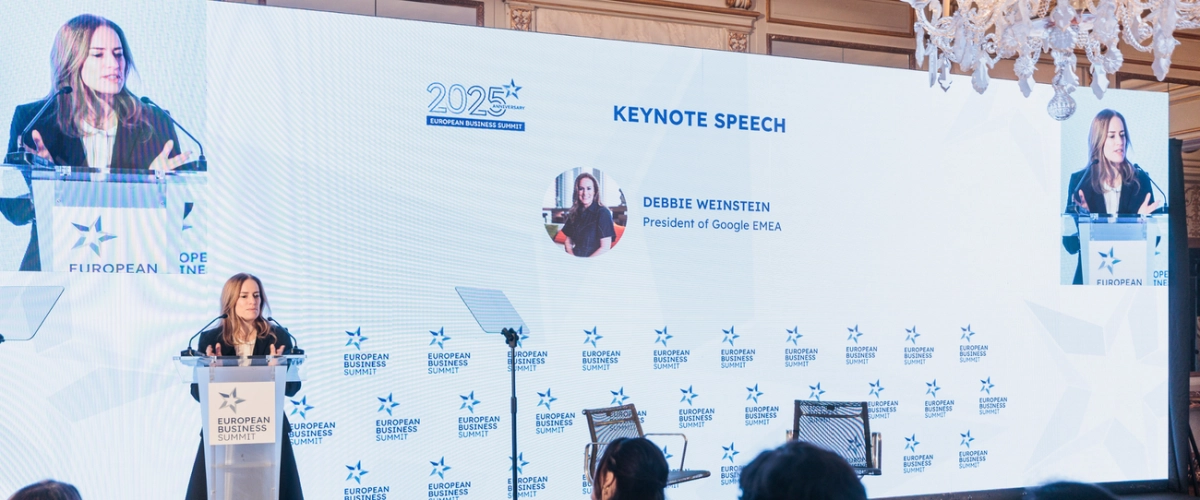
Debbie Weinstein, Google EMEA President, recently delivered her inaugural address at the European Business Summit in Brussels, presenting a stark assessment of Europe's position in the global AI race. According to the announcement, Weinstein underscored the continent's immense potential for AI-driven economic growth while simultaneously highlighting critical barriers impeding its realization. Her remarks serve as a direct challenge to European policymakers and business leaders, urging a strategic re-evaluation to prevent the region from falling further behind.
The economic stakes are undeniably high. Europe stands to gain an estimated 1.2 trillion Euro within a decade from AI adoption, yet current figures reveal a significant lag. Only 14% of European businesses currently leverage AI, a stark contrast to adoption rates in China and the United States. This disparity translates into a competitive disadvantage, as businesses operating on older technological stacks struggle to keep pace with global rivals benefiting from the latest AI advancements.
A primary concern articulated by Weinstein centers on access to cutting-edge technology. She noted that the latest Google AI models are exponentially more powerful than those from just two years prior, creating a chasm for businesses unable to integrate such tools. This technological gap affects critical sectors, from automotive, where advanced AI could prevent accidents, to cybersecurity, where sophisticated AI is essential to counter evolving threats. Paradoxically, some European governments are implementing measures that restrict access to these very advanced technologies, further exacerbating the problem.
Regulatory Hurdles and the Path Forward
Beyond technology access, Europe's regulatory landscape presents a formidable challenge. Since 2019, the EU has introduced over 100 regulations targeting the digital economy, a volume Mario Draghi's report deemed unsustainable. These frequent and often abrupt policy shifts create an unpredictable environment, delaying the launch of advanced AI features from major players like Meta, OpenAI, and Google within the European market. While regulation is necessary, the current approach risks stifling innovation and penalizing businesses striving for global competitiveness.
The third critical pillar for Europe's AI future is the development of a robust, AI-literate workforce. The demand extends beyond data scientists and engineers to include leaders capable of identifying AI opportunities and a general workforce proficient in using these new tools safely and effectively. Google has committed to this through initiatives like the 15 million euro AI Opportunity Fund and a decade of digital skills training for over 15 million Europeans. This long-term investment in skills, coupled with a collaborative partnership approach involving governments and civil society, is essential to build the confidence and capability needed to seize the AI moment.