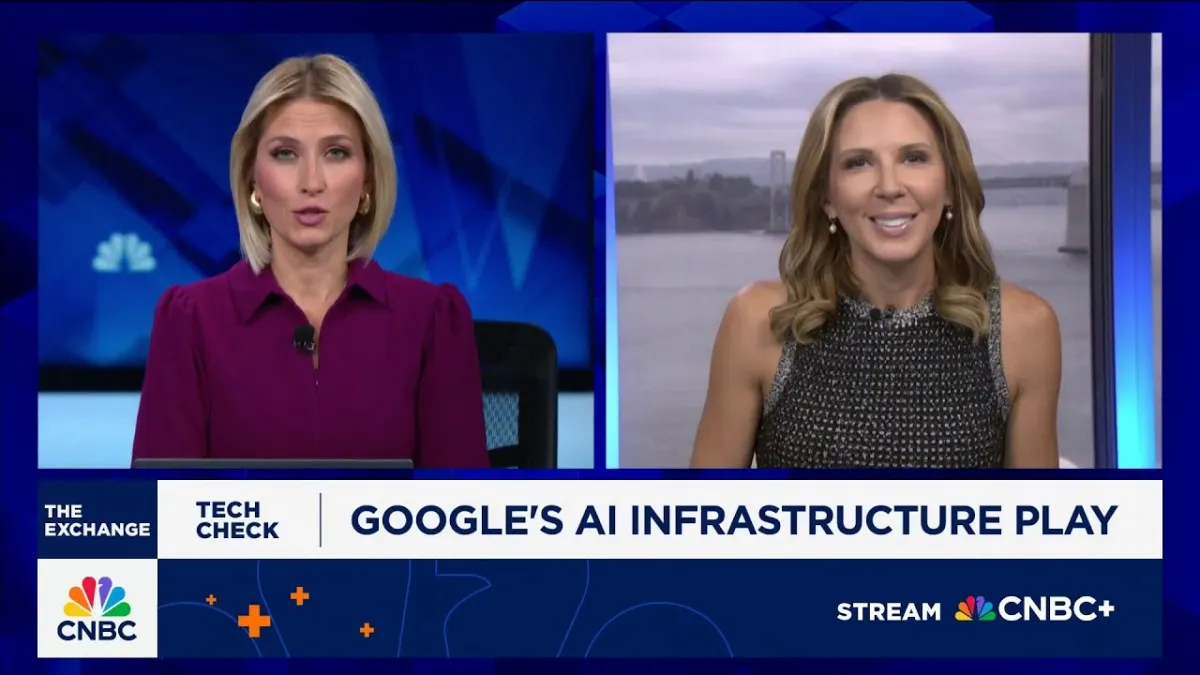
The existential question confronting Google in the age of generative AI is not whether it can innovate, but whether its innovations can outpace the disruptive forces threatening its entrenched empire. This core tension, between the pressure on its legacy businesses and the opportunity for reinvention, formed the crux of a recent CNBC "Power Lunch" segment, where reporter MacKenzie Sigalos spoke with host Morgan Brennan about Google's shifting AI narrative and its impact on the company's stock and strategic direction. While Alphabet's Class A stock has seen a significant jump of over 65% in the last six months, it still trades at a discount compared to its big tech peers, signaling a palpable investor skepticism regarding Google’s ability to lead the next technological wave rather than merely reacting to it.
A critical insight emerging from the discussion is the dual nature of generative AI for Google: both a profound threat to its core revenue streams and a substantial opportunity in cloud infrastructure. Sigalos articulated this succinctly, stating that Tuesday’s headlines "captured both the pressure that Gen AI places on Google’s core business and the opportunity to reinvent it." This dichotomy underscores the complex strategic tightrope Google must walk. On one hand, the rise of AI-native platforms could erode the dominance of its search and advertising engine; on the other, its deep investment in AI infrastructure positions it as a crucial enabler for the very companies challenging it.
One of the most immediate threats to Google's foundational business, as highlighted by Sigalos, is the potential emergence of an "agentic" browser, exemplified by the rumored OpenAI "Atlas" project. This concept suggests a browser deeply integrated with generative AI, capable of performing complex tasks and answering queries directly, bypassing traditional search results and, critically, the advertisements that fund Google's vast operations. Microsoft, despite its partnership with OpenAI, struggled to make Bing a true rival to Google Search. However, an AI-first browser, "already tied to 800 million weekly ChatGPT users," presents a different, more direct challenge to Chrome, which serves as Google's primary gateway to the web and the bedrock of its advertising revenue. The ability of such a browser to "unlock the web" in a new, conversational way could fundamentally alter user behavior and disrupt the established search paradigm.
The financial implications of this competitive pressure are not yet fully visible in Google's earnings reports. Sigalos noted that "pressure from its AI rivals hasn’t shown up in Google earnings yet," but she would be closely watching the next print to see "if there’s any sign that Gemini is cannibalizing its cash cow search business." This observation points to the potential for self-cannibalization as Google integrates its own generative AI, like Gemini, into its products. The company's past behavior, revealed during an antitrust trial, of "quietly rais[ing] cost per click to hit revenue goals," suggests a willingness to manipulate its ad business to maintain financial targets, a tactic that can only work for so long before impacting advertiser satisfaction or competitive positioning.
Related Reading
- OpenAI Livestream Sends Alphabet Shares Tumbling Amidst AI Browser Wars
- Impactive Capital's Lauren Taylor Wolfe Declares AI Market a Bubble Set to Burst
Beyond the consumer-facing search and browser wars, the enterprise segment presents a different battleground: AI infrastructure. Here, Google appears to be on stronger footing. Wells Fargo, in a TMT note, described Anthropic "leaning more towards TPU [Google’s Tensor Processing Units] as a positive for GOOG’s silicon efforts and chip design prowess." This indicates a strategic advantage in developing proprietary hardware optimized for AI workloads, rivaling Nvidia's dominant GPUs. The recent Amazon cloud outage, which took services offline, further underscored the importance of robust, multi-cloud infrastructure, as Anthropic notably "stayed up and running thanks to its multi-cloud setup with Google." This resilience in the face of widespread disruptions highlights Google Cloud's potential as a critical enabler for generative AI companies, positioning Google as a vital infrastructure provider even as it competes on other fronts.