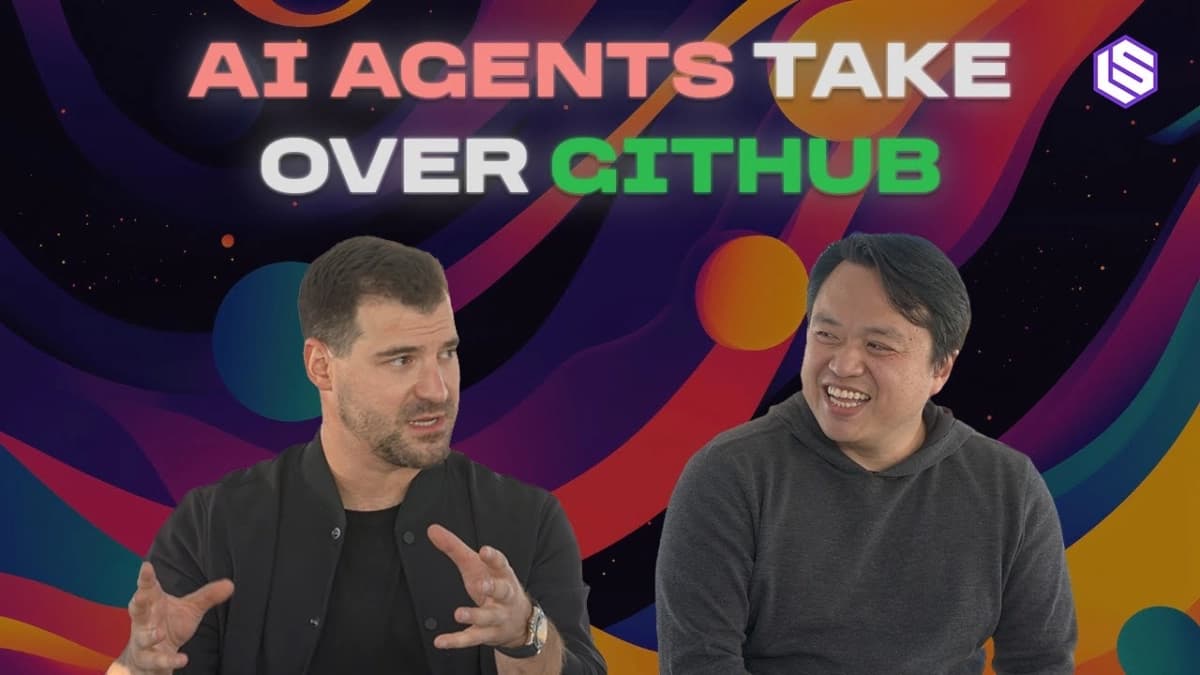
"The scale is immense," Jared Palmer, SVP at GitHub and VP of CoreAI at Microsoft, observed, reflecting on his journey from specialized AI initiatives to leading the charge for a universal coding agent platform. He spoke with Swyx, Editor of Latent Space, at GitHub Universe 2025, detailing the evolution of AI-powered developer tools and the launch of Agent HQ, a new collaboration hub for coding agents and developers. This conversation illuminated the strategic shift from narrow, focused AI solutions to a comprehensive ecosystem designed to integrate AI seamlessly into every facet of the developer workflow.
Palmer’s trajectory in the AI space is a microcosm of the industry’s rapid evolution. His prior role at Vercel saw him spearhead the development of v0, a groundbreaking coding agent focused specifically on Next.js frontend applications, alongside the AI SDK. This initial constraint, he noted, was "rather liberating" for the team, allowing for laser-focused experimentation and rapid iteration within a defined problem space. The success of v0, built with a built-in renderer and a clear objective, demonstrated the immense potential of AI in generating functional code from natural language prompts.
The transition to GitHub, however, represented a significant broadening of scope. Where v0 targeted a specific language and framework, Agent HQ on GitHub is envisioned as the "home of all languages and frameworks and developers." This expanded ambition necessitates a platform that can accommodate diverse coding agents, each potentially specialized for different tasks or programming paradigms. GitHub’s massive developer network, boasting over 80 million users, provides an unparalleled environment for this grand experiment in AI-driven development.
A core insight emerging from Palmer's narrative is the evolving nature of AI-developer interaction. Early iterations of coding agents, like GitHub Copilot, focused primarily on code completion. With the advent of more powerful models, the interaction quickly progressed to conversational interfaces. Palmer recounted the genesis of Vercel's AI Playground, an early exploration into generative UI where users could describe an interface and receive functional code. This experience, he explained, forced a deep dive into the "quirks" and "nuances" of various model providers, highlighting the complexity of building robust AI tools.
The journey revealed a critical shift from mere completions to dynamic, multi-turn interactions. Initially, Vercel’s AI Playground didn't even implement chat, focusing instead on direct completions. "Chat wasn't actually... as important; it was just like completions," Palmer recalled. However, as models advanced, the ability to engage in extended dialogue became paramount, leading to the development of the AI SDK and, eventually, v0. This evolution underscores a key challenge: AI products must not only generate code but also engage with developers in a fluid, intuitive manner that mirrors human collaboration.
The concept of "agent world" is central to GitHub's vision. This isn't just about AI writing code; it's about agents operating within an "A-loop" – an autonomous cycle where they can interpret code, access file systems, make tool calls, and even render generative UI. Palmer highlighted the critical need for seamless integration into the developer's native workflow. Imagine AI that can intelligently resolve merge conflicts, assign issues, or automate complex deployment tasks, all from within the familiar GitHub interface or VS Code. This fluidity, he believes, is the future of developer productivity.
However, achieving this seamlessness is fraught with challenges, particularly concerning the underlying infrastructure and the quality of AI outputs. Palmer candidly discussed the "poor quality" of many AI products, emphasizing the need for rigorous measurement of "error-free sessions" and dropped requests. The reliability and performance of inference providers are not yet as stable as traditional databases, requiring robust routing and fallback mechanisms. This highlights a crucial insight: the advancement of coding agents is as much an infrastructure and quality control problem as it is a model intelligence problem.
Related Reading
- Cursor's Maverick Ascent: AI Editor Disrupts Developer Orthodoxy
- Google Labs' Jules: Autonomy Redefines AI Coding
- OpenAI’s Agent RFT: Boosting Autonomous AI Performance Through Tailored Reinforcement Learning
Furthermore, the conversation touched upon "stack diffs," a concept gaining traction in large organizations like Facebook. This workflow, which involves branching and re-stacking small, atomic changes, offers a more fluid approach to version control than traditional linear pull requests. Integrating such nuanced development practices into AI-powered workflows requires a deep understanding of developer needs and the ability to build flexible, configurable agents. The goal, Palmer asserted, is to enable developers to "stay in a flow state" across all devices and platforms, whether on GitHub.com, mobile, or a local editor.
GitHub's commitment to "model choice" is a strategic differentiator. While Vercel's v0 focused on a single stack, GitHub aims to offer a diverse ecosystem where developers can leverage different models and tools, including custom agents. This approach acknowledges that no single model or agent will be optimal for all tasks. By putting "things that are alike closer together" within the CoreAI organization, Microsoft and GitHub are striving to create a cohesive yet flexible environment for AI development. This includes integrating Visual Studio, VS Code, and Azure services, ensuring that the entire development lifecycle benefits from AI enhancements. The vision is clear: to move beyond mere assistance and empower agents to become integral, seamless partners in the coding process, transforming how software is built.