


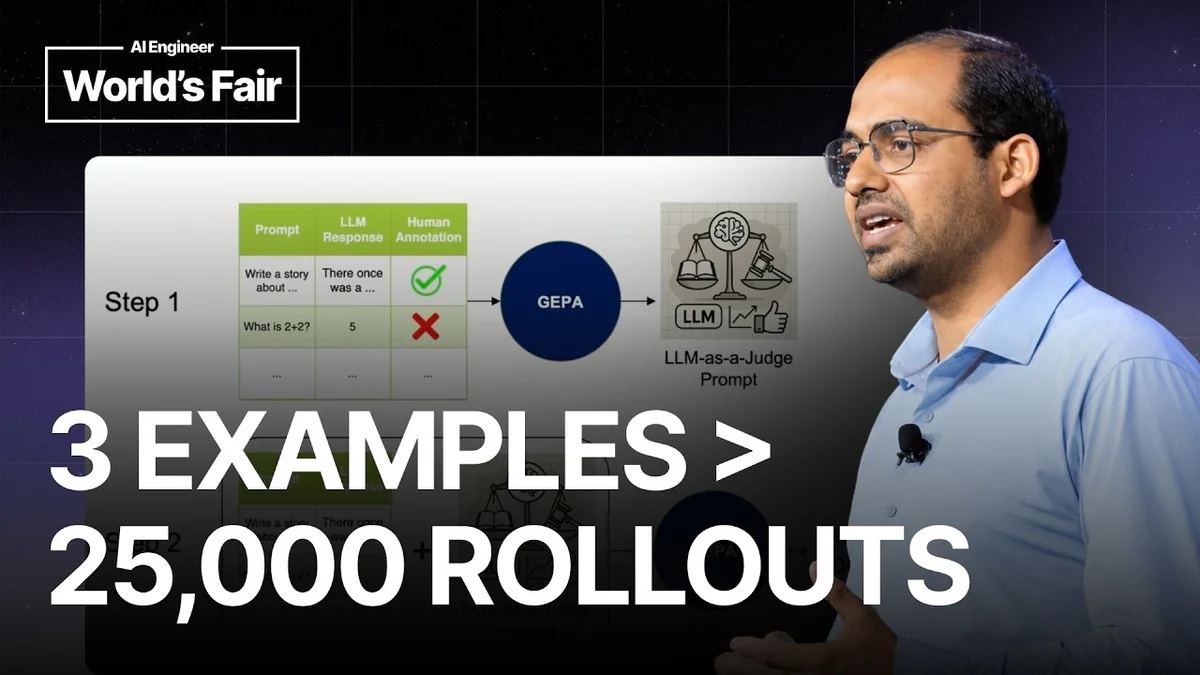
Lakshya A. Agrawal took the stage at AI Engineer to pitch reflection over reinforcement, and he brought receipts. His team’s GEPA optimizes prompts and agents not with rewards alone but by reading the whole trace and rewriting the instruction.
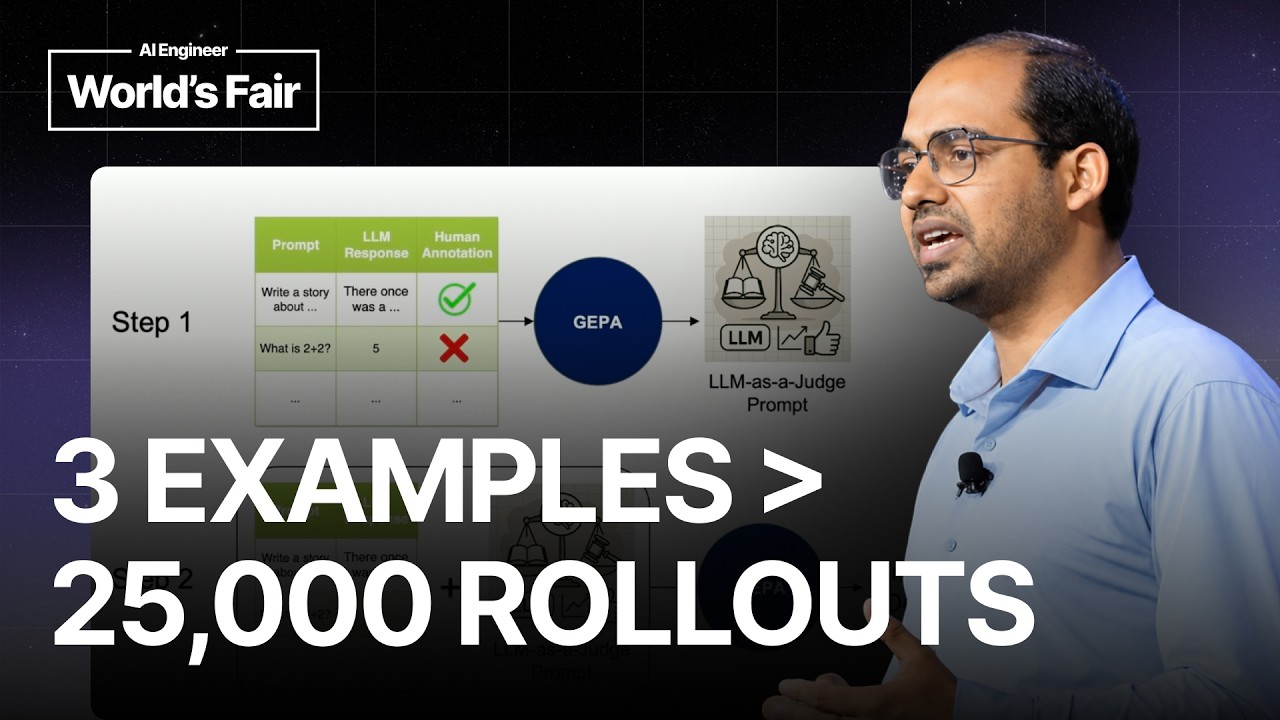
The math is stark.
GEPA hit twice the gain of GRPO using just three examples and one round of reflection, versus 25,000 rollouts for the RL baseline, per the talk. Agrawal, presenting the GEPA effort, showed Qwen 38B optimizing itself with no external teacher, then kept compounding the lead with a few more reflective iterations. The point is sample efficiency, when rollouts take hours and call expensive tools, gradients waste the diagnostic signal sitting in chains of thought and tool errors.
The trick is text. Instead of nudging weights, GEPA nudges language, where changing "generate a one-line summary" to "10-line summary" flips behavior in one edit. It mines a rollout for what worked and what failed, can even pull docs or guides, and proposes a new prompt. Under the hood it is an evolutionary loop with a Pareto pool that keeps every candidate that wins on at least one training example, not just the top scorer.
That Pareto pool matters when a loop would stall. In a head-to-head search tree, the naive LLM-in-a-loop kept polishing the same local optimum until the budget ran out, while GEPA’s diverse pool explored more branches and converged higher. Across four benchmarks the pool accounted for more than half the lift, nearly doubling gains versus looping.