

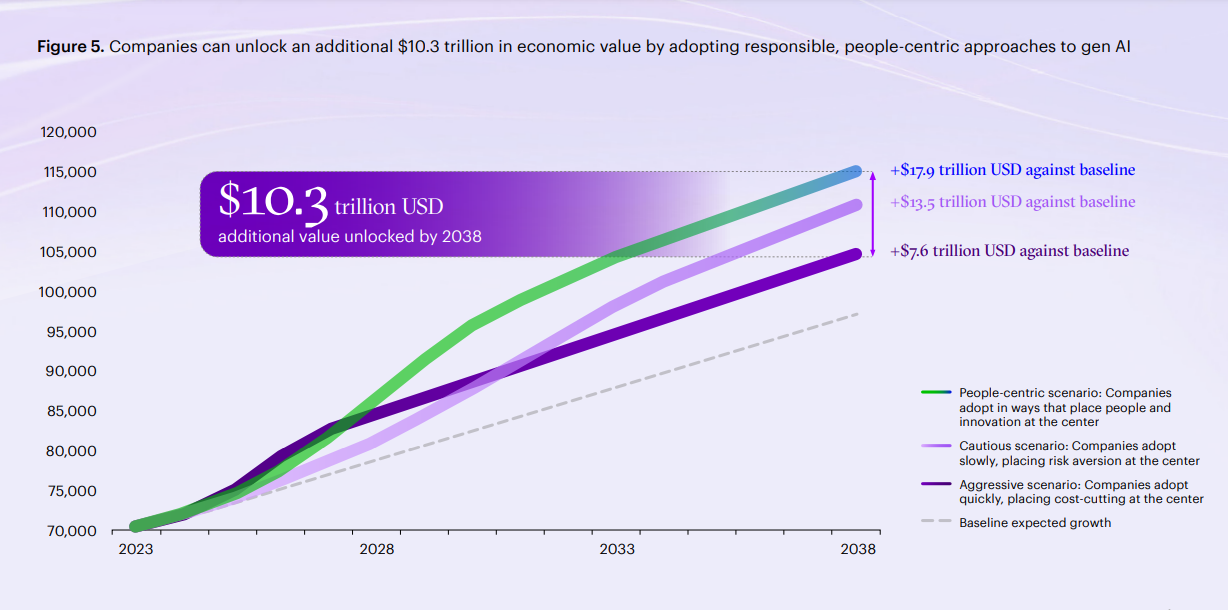
We're clearly at an inflection point in relation to the last decades' worth of technological advancements, and Accenture penned their timely perspective. They released a trove of new insights on the state of technology and Generative AI, sizing the potential economic value at upwards of $8 trillion by 2038, and revealing their predictions for 2024 and beyond.
According to Accenture research, Generative AI has the potential to impact 44% of all working hours across industries in the U.S., enable productivity enhancements across 900 different types of jobs and create $10.3 trillion in global economic value over the next 14 years. The estimation is a simulated GDP growth across 22 countries, where $10.3 trillion in economic value can be created by adopting responsible, people-centric approaches to Generative AI.
95% of workers acknowledge the value of Generative AI, yet only 5% of organizations are actively reskilling their workforce. This gap echoes with Databricks and MIT Technology Insights Review latest survey, where they found 40% of organizations' struggles stem from workforce upskilling and training.
The advent of Generative AI is significantly transforming work processes and productivity. However, it also brings challenges related to job security, privacy, and ethical use.
Predictions in Generative AI, HMI, and Spatial Computing:
Technology Vision 2024 doesn't reveal anything new to those who are mildly familiar with mainstream technologies. Accenture's authors largely labor over contextualizing the most profound advancement we've witnessed in the last few decades; OpenAI's ChatGPT, their underlying Large Language Models (LLMs), and the ensuing revolution. We did, however, find their predictions and timeline of key events leading up to present day, and what we might expect in the future, worth repeating.