


• StartupHub.ai
    StartupHub.aiAI Intelligence
Discover
  • Home
  • Search
  • Trending
  • News
Intelligence
  • Market Analysis
  • Comparison
  • Market Map
Workspace
  • Email Validator
  • Pricing
Company
  • About
  • Editorial
  • Terms
  • Privacy
  • v1.0.0
  1. Home
  2. News
  3. Gemini Vs Chatgpt The Ai War Just Got Brutal
Back to News
Startup news

Gemini vs ChatGPT: The AI War Just Got Brutal

S
StartupHub Team
Oct 12, 2025 at 10:40 PM3 min read
Gemini vs ChatGPT: The AI War Just Got Brutal

The generative AI boom officially has its first real horse race, and it’s turning into a street fight. For the first time since ChatGPT went supernova, new web traffic data reveals a genuine threat to OpenAI’s throne, and it’s coming from Google. According to analytics firm Similarweb, Gemini has not only smashed the 1 billion monthly visit milestone but is growing at a rate that makes ChatGPT look like it’s standing still.

This isn’t just another competitor nipping at the heels of the incumbent. Gemini’s explosive momentum signals a new, more brutal phase in the AI wars, one fought not just on features, but on the brutal economics of scale.

A War Fought With Different Dollars

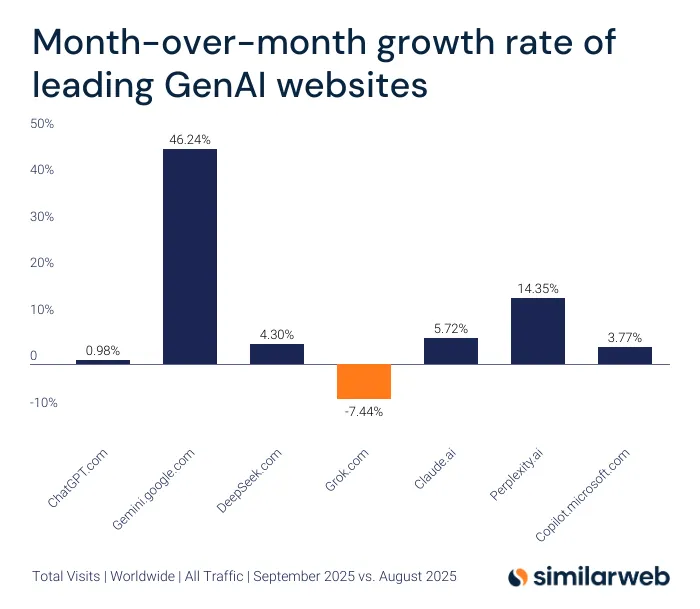
The numbers from September 2025 are staggering. Gemini clocked 1.057 billion visits, a blistering 46.24 percent jump in a single month and its ninth consecutive month of gains. For context, ChatGPT grew by a comparatively microscopic 0.98 percent. This isn’t just Gemini riding an industry wave; it *is* the wave. The data shows this happening while internet titans like YouTube and Facebook are actually shrinking, making Gemini’s growth a world-breaking anomaly.

This surge has visibly eroded OpenAI’s market dominance. Twelve months ago, ChatGPT was a near-monopolist with 87.1 percent of generative AI traffic. Today, that’s down to 73.8 percent. The primary beneficiary? Gemini, which has more than doubled its share from 6.5 to 13.7 percent.

But there’s a crucial twist: the loyalty paradox. While Google is winning the battle for new eyeballs, OpenAI is still winning the war for user habits. A stunning 82.2 percent of ChatGPT’s audience uses it exclusively, a testament to a deeply entrenched user base. Gemini’s audience is far more promiscuous, with only 49.1 percent exclusivity. Google is getting people in the door, but OpenAI has them locked in.

So why does Gemini’s growth matter so much? Because it’s a direct assault on the financial model propping up the entire OpenAI ecosystem. The alliance between OpenAI, Microsoft, and hardware suppliers like Nvidia is an incredibly expensive one. It’s a complex web of multi-billion dollar deals where everyone pays the “Nvidia tax” and margins are stacked at every step. This high-cost structure only works if you have overwhelming market dominance.

Gemini is a threat because it’s built on a different, more efficient economic engine. Google’s vertical integration—designing its own TPU chips, servers, and data centers—is a self-reliant fortress that doesn’t pay a toll to an external kingmaker.

Every user who chooses Gemini is one being served by a more cost-efficient machine. This forces the OpenAI/Microsoft alliance into a war of attrition against a competitor with a fundamentally lower cost of doing business. The AI war is no longer just about who has the smartest model. It’s about whose economic engine is built to last. Gemini’s traffic explosion is the first real sign that Google’s long-term bet on self-reliance is starting to pay off, putting its rivals under unprecedented pressure.

#AI Infrastructure
#Competition
#Generative AI
#Google
#LLM
#Market Analysis
#Microsoft
#OpenAI

AI Daily Digest

Get the most important AI news daily.

GoogleSequoiaOpenAIa16z
+40k readers