

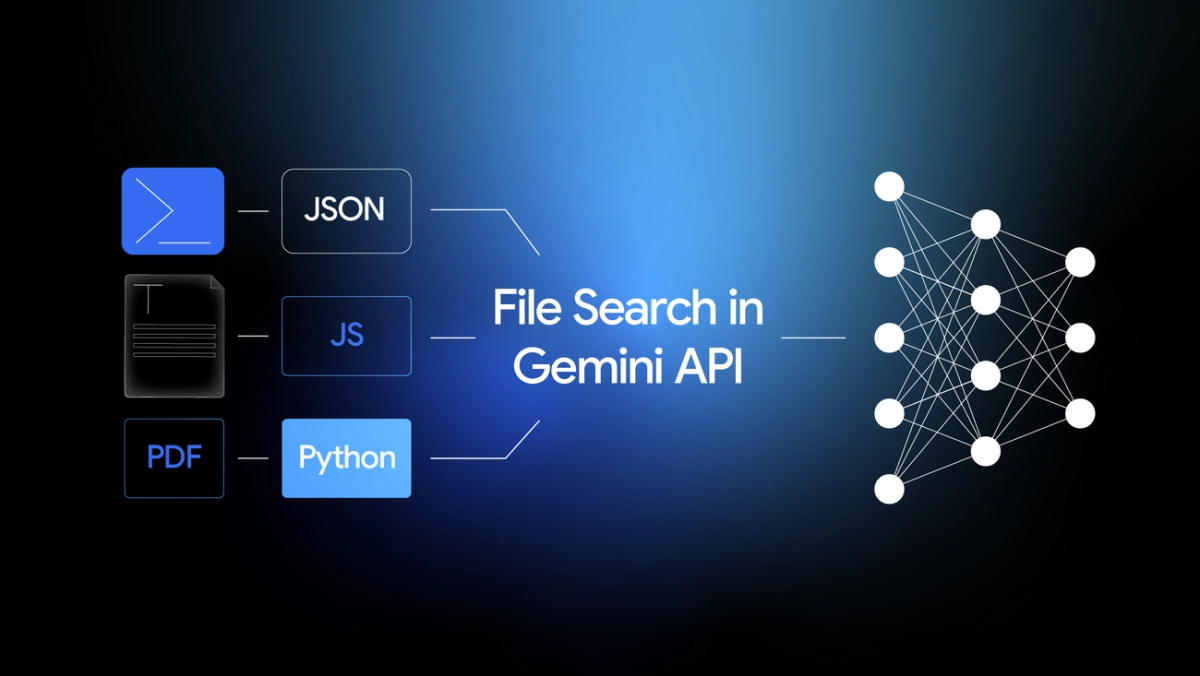
Google DeepMind has unveiled the Gemini API File Search, a fully managed Retrieval Augmented Generation (RAG) system integrated directly into the Gemini API. This new tool abstracts away the complex retrieval pipeline, allowing developers to focus on application logic rather than infrastructure. It promises a simpler, more scalable approach to grounding Gemini models with proprietary data, enhancing response accuracy and verifiability.
The File Search Tool significantly streamlines the RAG development workflow. It automatically handles file storage, implements optimal chunking strategies, generates embeddings, and dynamically injects retrieved context into prompts. This integrated experience, operating within the existing generateContent API, offers a compelling alternative to resource-intensive self-managed RAG setups.
Rethinking RAG Economics
Perhaps the most impactful aspect is the revised billing model. According to the announcement, storage and embedding generation at query time are now free. Developers only incur costs for initial file indexing, priced at a fixed rate of $0.15 per 1 million tokens using the gemini-embedding-001 model. This paradigm shift dramatically lowers the barrier to entry and ongoing operational costs for sophisticated RAG implementations.
Underpinning File Search is Google's state-of-the-art Gemini Embedding model, enabling powerful vector search that comprehends query meaning beyond exact keywords. The system also automatically generates citations, linking model responses directly to source documents for enhanced transparency and trust. Its broad support for file formats, from PDFs to programming language files, ensures comprehensive knowledge base creation.
The implications for enterprise AI adoption are substantial. By democratizing access to advanced RAG capabilities and simplifying its deployment, Gemini API File Search empowers a wider range of developers to build intelligent support bots, internal knowledge assistants, and sophisticated content platforms without deep MLOps expertise. This move could accelerate the integration of grounded AI across industries, making verifiable, context-aware AI a standard.