

Fixing AI Bugs: Humanity's Last Big Problem?

Ben Hylak, CTO of Raindrop, discusses the critical challenge of fixing AI agent bugs, calling it "Humanity's Last Big Problem to Solve" and highlighting Raindrop's approach to creating self-healing AI.

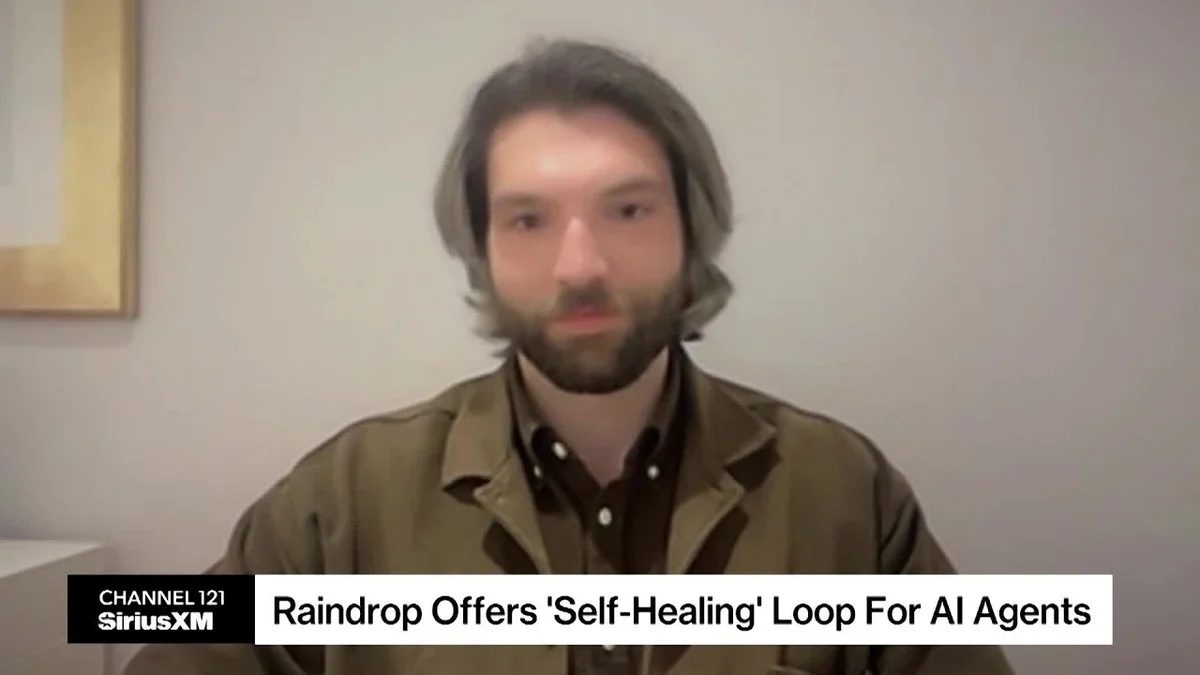
Ben Hylak, Co-Founder and CTO of Raindrop, speaking on a video call.
Bloomberg Podcast
Visual TL;DR
AI Agent FailuresDriver
AI agents get stuck in retry loops, failing tasks repeatedly
From the article 9+ mentionsHylak explained that AI agents, particularly those powered by large language models (LLMs), often exhibit complex failure patterns.
High-Stakes SectorsDriver
From the articleBen Hylak, Co-Founder and CTO of Raindrop, recently discussed the critical challenge of fixing bugs in AI agents, calling it "Humanity's Last Big Problem to Solve." Speaking on a broadcast, Hylak highlighted the increasing deployment of AI agents in high-stakes sectors such as medicine, finance, and defense, where errors can have severe consequences.
Raindrop's ApproachCore
Focus on creating self-healing AI agents for reliability
From the article 2 mentionsRaindrop is developing a platform designed to address this challenge by creating a "self-healing" loop for AI agents.
Complex Failure PatternsContext
LLM-powered agents exhibit intricate and hard-to-predict failure modes
From the articleHylak explained that AI agents, particularly those powered by large language models (LLMs), often exhibit complex failure patterns.
Deprecated ConfigurationsContext
Example of an agent failing due to outdated build syntax
From the article 3 mentionsHe cited an example where an agent using a deprecated configuration syntax repeatedly failed to build projects, despite multiple attempts to correct itself.
AI Reliability GoalContext
From the article 2 mentionsHe noted that while AI has made strides in capability, ensuring its reliability and safety in real-world applications remains a formidable task.
Future of DebuggingOutcome
AI debugging is humanity's last big problem to solve
From the article 2 mentionsThe conversation underscored the ongoing shift in how software development and debugging are approached in the age of AI.
Contents(3)

Ben Hylak, Co-Founder and CTO of Raindrop, recently discussed the critical challenge of fixing bugs in AI agents, calling it "Humanity's Last Big Problem to Solve." Speaking on a broadcast, Hylak highlighted the increasing deployment of AI agents in high-stakes sectors such as medicine, finance, and defense, where errors can have severe consequences. He noted that while AI has made strides in capability, ensuring its reliability and safety in real-world applications remains a formidable task.

The Problem of AI Agent Failures

Hylak explained that AI agents, particularly those powered by large language models (LLMs), often exhibit complex failure patterns. These agents can get stuck in retry loops, repeatedly attempting the same task with incorrect configurations or inputs, leading to build failures or other undesirable outcomes. He cited an example where an agent using a deprecated configuration syntax repeatedly failed to build projects, despite multiple attempts to correct itself.

The core issue, Hylak elaborated, lies in the difficulty of establishing objective metrics for AI performance. Unlike traditional software, where bugs can often be traced to specific lines of code and fixed with clear, quantifiable solutions, AI errors can be more nuanced and context-dependent. This ambiguity makes it challenging to train AI systems to autonomously identify and rectify their own mistakes.

The full discussion can be found on Bloomberg Podcast's YouTube channel.

Fixing AI Bugs 'Humanity's Last Big Problem to Solve,' Says Ben Hylak - Bloomberg Podcast
Fixing AI Bugs 'Humanity's Last Big Problem to Solve,' Says Ben Hylak, from Bloomberg Podcast

"The problem is that there are often no objective answers," Hylak stated. "It's like trying to tell an AI agent that its output is wrong without a clear definition of what 'right' looks like." This lack of objective ground truth makes it difficult for AI systems to learn from their errors and improve their performance autonomously.

Raindrop's Approach to AI Reliability

Raindrop is developing a platform designed to address this challenge by creating a "self-healing" loop for AI agents. This involves providing agents with the tools and context needed to monitor their own performance, identify deviations from expected behavior, and implement corrective actions. Hylak emphasized the importance of giving AI agents access to a wide range of tools and information, including their own execution logs and development environments.

"We want to give AI agents visibility into everything," Hylak explained. "They need to be able to see their own code, their own logs, and have the ability to make changes to their own prompts or configurations." This level of introspection, he believes, is crucial for enabling AI agents to become more robust and reliable.

Hylak also touched upon the need for companies to understand the return on investment for AI deployments. "Companies are spending tens of thousands, even hundreds of thousands of dollars per employee per month on AI agent usage," he noted. "They need to see that this investment is translating into tangible benefits and that the agents are performing reliably and safely."

The Future of AI Debugging

The conversation underscored the ongoing shift in how software development and debugging are approached in the age of AI. Instead of relying solely on human developers to identify and fix bugs, the future may see AI agents taking a more active role in their own maintenance and improvement. This requires developing sophisticated AI systems that can not only perform tasks but also understand their own limitations and learn from their mistakes.

Hylak's insights suggest that the ability to "fix AI bugs" is not just a technical challenge but a fundamental requirement for the widespread and safe adoption of AI across various industries. As AI agents become more integrated into critical systems, ensuring their reliability through self-correction mechanisms will be paramount.

© 2026 StartupHub.ai. All rights reserved. You may not republish this article in full without a license. Search engines and AI research tools may crawl and summarize for reference. Bulk reproduction or model training requires a license. See our terms.
Daniel Singer

Written by

Daniel Singer

Editor, StartupHub.ai

Daniel Singer is the editor of StartupHub.ai, a technology expert and thought leader on AI and its applications across sectors, from fintech and healthcare to developer tooling and consumer software. He writes and tests the tools covered here thoroughly and regularly, and built StartupHub.ai to give founders, operators and buyers a clearer read on what they are actually being sold.