Lovable's AI Self-Improvement: A Deep Dive

Benjamin Verbeek of Lovable explains how their AI agents continuously learn and improve, using a 'vent tool' to report issues for rapid developer feedback and resolution.

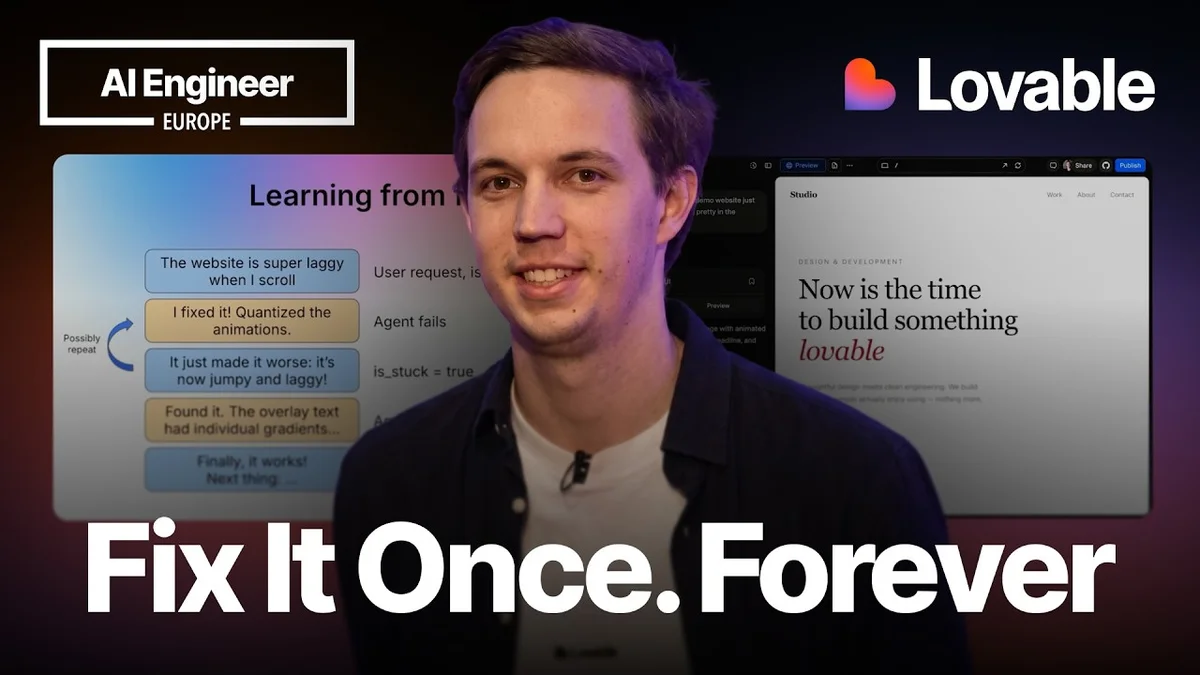
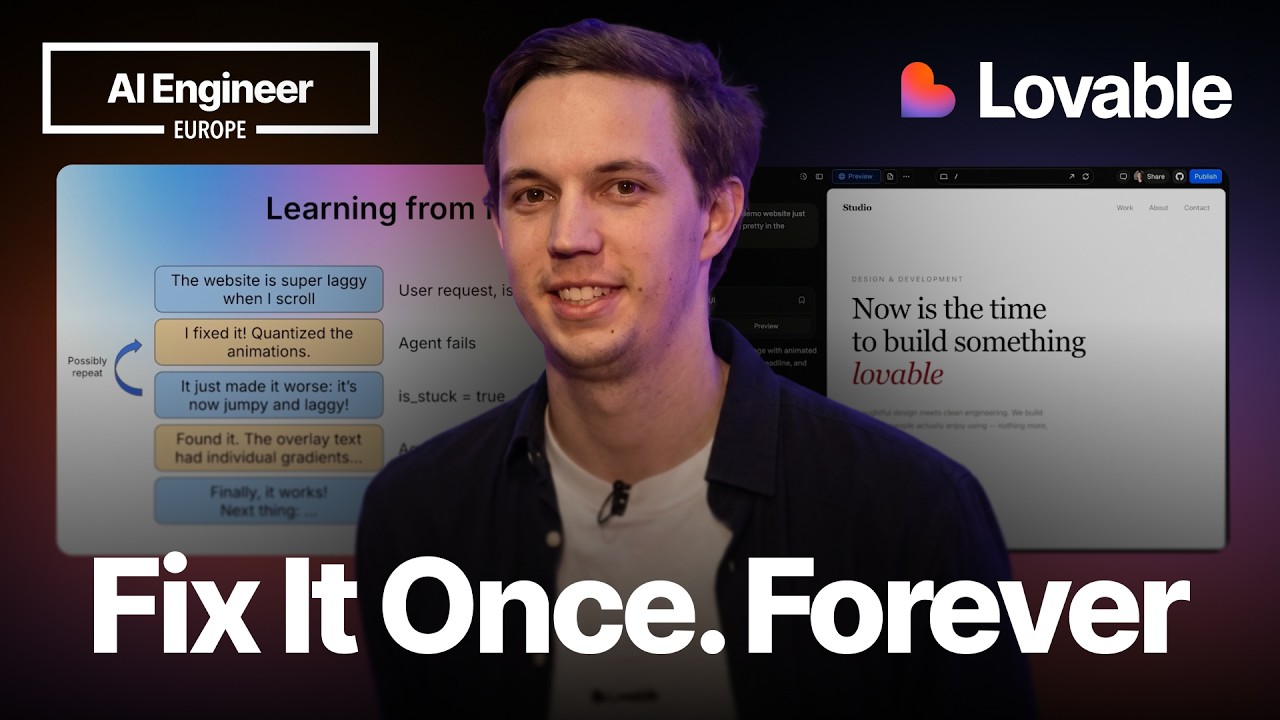
Benjamin Verbeek presenting on how Lovable AI self-improves at AI Engineer Europe.
Benjamin Verbeek, Lovable, discusses continuous learning in AI.· AI Engineer
Visual TL;DR
Verbeek's Physics BackgroundDriver
foundation in complex scientific and engineering challenges informs AI approach
From the articleVerbeek began by outlining his diverse background, which includes work with satellites, particle physics, and fusion reactors.
Lovable's AI MissionContext
achieve continuous learning at scale, the holy grail of AI
From the article 9+ mentionsLovable's commitment to continuous learning and user feedback is central to its mission.
Continuous Learning PlatformCore
software for the 99% who cannot code, democratizing creation
From the article 2 mentionsHe noted that the company's core mission is to achieve "continuous learning at scale," which he considers the "holy grail" of AI development.
Learning from MistakesEffect
From the article 5 mentionsVerbeek explained that the platform is designed to learn from mistakes and adapt over time, preventing the same errors from recurring.
Identifying Stuck StatesContext
mechanisms to detect when AI agents are not improving
From the articleTo tackle user frustration, Lovable has implemented a system for identifying when an agent is "stuck." This includes recognizing when a user asks for the same thing multiple times, complains about implementation failures, or abandons a session prematurely.
The 'Vent Tool'Core
AI reports issues for rapid developer feedback and resolution
From the article 4 mentionsThe team has developed a "vent tool" that allows agents to send feedback directly to creators via Slack.
Data-Driven ImprovementContext
internal metrics guide ongoing enhancement of AI agents
From the article 2 mentionsThis feedback is crucial for continuous improvement.
Future Self-Improving AIOutcome
ongoing development towards more autonomous and capable AI
Contents(6)

Benjamin Verbeek, a technical staff member at Lovable, recently shared insights into how the company's AI agents continuously improve themselves. The presentation, titled "How Lovable Self-Improves Every Hour," detailed the mechanisms and philosophy behind this ongoing enhancement process.

Lovable's AI Self-Improvement: A Deep Dive - AI Engineer
Lovable's AI Self-Improvement: A Deep Dive, from AI Engineer

From Physics to AI: Verbeek's Background

Verbeek began by outlining his diverse background, which includes work with satellites, particle physics, and fusion reactors. This foundation in complex scientific and engineering challenges has informed his approach to AI development at Lovable. He noted that the company's core mission is to achieve "continuous learning at scale," which he considers the "holy grail" of AI development.

The Lovable Approach to Continuous Learning

Lovable is building software for the 99% who cannot code, aiming to democratize software creation. Verbeek explained that the platform is designed to learn from mistakes and adapt over time, preventing the same errors from recurring. He highlighted a key challenge: ensuring that users, even those without technical expertise, can successfully create software without getting stuck.

The presentation contrasted the journey of a "technical persona" versus a "non-technical persona" when encountering difficulties. Technical users are more likely to persevere through issues, troubleshoot problems, and find solutions. Non-technical users, however, often give up when faced with similar challenges, leading to frustration and abandonment of the task. Lovable's goal is to minimize these "stuck" moments for all users.

Identifying and Addressing "Stuck" States

To tackle user frustration, Lovable has implemented a system for identifying when an agent is "stuck." This includes recognizing when a user asks for the same thing multiple times, complains about implementation failures, or abandons a session prematurely. The team categorizes these "stuck" scenarios into two types: those that are solvable with current tools and right prompting, and those that are fundamentally difficult or impossible to solve with existing technology.

For the first category, "stuck but possible to solve," Lovable aims to provide immediate solutions. This is achieved through a process that involves learning from failures. When an agent encounters an issue, such as a website being "super laggy" or an image failing to copy due to filename spaces, the agent can report this. The team has developed a "vent tool" that allows agents to send feedback directly to creators via Slack.

The "Vent Tool" and Feedback Loop

The "vent tool" allows agents to report specific issues, like missing or unsuitable tools, unclear parameters, confusing documentation, or broken platform behavior. This feedback is crucial for continuous improvement. The process involves an external reviewer, often an agent itself, that investigates these reports, de-duplicates them, and creates a pull request (PR) to fix the identified problem.

Verbeek shared examples of such feedback, including an agent that complained about the difficulty of handling filenames with spaces, which prevented it from copying images. The agent's feedback led to a code change that replaced spaces with underscores, resolving the issue. This iterative process of detection, review, and merging fixes is fundamental to Lovable's self-improvement loop.

Data-Driven Improvement and Internal Metrics

Lovable also tracks internal metrics, such as the number of "vent tool" calls over time. Spikes in these calls often correlate with specific issues or bugs. By analyzing this data, the team can identify areas that require immediate attention and prioritize improvements. They also maintain an internal "LSO known problems and solutions" database, which is continuously updated to reflect new issues and their resolutions.

The company's approach emphasizes learning from what does not work to build a more robust and efficient system. Verbeek highlighted that the goal is to create a feedback loop where agents can not only identify problems but also suggest solutions, thereby accelerating the self-improvement process.

The Future of Self-Improving AI

Lovable's commitment to continuous learning and user feedback is central to its mission. By enabling agents to report and help resolve issues, the company is fostering an environment where AI systems can adapt and improve autonomously. This approach ensures that the platform remains effective and "lovable" for its users, ultimately empowering a wider audience to create software.

The presentation concluded by emphasizing the importance of this continuous loop: detecting shortcomings, reviewing and evaluating them, and then merging fixes to create a better product. This iterative process is key to Lovable's vision of building and improving AI at scale.

© 2026 StartupHub.ai. All rights reserved. You may not republish this article in full without a license. Search engines and AI research tools may crawl and summarize for reference. Bulk reproduction or model training requires a license. See our terms.
Daniel Singer

Written by

Daniel Singer

Editor, StartupHub.ai

Daniel Singer is the editor of StartupHub.ai, a technology expert and thought leader on AI and its applications across sectors, from fintech and healthcare to developer tooling and consumer software. He writes and tests the tools covered here thoroughly and regularly, and built StartupHub.ai to give founders, operators and buyers a clearer read on what they are actually being sold.

More from Daniel Singer