The silent, sprawling landscapes of North America are rapidly being reshaped by an infrastructure boom rivaling the largest projects in human history. This is the central, stark revelation from Epoch AI's recent webinar, where Yafah Edelman, Head of Data and Trends, and Ben Cottier, a researcher at Epoch AI, introduced their groundbreaking Frontier Data Centers hub. Moderated by Maria de la Lama, the webinar showcased how Epoch AI is leveraging satellite imagery and open data to meticulously track the construction, power, compute, and cost of the world's most formidable AI data centers, offering unprecedented transparency into the physical backbone of the artificial intelligence revolution.
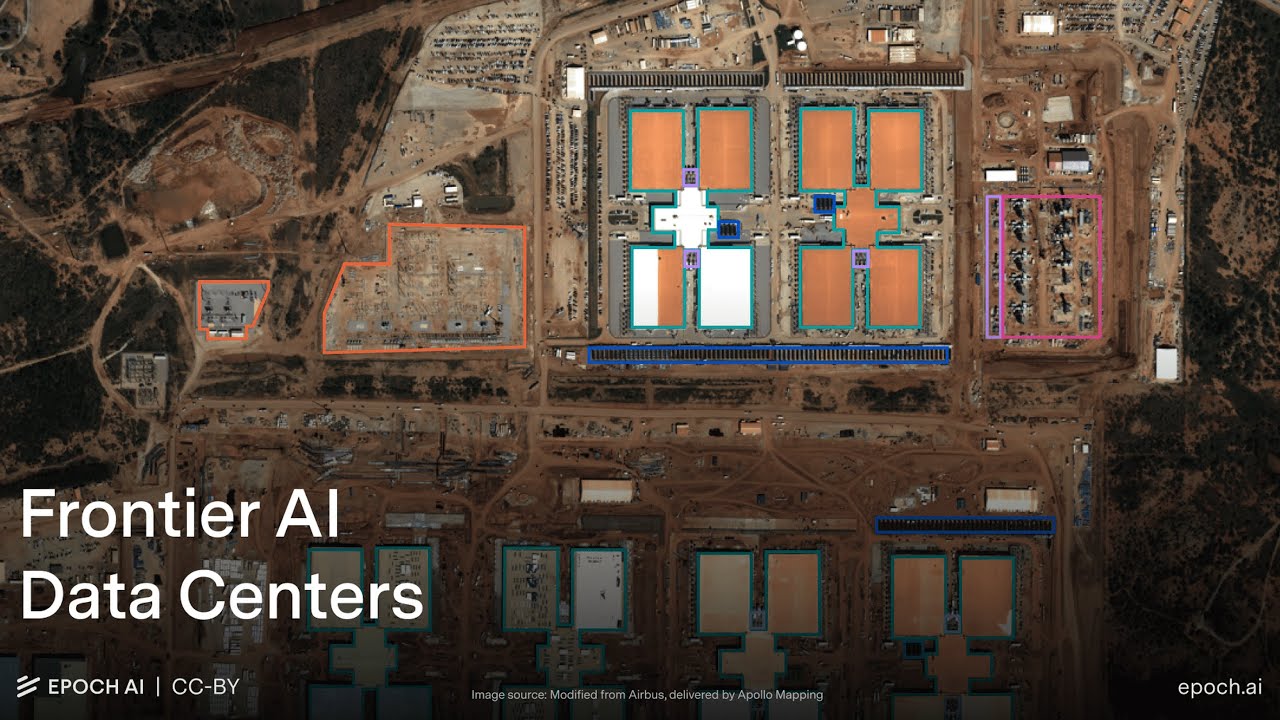
AI companies are investing at an astonishing scale, erecting facilities that dwarf conventional data centers and demand gargantuan energy supplies. As Yafah Edelman underscored, "AI companies are planning a build-out of data centers that will rank among the largest infrastructure projects in history... the largest we're tracking right now, we expect to cost $100 billion when it comes online in 2028." This level of investment, often reaching tens of billions of dollars per site, signifies a profound shift in the global technological and economic landscape. Understanding these colossal developments is not merely an exercise in data collection; it is fundamental to grasping the distribution of compute power among leading companies and nations, and by extension, the very trajectory of AI development itself.
Epoch AI's commitment to transparency is a cornerstone of their Frontier Data Centers hub. Unlike proprietary databases, Epoch AI offers its extensive dataset and methodologies freely to the public. As Edelman stated, "Our database is entirely free and open... we're committed to transparency. We also share our methodology in even more detail on our website." This open-source approach empowers a broader audience, from founders and VCs to defense analysts and tech insiders, to scrutinize and utilize the data, fostering a more informed discourse around AI's physical footprint and its societal implications.
The methodology behind Epoch AI's insights is a sophisticated blend of publicly available information and advanced geospatial analysis. Ben Cottier demonstrated the hub's interactive satellite explorer, revealing high-resolution images of various data center sites across the US. Each site is meticulously annotated, highlighting buildings, grid power connections, backup power systems, and crucial cooling equipment. By analyzing visual cues like the size and number of cooling towers, Epoch AI can extrapolate vital metrics. "We developed a model where we can take some visual feature like the diameter of these fans [cooling towers] and actually predict quite accurately how much cooling capacity, how much heat is being taken out of the building," Cottier explained, showcasing the ingenuity in deriving quantitative data from qualitative satellite imagery. This capacity data, combined with information from public permits and environmental reports, allows Epoch AI to estimate the operational compute capacity and even capital expenditure for each data center.
The timeline feature within the hub vividly illustrates the rapid pace of construction. Gigawatt-scale data centers, once thought to be multi-year endeavors, are now being built in two years or less. This accelerated development is driven by the insatiable demand for AI compute. Looking ahead, Epoch AI projects that the largest AI data centers in 2028 will be 3.5 times larger than those in 2026, signaling an exponential growth curve that continues unabated.