

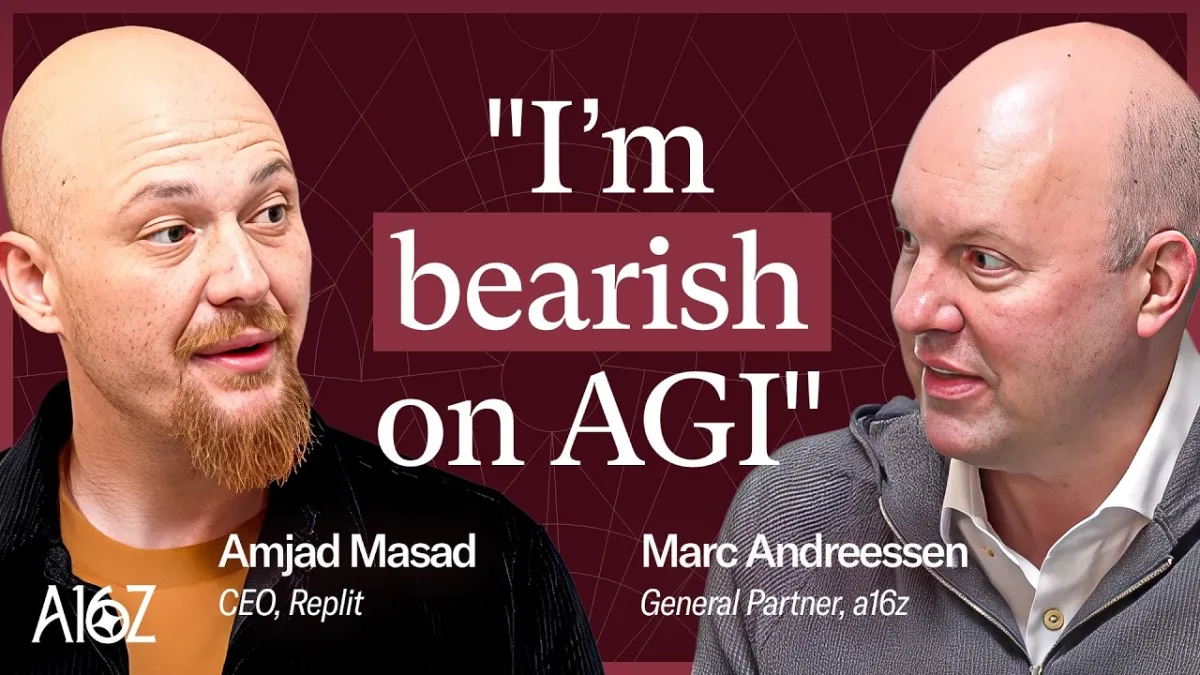
"This is the most amazing technology ever, and it's moving really fast, and yet we're still really disappointed," Marc Andreessen quipped, encapsulating the paradoxical sentiment surrounding AI's rapid ascent. This observation set the stage for a fascinating discussion on the a16z podcast, where Replit founder and CEO Amjad Masad, alongside Andreessen and Erik Torenberg, delved into the transformative potential of AI agents in programming. Their conversation illuminated a future where the barriers to software creation are dramatically lowered, fundamentally reshaping how ideas become reality.
Masad articulated Replit's core vision: to abstract away the "accidental complexity" that has historically plagued software development. For a novice programmer, or even someone with limited coding experience, Replit aims to eliminate the daunting setup of development environments and the intricacies of various tech stacks. Instead, the user simply articulates their idea in natural language – perhaps, "I want to sell crepes online" – and Replit's AI agent intelligently selects the optimal programming language and framework. This paradigm shift empowers individuals to focus purely on their innovative concepts, rather than the underlying technical hurdles.
The AI agent, in this new model, effectively becomes the programmer. Masad detailed a workflow where the user's natural language prompt is translated into an actionable plan. The agent then generates a list of tasks, such as "set up a database," "do migrations," "build the site," and "test it." The agent proceeds to execute these tasks, often in minutes, with a speed and efficiency that Andreessen likened to "watching John Carmack on cocaine work." This hyper-productive entity then presents a deployable application, ready for testing and iteration based on user feedback.
Behind this seamless experience are significant technical breakthroughs, particularly in "long-horizon reasoning" and "verification loops." Masad explained that early AI agents struggled to maintain coherence beyond a few minutes, often "spinning out" into irrelevant tangents. However, recent advancements, especially in Reinforcement Learning (RL) from code execution, have dramatically extended this capability. By treating the agent's internal thought processes and actions as "trajectories" that can be evaluated and refined, the AI learns to self-correct and pursue complex, multi-step goals. The "verification loop" further enhances this by allowing the agent to test its own code, ensuring functionality and iterating until the problem is solved. This ability to reason and self-correct over extended periods, now reaching 200 minutes or more in some cases, is a game-changer.
This evolution draws fascinating parallels to the history of programming itself. Masad referenced Grace Hopper's pioneering vision of programming in English, a concept that seemed radical when computing relied on machine code. The progression from machine code to higher-level languages like C, and then to even more abstracted languages like Python and JavaScript, has always been about democratizing access to computing power. "Ultimately, English is the programming language," Masad asserted, positioning the current AI-driven shift as the next logical step in this historical trajectory, moving beyond syntax to direct thought-to-code translation.
Related Reading
- ChatGPT Atlas Redefines Web Browsing with AI Integration
- Build AI Apps for free in Google AI Studio!
- AI Agents: From Prediction to Autonomous Action
The rapid progress in AI's coding capabilities is not accidental; it is fundamentally tied to the verifiable nature of software development. As Masad explained, domains like mathematics, physics, and code offer clear "true/false" answers. If code compiles and passes tests, its correctness is largely verifiable. This contrasts sharply with "squishy" domains like law, healthcare, or creative writing, where outcomes are often subjective and harder to definitively prove correct. Consequently, AI's advancement in these verifiable fields is accelerating at an unprecedented pace, with the "length of tasks AI can do doubling every seven months," according to Metr.org.
This progress, however, sparks critical questions about the path to Artificial General Intelligence (AGI). While AI agents are becoming incredibly powerful at definable tasks, their ability to generalize across vastly different domains, a hallmark of human intelligence, remains a challenge. Masad noted that significant "transfer learning" across domains (e.g., from physics to politics) is not yet evident in AI. In this new landscape, the human role evolves from the meticulous coder to the visionary idea-generator and discerning overseer. The AI agent becomes the primary programmer, wielding a suite of tools to execute tasks, thereby democratizing software creation and enabling a broader spectrum of individuals to bring their ideas to fruition.

