

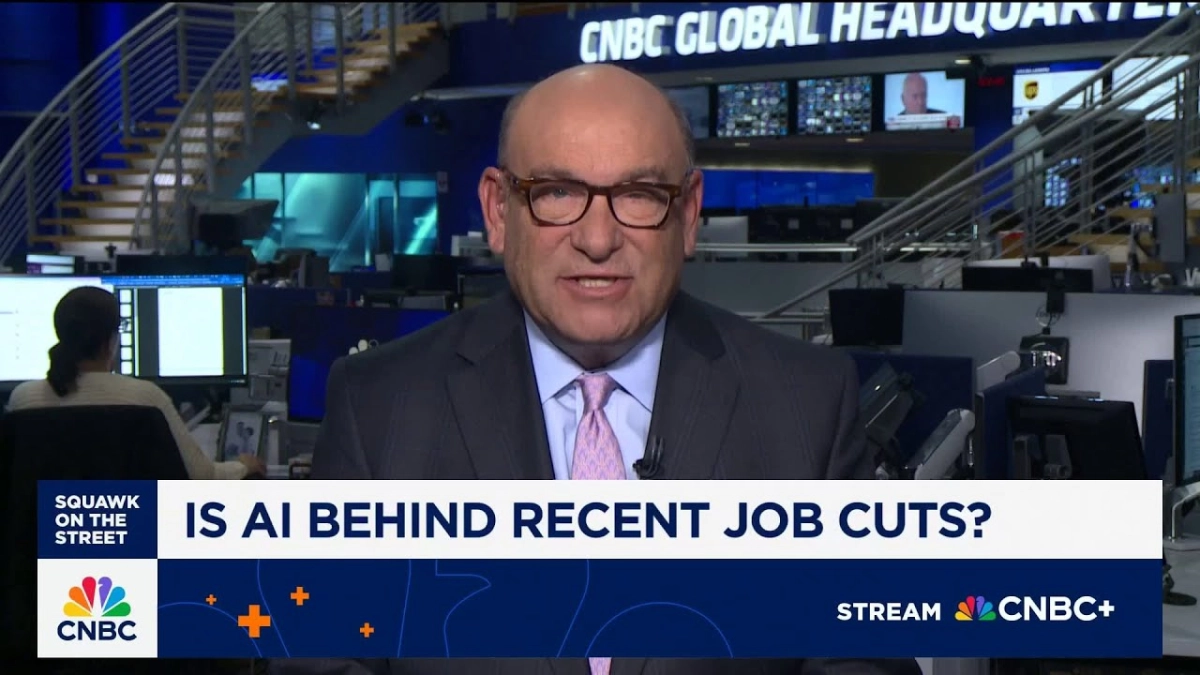
The current discourse surrounding artificial intelligence often paints a picture of rapid, job-displacing transformation. However, as CNBC's Steve Liesman and Peter Cappelli of UPenn's Wharton School discussed on "Squawk Box," a closer look reveals that many recent corporate layoffs are less about AI-driven automation and more about traditional business factors, sometimes cloaked in the buzzword of AI. This phenomenon, which Liesman termed "AI-washing," suggests that companies may be leveraging the AI narrative to explain workforce reductions that stem from downturns, restructuring, or other operational efficiencies.
Liesman, a Senior Economics Reporter for CNBC Business News, along with his colleague Gabrielle Fonrouge and Frank Holland, delved into the specifics of recent job cuts at major corporations like UPS, Amazon, and Target. While the sheer numbers—48,000 at UPS, 14,000 at Amazon, 1,800 at Target—might immediately trigger fears of AI-induced displacement, the underlying reasons are often far more mundane. UPS, for instance, in its earnings call, stated, "We launched our Efficiency Reimagined initiatives to undertake the end-to-end process redesign effort which will align our organizational processes to the network reconfiguration." This verbose corporate speak, Liesman highlighted, can easily be misinterpreted as AI-driven efficiency when it primarily reflects a response to shifting business dynamics, such as the post-pandemic normalization of online shopping.
Similarly, Amazon CEO Andy Jassy found himself needing to clarify the narrative around his company's layoffs. He explicitly stated that the job cuts "were not really financially driven, and it's not even really AI driven, not right now. It's culture." This candid admission underscores a crucial insight: many companies are undergoing significant restructuring to adapt to new market realities and economic pressures, a process that inherently involves workforce adjustments. Attributing these changes solely to AI oversimplifies a complex interplay of factors, potentially masking deeper organizational or market-related challenges.
Moreover, the practicalities of implementing AI on a scale that would lead to mass job displacement are often underestimated. Peter Cappelli, a Professor of Management at the Wharton School, emphasized this point, noting, "Using AI and introducing it to save jobs turns out to be an enormously complicated and time-consuming exercise... I think there's still a perception that it's simple and easy and cheap to do and it's really not." This perspective is vital for founders and VCs who might be swayed by the hype. The reality of integrating advanced AI systems into existing operational frameworks, training staff, and ensuring reliability is a monumental undertaking, far from the plug-and-play solution often imagined.
While AI is not yet the primary driver of widespread job loss, it is certainly impacting the workforce in more nuanced ways. Goldman Sachs’s survey of 100 investment bankers revealed potential AI-related workforce reductions of 4% over the next year and 11% over three years among their clients. This data, while significant, points more towards a gradual shift rather than an immediate overhaul. Liesman noted that "so far AI job losses look like mostly the low-skilled and entry-level jobs." Some companies are also implementing hiring freezes, anticipating future productivity gains from AI, suggesting a proactive adjustment rather than reactive cuts. This is a subtle yet important distinction: AI is influencing hiring strategies and the types of roles being filled, rather than outright replacing a large swath of existing employees.
Related Reading
- AI's Untapped Capital Expenditure and the Looming K-Shaped Economy
- AI Spend Mania Signals Caution for Tech Investors
- Wall Street's AI Reckoning: Monetization Separates Hyperscaler Winners from Losers
The broader economic context further complicates the picture. The U.S. economy is characterized by constant job churn, with millions of jobs being created and lost annually. This dynamism, often overlooked in the sensationalized headlines about AI and layoffs, is a natural part of economic evolution. Factors like the shift to remote work, changes in labor force participation, and ongoing immigration patterns also significantly influence employment figures. These macro trends, rather than solely AI, often dictate the pace and nature of workforce adjustments across industries.
Ultimately, the consensus among the experts interviewed is that investors and industry leaders must exercise caution. Liesman warned that "investors need to be wary of regular old job cuts wrapped in AI clothing." The allure of AI as a catch-all explanation for efficiency gains and cost reductions can be powerful, but it risks obscuring the true drivers of corporate strategy and workforce changes. The current phase of AI adoption appears to be more about complementing human capabilities and optimizing specific, often lower-skilled, tasks rather than a wholesale replacement of the workforce. The long-term impact remains to be seen, but for now, the narrative of AI-driven mass layoffs is largely exaggerated, a product of hype rather than present-day reality.



