
DeepSeek V4 vs. Opus: Ahmad Awais on AI Coding Taste

Ahmad Awais discusses how AI coding agents can learn 'coding taste' to outperform generic models, focusing on the difference between functional code and good design.

7 min read
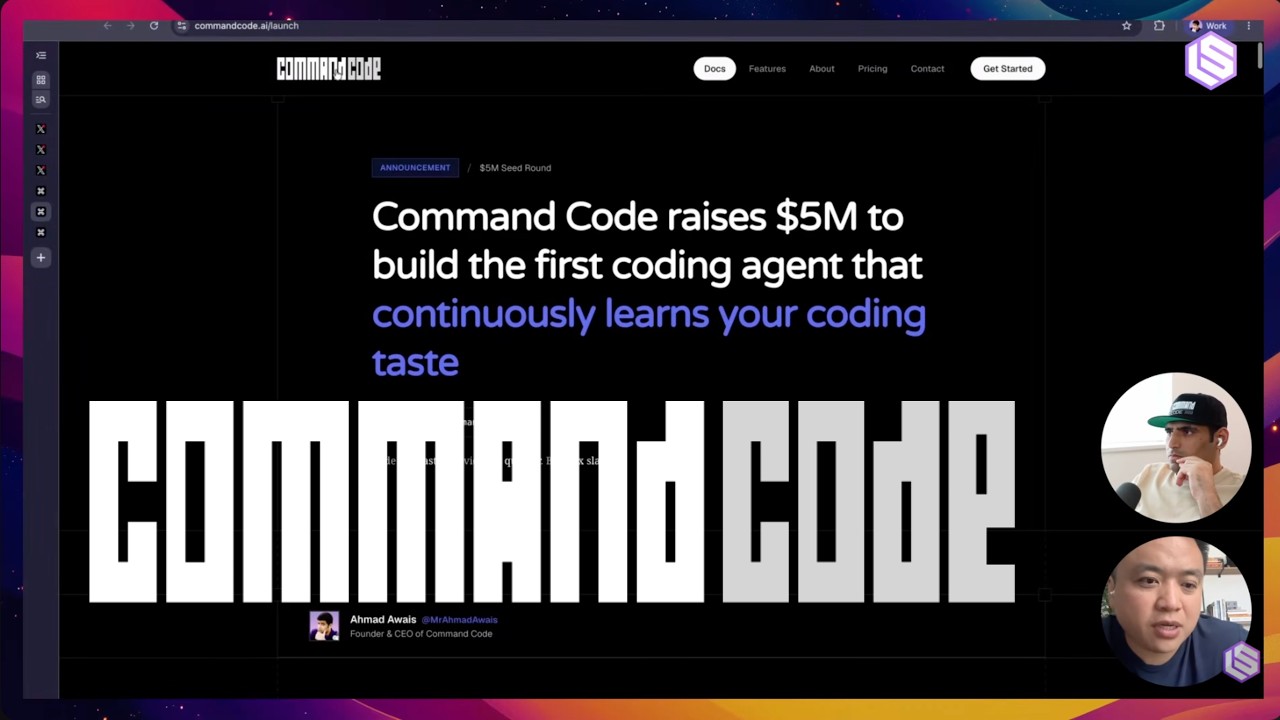
Ahmad Awais speaking on a podcast, discussing AI coding agents.
Latent Space

In a recent discussion on the Latent Space podcast, Ahmad Awais, Founder & CEO of Command Code, delved into the nuances of AI coding agents and their ability to learn "coding taste." Awais, a seasoned developer with extensive experience in the open-source community and prior roles at major tech companies, shared his insights on why "open model bad at tool calling" is fundamentally a harness problem, not a model limitation.

DeepSeek V4 vs. Opus: Ahmad Awais on AI Coding Taste - Latent Space
DeepSeek V4 vs. Opus: Ahmad Awais on AI Coding Taste — from Latent Space

Visual TL;DR. Generic AI Code leads to AI Coding Taste. Harness Problem leads to Generic AI Code. Ahmad Awais leads to AI Coding Taste. Ahmad Awais leads to Harness Problem. AI Coding Taste leads to Outperform Generic Models. Work-Pattern-First leads to AI Coding Taste. AI Coding Taste leads to Continuous Learning. Design Taste Importance leads to AI Coding Taste.

  1. Generic AI Code: syntactically correct but lacks user's design preferences
  2. AI Coding Taste: learning user's specific style and preferences over time
  3. Harness Problem: open models struggle with tool calling due to integration
  4. Ahmad Awais: Founder & CEO of Command Code, expert on AI coding
  5. Work-Pattern-First: composition approach prioritizing user's workflow and habits
  6. Outperform Generic Models: AI agents with taste provide better, personalized code
  7. Design Taste Importance: crucial for AI development beyond just functional code
  8. Continuous Learning: models adapt to user's evolving coding style

Visual TL;DR
Visual TL;DR — startuphub.ai Generic AI Code leads to AI Coding Taste. Ahmad Awais leads to AI Coding Taste. AI Coding Taste leads to Outperform Generic Models. AI Coding Taste leads to Continuous Learning Generic AI Code AI Coding Taste Ahmad Awais Outperform Generic Models Continuous Learning From startuphub.ai · The publishers behind this format
Visual TL;DR — startuphub.ai Generic AI Code leads to AI Coding Taste. Ahmad Awais leads to AI Coding Taste. AI Coding Taste leads to Outperform Generic Models. AI Coding Taste leads to Continuous Learning Generic AI Code AI Coding Taste Ahmad Awais OutperformGeneric Models ContinuousLearning From startuphub.ai · The publishers behind this format
Visual TL;DR — startuphub.ai Generic AI Code leads to AI Coding Taste. Ahmad Awais leads to AI Coding Taste. AI Coding Taste leads to Outperform Generic Models. AI Coding Taste leads to Continuous Learning Generic AI Code syntactically correct but lacks user'sdesign preferences AI Coding Taste learning user's specific style andpreferences over time Ahmad Awais Founder & CEO of Command Code, expert onAI coding Outperform Generic Models AI agents with taste provide better,personalized code Continuous Learning models adapt to user's evolving codingstyle From startuphub.ai · The publishers behind this format
Visual TL;DR — startuphub.ai Generic AI Code leads to AI Coding Taste. Ahmad Awais leads to AI Coding Taste. AI Coding Taste leads to Outperform Generic Models. AI Coding Taste leads to Continuous Learning Generic AI Code syntacticallycorrect but lacksuser's design… AI Coding Taste learning user'sspecific style andpreferences over… Ahmad Awais Founder & CEO ofCommand Code,expert on AI coding OutperformGeneric Models AI agents withtaste providebetter,… ContinuousLearning models adapt touser's evolvingcoding style From startuphub.ai · The publishers behind this format
Visual TL;DR — startuphub.ai Generic AI Code leads to AI Coding Taste. Harness Problem leads to Generic AI Code. Ahmad Awais leads to AI Coding Taste. Ahmad Awais leads to Harness Problem. AI Coding Taste leads to Outperform Generic Models. Work-Pattern-First leads to AI Coding Taste. AI Coding Taste leads to Continuous Learning. Design Taste Importance leads to AI Coding Taste Generic AI Code syntactically correct but lacks user'sdesign preferences AI Coding Taste learning user's specific style andpreferences over time Harness Problem open models struggle with tool calling dueto integration Ahmad Awais Founder & CEO of Command Code, expert onAI coding Work-Pattern-First composition approach prioritizing user'sworkflow and habits Outperform Generic Models AI agents with taste provide better,personalized code Design Taste Importance crucial for AI development beyond justfunctional code Continuous Learning models adapt to user's evolving codingstyle From startuphub.ai · The publishers behind this format
Visual TL;DR — startuphub.ai Generic AI Code leads to AI Coding Taste. Harness Problem leads to Generic AI Code. Ahmad Awais leads to AI Coding Taste. Ahmad Awais leads to Harness Problem. AI Coding Taste leads to Outperform Generic Models. Work-Pattern-First leads to AI Coding Taste. AI Coding Taste leads to Continuous Learning. Design Taste Importance leads to AI Coding Taste Generic AI Code syntacticallycorrect but lacksuser's design… AI Coding Taste learning user'sspecific style andpreferences over… Harness Problem open modelsstruggle with toolcalling due to… Ahmad Awais Founder & CEO ofCommand Code,expert on AI coding Work-Pattern-First compositionapproachprioritizing user's… OutperformGeneric Models AI agents withtaste providebetter,… Design TasteImportance crucial for AIdevelopment beyondjust functional… ContinuousLearning models adapt touser's evolvingcoding style From startuphub.ai · The publishers behind this format

The 'Taste' of AI in Code Generation

Awais explained that while LLMs can write fluent code, they often lack genuine design taste. This means that while the output might be syntactically correct, it doesn't necessarily reflect the user's preferences or adhere to good design principles. He posited that the key to improving AI coding is to train models that can continuously learn and adapt to a user's specific coding style and preferences over time, moving beyond generic, rule-based outputs.

Related startups

Benchmarking and Evaluating AI Models

The conversation touched upon the challenges of evaluating AI models, particularly in areas like design. Awais highlighted that while benchmarks often focus on technical correctness, they often miss crucial aspects like design taste and user experience. He drew a parallel to how human designers intuitively understand and apply these principles, something current AI models struggle to replicate. This, he suggested, is a significant gap that needs to be addressed for more sophisticated AI development tools.

The Importance of 'Work-Pattern-First' Composition

Awais elaborated on the concept of "work-pattern-first composition," explaining that an AI agent should first identify the underlying patterns and intent behind a user's request before generating code. This approach allows the AI to create more contextually relevant and aesthetically pleasing outputs. He contrasted this with models that might simply follow a generic template, leading to a less refined and less personalized user experience.

The Role of Design Taste in AI Development

The core of Awais's argument centered on the idea that "design taste" is not merely a cosmetic issue but a fundamental aspect of building effective AI tools. By understanding and incorporating user preferences, AI models can move beyond simply generating functional code to creating solutions that are also intuitive, efficient, and aesthetically pleasing. This, he believes, is the next frontier in AI-assisted development.

© 2026 StartupHub.ai. All rights reserved. Do not enter, scrape, copy, reproduce, or republish this article in whole or in part. Use as input to AI training, fine-tuning, retrieval-augmented generation, or any machine-learning system is prohibited without written license. Substantially-similar derivative works will be pursued to the fullest extent of applicable copyright, database, and computer-misuse laws. See our terms.