

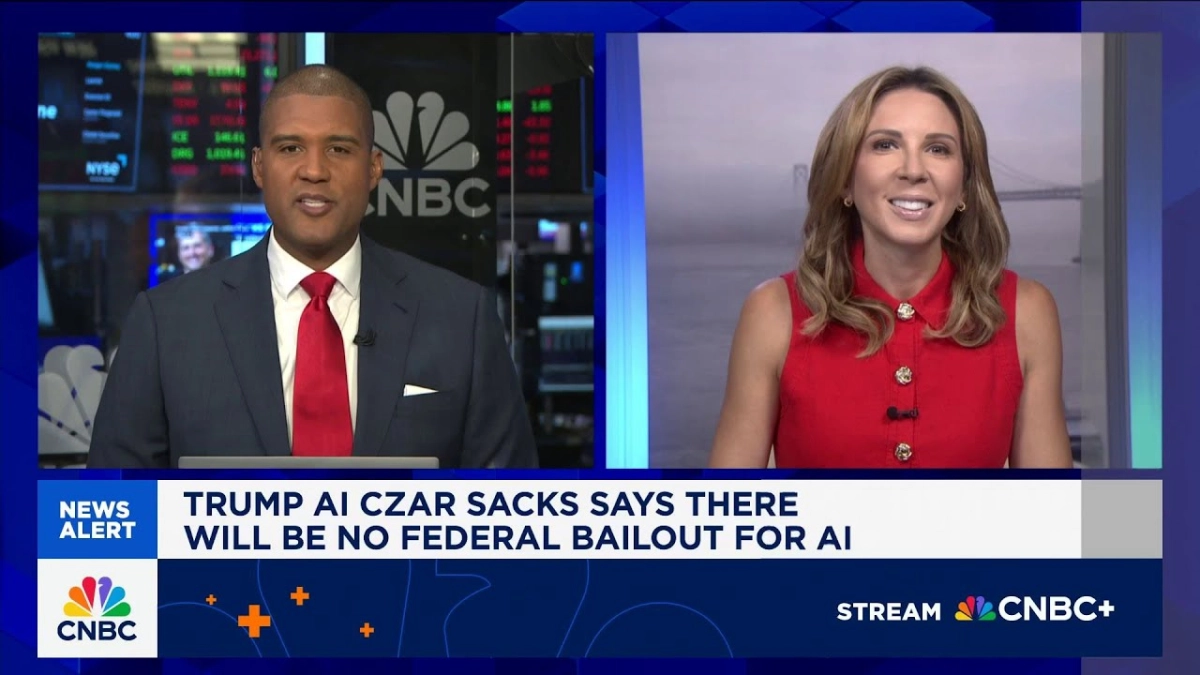
"There will be no federal bailout for AI." This unequivocal statement from David Sacks, identified as a White House AI and Crypto Czar, cuts directly to the heart of a burgeoning debate within the tech industry: the role of government support in the capital-intensive world of artificial intelligence. His remarks, disseminated via social media platform X and reported by CNBC's MacKenzie Sigalos on the "Halftime Report," served as a pointed rebuttal to earlier suggestions from OpenAI CFO Sarah Friar regarding potential government-guaranteed financing for AI infrastructure. The discussion, unfolding on a prominent business news platform, highlights the growing scrutiny over the financial models and public expectations surrounding frontier AI development.
Sacks’ firm declaration underscores a prevailing sentiment among certain tech leaders and policymakers that the AI sector, despite its strategic importance, should operate under free-market principles, without the safety net of taxpayer-funded rescues. He articulated that the U.S. boasts "at least 5 major frontier model companies," implying a robust and competitive landscape where the failure of one player would not create an existential vacuum but rather allow "others will take its place." This perspective suggests that market mechanisms are sufficient to ensure innovation and progress, even in the face of significant investment demands and inherent risks.
The catalyst for Sacks' commentary was OpenAI CFO Sarah Friar's prior suggestion that the U.S. government could help guarantee financing for AI data centers, a move intended to lower borrowing costs for companies racing to build massive compute infrastructure. Such a mechanism, reminiscent of government-backed loans or guarantees seen in other critical industries, would ostensibly de-risk private investment and accelerate development. Friar has since clarified her comments, indicating OpenAI is not actively seeking such a backstop.
Despite Friar's clarification, the very notion of a government bailout or financial guarantee for AI companies has ignited a debate about moral hazard and market distortion. For founders and venture capitalists navigating the intense capital demands of AI, the prospect of government intervention might seem appealing, potentially easing the burden of raising billions for GPU clusters and research. However, Sacks' position signals a clear disinclination from the government to become a direct financial guarantor in the AI arms race. This stance firmly rejects the notion of a "too big to fail" paradigm for artificial intelligence.
The sheer scale of investment required for advanced AI models is staggering, with estimates ranging into the tens of billions for next-generation systems. This capital intensity naturally leads some to consider whether traditional financing models are adequate or if public-private partnerships, beyond mere research grants, are necessary. Sacks, however, advocates for a different form of government assistance, one focused on enabling rather than underwriting. He emphasized that the government should instead concentrate on "speeding up permitting and power generation." This approach shifts the focus from direct financial aid to addressing systemic bottlenecks that can hinder growth and innovation across the entire industry.