

Databricks CEO on AI Agents and Market Trends

Databricks CEO Ali Ghodsi discusses the launch of 'Genie Code,' an AI agent for non-technical users, and the acquisition of Quotient AI to enhance AI monitoring.

Mar 11 at 6:31 PM4 min read
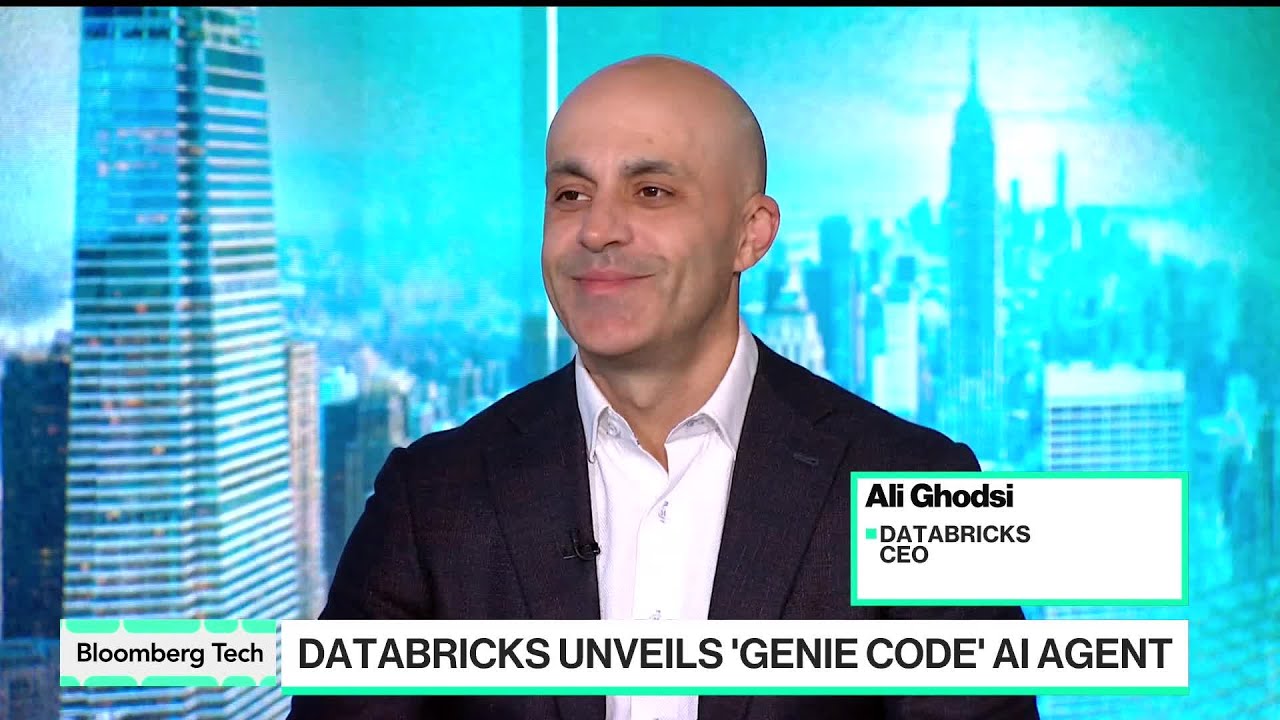
Ali Ghodsi, CEO of Databricks, interviewed on Bloomberg Tech.

In a recent appearance on Bloomberg Tech, Ali Ghodsi, CEO of Databricks, detailed the company's strategy and new product offerings in the rapidly evolving AI landscape. Ghodsi highlighted the launch of 'Genie Code,' an AI agent designed to democratize AI model development by enabling individuals without deep technical expertise to create machine learning models. This initiative directly addresses the growing need for AI capabilities across various departments within organizations, including marketing, HR, and finance, who may not have dedicated data scientists.

The full discussion can be found on Bloomberg Technology's YouTube channel.

Databricks Launches AI Assistant for Technical Talent — from Bloomberg Technology

Who Is Ali Ghodsi?

Ali Ghodsi is the co-founder and CEO of Databricks, a prominent data analytics and AI company. Ghodsi holds a Ph.D. in computer science from UC Berkeley, where he was a lead developer of Apache Spark, a powerful open-source engine for large-scale data processing. His background in distributed systems and machine learning underpins Databricks' mission to unify data engineering, data science, and machine learning on a single platform. Ghodsi is a key figure in advocating for the Lakehouse architecture, which aims to combine the benefits of data lakes and data warehouses.

Databricks Unveils 'Genie Code' AI Agent

Ghodsi introduced 'Genie Code,' a new AI agent from Databricks. He explained that while many AI tools can generate code, Genie Code's primary function is to help users build machine learning models. This includes tasks like predicting prices, estimating sales, and performing risk assessments. The agent automates many of the complex steps previously handled by data scientists, such as model building, iteration, and performance monitoring. Ghodsi emphasized that this capability democratizes AI, allowing non-technical professionals to leverage advanced analytics and predictive modeling within their daily workflows.

Ghodsi elaborated on the practical application of Genie Code: "What Genie Code really can do is bring it to the knowledge worker. The people that create your dashboards inside an organization, and they make sure that your revenue numbers are correct, or the people that are building machine learning models themselves, they just automate that portion." He further explained that it complements their existing offerings, such as the recently acquired Quotient AI, which focuses on the quality assurance and monitoring of AI models.

Databricks Acquires Quotient AI

The conversation also touched upon Databricks' strategic acquisition of Quotient AI. Ghodsi highlighted the importance of this acquisition in complementing their Genie Code initiative and overall AI platform strategy. He stated, "The other piece of the puzzle is we also acquired a company called Quotient AI. And these are the folks behind GitHub Copilot's quality measurement." He elaborated on Quotient AI's role in ensuring that AI models function correctly and reliably, especially when deployed within enterprise systems. "They focus on quality measurement, making sure that they can do monitoring of how things are going. So this is the other piece of the puzzle," Ghodsi explained. This acquisition aims to provide Databricks customers with robust tools for monitoring and validating their AI models, ensuring accuracy and preventing issues like model drift or erroneous outputs.

Democratizing AI and Empowering Knowledge Workers

Ghodsi stressed that Databricks' approach with Genie Code and the integration of Quotient AI is about empowering a broader range of employees within an organization. He noted, "We have 5,000-6,000 people within Databricks, about 3,000 to 4,000 of them are in this category that they're quite technical, but they're not data scientists. And they're now using Repli themselves, and they love it. You know, it's just, these are people that would never have otherwise even touched code, and they're now using Repli themselves, and they're building things that actually work." The goal is to move beyond specialized data science teams and enable a wider workforce to leverage AI for practical business outcomes, such as improving marketing campaigns, optimizing HR processes, or enhancing financial forecasting.

Databricks' Path to Public Markets

When questioned about Databricks' potential move towards an Initial Public Offering (IPO), Ghodsi indicated a cautious approach. He stated, "I don't think right now is the best time to be public, right? With everything that's going on in the markets today." He emphasized the company's current focus on private growth and investment in its AI capabilities. "We will be public, but I don't think now is the time to be public," Ghodsi reiterated, suggesting that the company is prioritizing its strategic development and market expansion initiatives before considering a public debut.