

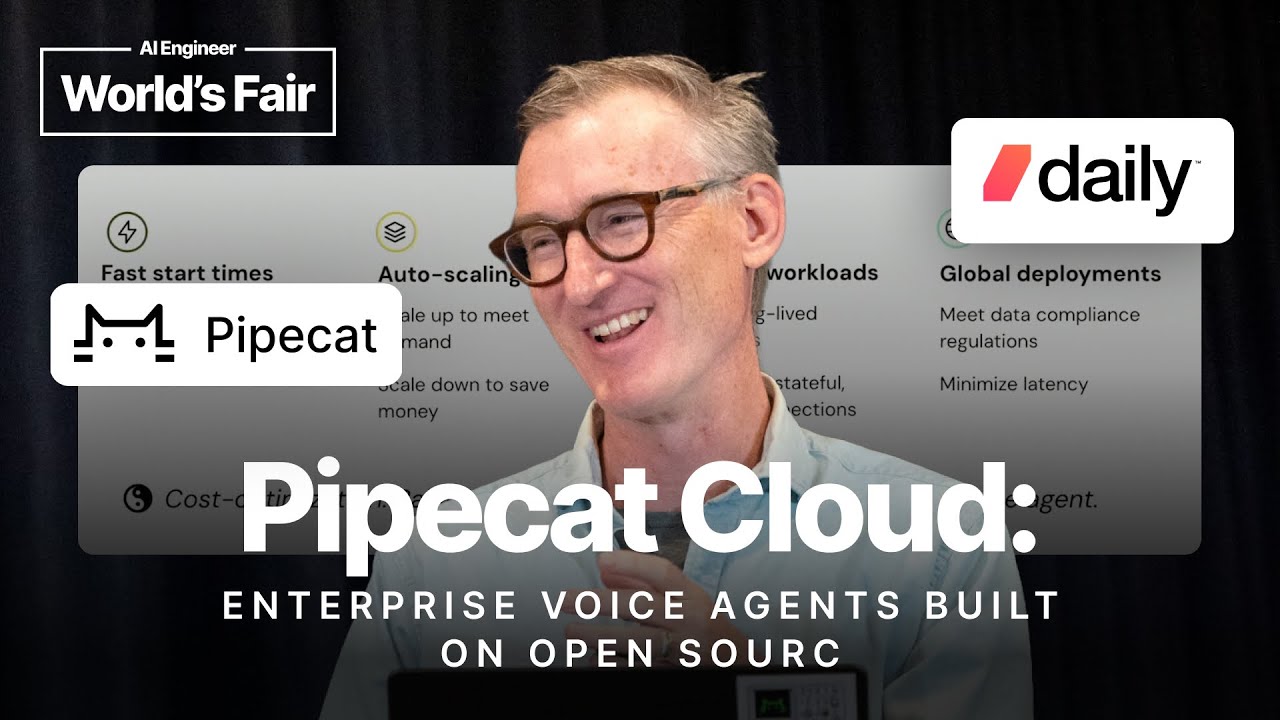
At the AI Engineer World's Fair, Kwindla Hultman Kramer, co-founder of Daily, presented Pipecat, an open-source framework for building enterprise-grade voice AI agents. The talk detailed the core challenges developers face in this domain and introduced Pipecat Cloud, a new hosting platform designed to abstract away the underlying infrastructure complexities. Kramer's presentation provided a clear roadmap for building performant voice agents, emphasizing the critical importance of meeting high user expectations in real-time interactions.
Kramer spoke with a room of AI professionals about the three fundamental steps required to build a voice agent. He framed the process as a sequence of distinct challenges: writing the agent's code, deploying that code to a scalable infrastructure, and connecting users to the agent over a network. This simplification cuts through the noise of a rapidly crowding market, offering a structured approach for engineering teams. He noted that while the tools are new, the user's benchmark is not. “Humans expect a 500 millisecond response time in natural human conversation," Kramer stated. "If you don't do that in your voice AI interface, you are probably going to lose most of your normal users.”
The Pipecat framework is Daily’s open-source answer to the first step: writing the code. It provides developers with a vendor-neutral toolkit to construct voice and multimodal AI agents. An agent in Pipecat is structured as a programmable pipeline, allowing developers to chain together services for transcription, language model inference, and voice generation from a wide array of providers. This modularity is a core insight, as it prevents vendor lock-in and allows for flexible, best-in-class component selection. “Pipecat appeals to developers because it's 100% open source and completely vendor neutral,” Kramer explained, highlighting the ability to use different services at every layer of the stack.
The primary announcement was the launch of Pipecat Cloud, a platform designed to solve the difficult deployment and infrastructure problems unique to voice AI. These are not typical web workloads; they involve long-lived, stateful connections that demand extremely low latency. Pipecat Cloud is engineered to manage these specific requirements, offering fast cold starts, intelligent auto-scaling, and global deployments to minimize latency by placing agents closer to end-users. This addresses a significant pain point for developers who would otherwise need deep expertise in complex systems like Kubernetes to achieve production-grade reliability and performance.
Ultimately, the platform is designed to abstract away the complex, real-time infrastructure challenges. This allows engineering teams to focus their resources on building core business logic, not on managing servers.