

Crusoe Cloud Offers Dedicated AI Inference

Crusoe Cloud launches Self-Serve Deployments, offering dedicated AI inference capacity for growing applications, moving beyond shared serverless pools.

Crusoe Cloud logo and graphic representing AI inference deployment options
Crusoe Blog
Visual TL;DR
Growing AI AppsDriver
applications gain traction, needing more reliable and scalable infrastructure for inference
From the article 2 mentionsThis move aims to provide growing AI applications with predictable performance and dedicated resources without the steep operational overhead of managing their own inference infrastructure.
Serverless LimitationsDriver
shared pools lead to noisy neighbors, latency issues, and restrictive rate limits
From the article 9+ mentionsCrusoe Cloud has launched Self-Serve Deployments, a new offering designed to bridge the gap between simple serverless AI inference and fully managed, bespoke solutions.
Crusoe Cloud LaunchesCore
introduces Self-Serve Deployments for dedicated AI inference capacity
From the article 2 mentionsTo get started, users can select a model, choose a deployment configuration profile (Responsiveness, Throughput, or Balanced), and launch their deployment through the Crusoe Cloud console.
Dedicated InferenceContext
offers reserved capacity, moving beyond shared serverless pools for predictability
From the article 9+ mentionsCrusoe's offering carves out a niche by focusing on dedicated, managed inference infrastructure for growing AI applications, aiming to provide a more stable and cost-effective alternative to shared serverless options as workloads mature.
Predictable PerformanceEffect
ensures consistent latency and throughput without 'noisy neighbor' interference
From the article 5 mentionsThis means consistent, predictable performance even under load.
Greater ControlEffect
teams gain more operational oversight without managing full infrastructure
From the article 2 mentionsCrusoe's Self-Serve Deployments address this by offering reserved inference capacity, providing teams with greater control and predictability.
Economic BenefitsOutcome
balances cost-effectiveness with performance, avoiding steep operational overhead
From the article 2 mentionsThis economic model is particularly relevant for companies scaling rapidly, where predictable costs are as important as predictable performance.
Scalable AI GrowthOutcome
supports applications as they mature, bridging the gap from serverless to dedicated
From the article 2 mentionsCrusoe's Self-Serve Deployments highlight a critical industry trend: the need for specialized, scalable solutions that balance performance, cost, and operational simplicity.
Contents(4)

Crusoe Cloud has launched Self-Serve Deployments, a new offering designed to bridge the gap between simple serverless AI inference and fully managed, bespoke solutions. This move aims to provide growing AI applications with predictable performance and dedicated resources without the steep operational overhead of managing their own inference infrastructure.

For many startups, the journey begins with serverless inference. It’s easy to use: call an API, pay per token, and get models into production. StartupHub.ai data shows this approach is common for early-stage companies. However, as applications gain traction, the shared nature of serverless can lead to performance bottlenecks. "Noisy neighbors" can impact latency, rate limits become restrictive, and scaling becomes a significant challenge. Crusoe's Self-Serve Deployments address this by offering reserved inference capacity, providing teams with greater control and predictability.

Bridging the Inference Gap

Crusoe Intelligence Foundry previously offered two extremes: Serverless Inference for quick, off-the-shelf deployments and Tailored Deployments for deeply customized, high-demand workloads. Self-Serve Deployments now occupy the crucial middle ground. This is where many teams find themselves after outgrowing the simplicity of serverless but hesitating to take on the complex task of managing inference engines and compute infrastructure themselves. Running inference efficiently requires specialized knowledge of hardware, software, and the rapidly evolving AI landscape. Crusoe argues that by abstracting this complexity, companies can focus on their core product differentiation rather than infrastructure management.

Performance and Control

The core promise of Self-Serve Deployments is dedicated capacity. Unlike shared serverless pools, these deployments run on reserved GPUs, ensuring that user traffic does not contend with other tenants. This means consistent, predictable performance even under load. Rate limits are also managed differently; throughput is bounded by the number of replicas configured for a deployment, giving users direct control over their scaling headroom and reducing the risk of hitting external limits.

Users can select from named configuration profiles tailored to specific needs: Responsiveness for low-latency, interactive applications; Throughput for cost efficiency at scale and high token volumes; and Balanced for a hybrid approach. The platform also supports deploying LoRA adapters trained via Crusoe's serverless fine-tuning offering, allowing users to serve their custom models on this dedicated infrastructure.

Economic Considerations

A significant shift with Self-Serve Deployments is the billing model. Instead of per-token pricing, users are billed per GPU-hour. This can become more economical for workloads with sustained high utilization. Crusoe provides an example: for a deployment of two NVIDIA H100 80GB GPUs on the Throughput profile, the cost is approximately $11.00 per GPU-hour. This translates to a monthly cost of $8,030.00. The break-even point compared to a serverless offering priced at $0.17 per million tokens is around 64.71 million tokens per hour, or roughly 1 million tokens per minute. Above this sustained volume, the GPU-hour model becomes more cost-effective. This economic model is particularly relevant for companies scaling rapidly, where predictable costs are as important as predictable performance.

StartupHub.ai data indicates Crusoe has a score of 58/100, positioning it in the competitive AI infrastructure space. Companies like Alphabet Inc. (NASDAQ:GOOGL) and Microsoft (NASDAQ:MSFT) offer extensive cloud services, while more specialized AI players like OpenAI (score 84/100) and Perplexity AI (score 71/100) are also prominent. Crusoe's offering carves out a niche by focusing on dedicated, managed inference infrastructure for growing AI applications, aiming to provide a more stable and cost-effective alternative to shared serverless options as workloads mature.

Why This Matters

The evolution of AI inference infrastructure reflects the broader maturation of the AI industry. As more companies move beyond experimentation and into production, the demands on underlying compute and serving platforms intensify. Crusoe's Self-Serve Deployments highlight a critical industry trend: the need for specialized, scalable solutions that balance performance, cost, and operational simplicity. For developers and product managers, this means more options to tailor their inference strategy to their specific application's growth phase, moving away from one-size-fits-all serverless solutions without demanding the deep infrastructure expertise previously required for dedicated deployments.

The choice between serverless and dedicated inference, as Crusoe frames it, hinges on workload predictability and volume. Serverless remains ideal for sporadic or low-volume use cases, offering simplicity and pay-per-use flexibility. However, for applications with sustained, high-volume traffic, the cost-per-token economics can quickly favor a dedicated, time-based billing model. The introduction of optimization profiles further refines this choice, allowing users to fine-tune deployments for either raw throughput or rapid response times, directly impacting user experience and operational efficiency.

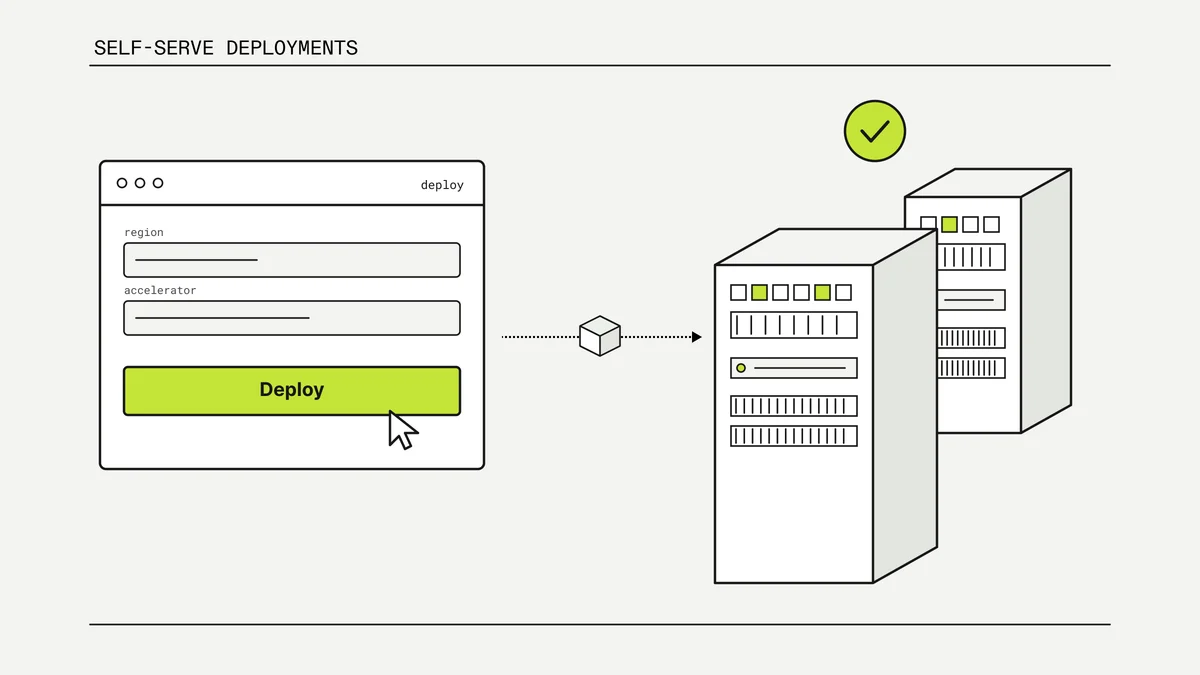
To get started, users can select a model, choose a deployment configuration profile (Responsiveness, Throughput, or Balanced), and launch their deployment through the Crusoe Cloud console. The platform handles the provisioning, engine selection, tuning, and management. Inference requests can then be made via an OpenAI-compatible API.

© 2026 StartupHub.ai. All rights reserved. You may not republish this article in full without a license. Search engines and AI research tools may crawl and summarize for reference. Bulk reproduction or model training requires a license. See our terms.
Daniel Singer

Written by

Daniel Singer

Editor, StartupHub.ai

Daniel Singer is the editor of StartupHub.ai, a technology expert and thought leader on AI and its applications across sectors, from fintech and healthcare to developer tooling and consumer software. He writes and tests the tools covered here thoroughly and regularly, and built StartupHub.ai to give founders, operators and buyers a clearer read on what they are actually being sold.