

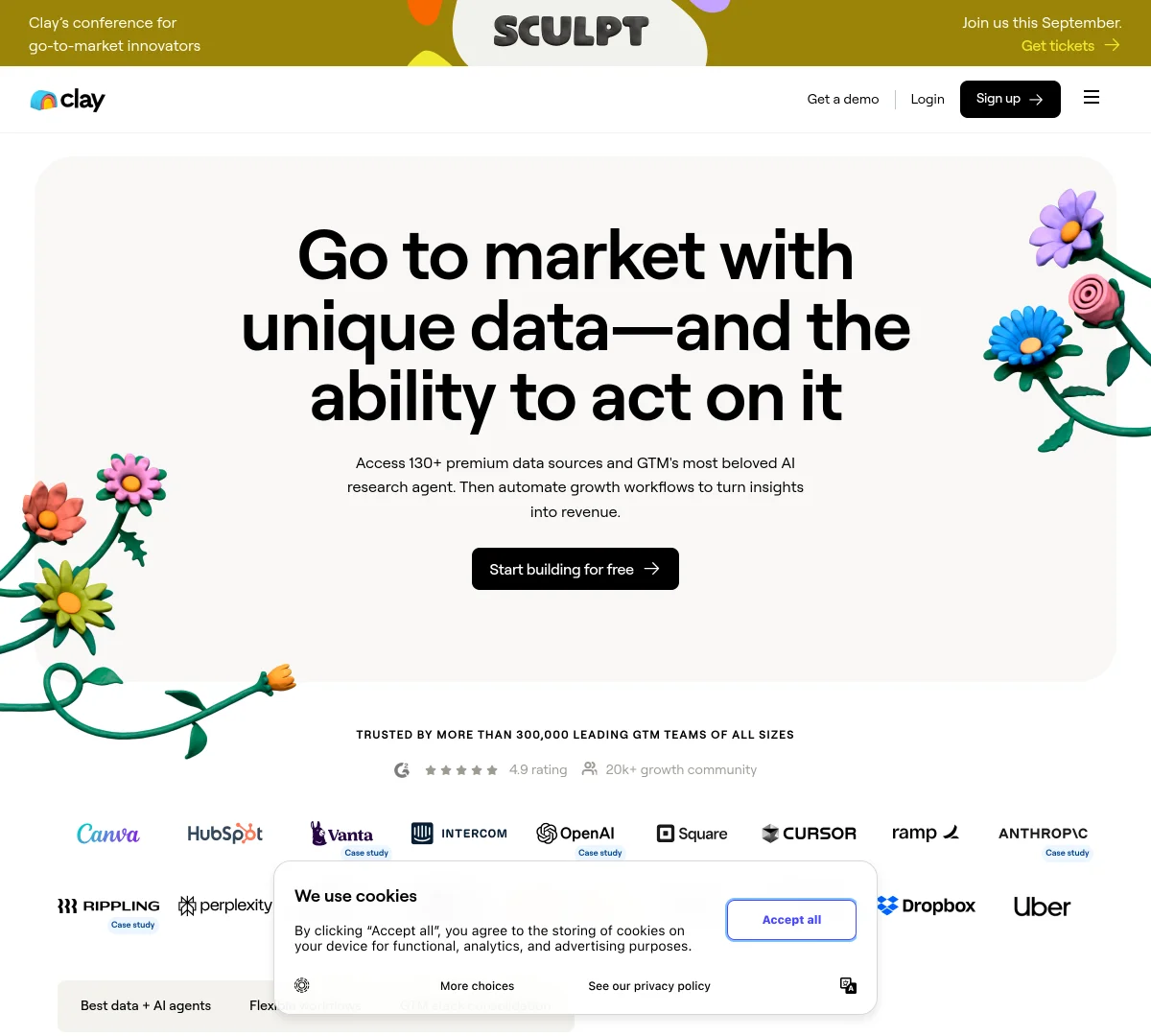
Clay, the New York-based sales automation and data enrichment platform, has reportedly closed a Series C funding round that values the company at approximately $3 billion. The new valuation, a significant jump from a $1.5 billion valuation set just a month prior during a secondary tender offer for employees, highlights intense investor interest in specialized AI tools for go-to-market teams. This latest round was led by the venture capital firm CapitalG.
The new funding follows closely on the heels of a tender offer that saw Sequoia agree to purchase up to $20 million in employee stock, demonstrating an early commitment to liquidity for Clay's team members.
Clay’s high valuation stems from a pivotal strategic shift made a few years ago. Founded in 2017, the company refocused its core mission to address a critical industry bottleneck: the manual, time-consuming, and often inefficient processes of prospecting and personalizing outreach.
Today, Clay's core strength lies in its ability to act as a powerful data orchestration layer. Rather than maintaining its own proprietary database, Clay integrates with over 100 external data providers and tools. Its platform is built around a spreadsheet-like interface where users can build sophisticated "waterfall" enrichment workflows. This means that for any given prospect, Clay can sequentially query multiple data sources (like Apollo, Clearbit, or People Data Labs) until it finds the required information, ensuring a higher data completion rate. Key features that define its technical depth include:
- AI-Powered Research: Through its "Claygent" feature, the platform can perform live web searches to find unique talking points, summarize LinkedIn profiles, or analyze company websites to fuel hyper-personalized outreach.
- No-Code Workflow Automation: An AI Formula Generator allows users to construct complex data-gathering and personalization logic using plain English commands, making advanced automation accessible to less technical users.
- Scalable Personalization: By combining data points from multiple sources, users can move beyond generic templates ("Hi {first_name}") to craft deeply resonant messages at scale (e.g., mentioning a prospect's recent podcast appearance, a company's new funding, or a specific technology they use).
Immense Power vs. Steep Learning Curve
Clay's sophisticated tools are leveraged by thousands of customers globally. Its clientele spans from industry giants like OpenAI, HubSpot, and Canva to a thriving ecosystem of over 100 small consulting agencies that specialize in helping other businesses integrate and maximize Clay's capabilities. This highlights both the platform's power and its complexity.
While users celebrate the platform's ability to save countless hours and achieve a level of personalization previously unimaginable at scale, they also caution that it comes with a steep learning curve. Mastering the platform's logic-based workflows requires experimentation and patience. The credit-based pricing model, where every action consumes credits, can also become costly if not managed efficiently, making it a better fit for dedicated teams who can invest the time to unlock its full potential.
A Crowded but Differentiated Competitive Arena
Clay operates in a highly competitive sales technology arena. Its direct competitors include:
- Data Providers: ZoomInfo, Lusha
- All-in-One Sales Platforms: Apollo.io, Seamless.AI
- GTM Platforms: Unify, Common Room
Clay differentiates itself by not trying to be an all-in-one solution. Unlike ZoomInfo or Lusha, it doesn't own its data but provides access to them and many others. Unlike Apollo.io, it does not include its own email-sending capabilities or a full-fledged CRM. Instead, it focuses exclusively on being the most powerful "top-of-funnel" engine for finding, enriching, and preparing prospect data before it's pushed into a CRM or an outreach tool.
Furthermore, Clay's function as a data orchestration engine places it in a broader context alongside general-purpose automation platforms like Zapier, Make, and n8n. These tools excel at connecting disparate apps and automating linear workflows across an entire business. Even tech giants are major players in this space, with Microsoft Power Automate deeply integrated into its enterprise ecosystem and Google offering sophisticated automation through Google Cloud Workflows and its powerful Vertex AI platform. However, Clay’s advantage lies in its specialized focus. While these other platforms can be configured for sales tasks, Clay is purpose-built for the complex, multi-step data enrichment and personalization challenges inherent to modern go-to-market strategies.
However, the most formidable long-term challenge may not originate from direct sales tech competitors, but from the foundational AI platforms themselves. General-purpose models from Google (Gemini), Anthropic (Claude), OpenAI (ChatGPT), and others are rapidly evolving beyond simple chat interfaces. They are increasingly architected to function as autonomous agents capable of complex workflows. By leveraging Retrieval-Augmented Generation (RAG) for deep contextual enrichment from URLs and proprietary documents, and utilizing emerging Agent-to-Agent (A2A) and Model Context Protocols (MCP), these platforms can orchestrate the entire GTM data process. This includes dynamically querying specialized data APIs and, crucially, directly controlling and updating records in CRMs like Salesforce, Airtable, or Monday.com. This trajectory threatens to commoditize Clay's core value proposition, raising questions about its long-term defensibility as a standalone service.
Beyond CapitalG and Sequoia, Clay has garnered significant backing from a strong roster of existing investors, including Meritech Capital, Boldstart Ventures, Maple VC, First Round Capital, and Box Group. The capital from this Series C round is expected to fuel further product innovation, expand Clay's market reach, and scale its operations to meet the accelerating demand for AI-powered sales intelligence in an increasingly data-driven global economy.

