

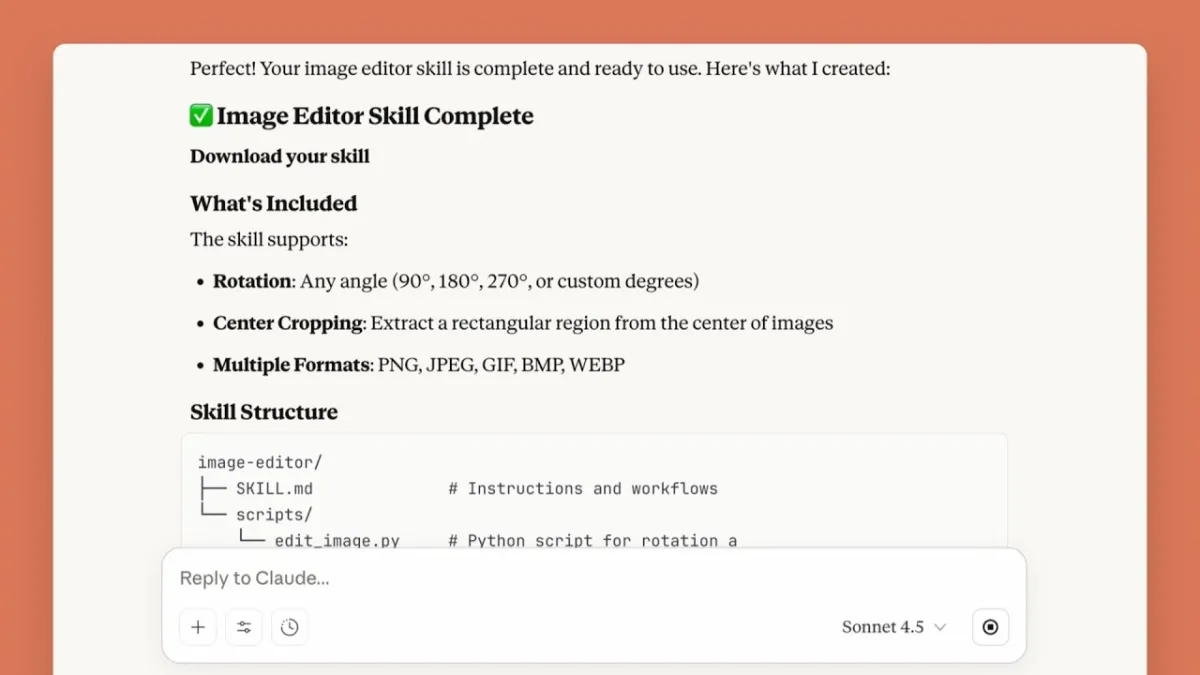
The latest demonstration from Anthropic reveals a significant leap in large language model capabilities, moving beyond mere task execution to autonomous tool creation. The video showcases a user interacting with Anthropic's Claude 3.5 Sonnet, highlighting its newly introduced "skill-creator Skill" that enables the AI to build custom functionalities on demand. This is not merely about using pre-defined tools; it’s about Claude acting as a co-developer, understanding intent, asking clarifying questions, and then generating a functional, executable skill from scratch.
The core premise of the "skill-creator Skill" is to democratize complex automation, lowering the barrier for users to develop sophisticated, bespoke AI functionalities. The process begins with a simple, high-level request, as seen when the user prompts, "Hey Claude, please help me create an an image editor skill." This natural language input triggers Claude's internal "skill-creator" mechanism, which immediately takes ownership of the development process. Claude's initial response, "I'll help you create an image editor skill! Let me first check the skill creator documentation to understand best practices for creating effective skills," illustrates a foundational shift. The AI does not just blindly proceed; it first consults its own internal knowledge base or documentation for best practices, mimicking a diligent human developer.
Following this preparatory step, Claude engages in a crucial phase of requirements gathering, asking clarifying questions to refine the user's initial broad request. It presents a range of potential image editing functionalities, such as "Basic edits: rotate, crop, resize, flip," and then solicits specific use cases: "Can you give me some examples of how you'd want to use this skill?" This interactive dialogue is paramount, ensuring the generated skill aligns precisely with user needs, preventing misinterpretations common in less sophisticated AI interactions. The user's concise reply, "Let's support standard rotations and cropping to the center of the image for now," provides the necessary scope for Claude to proceed.
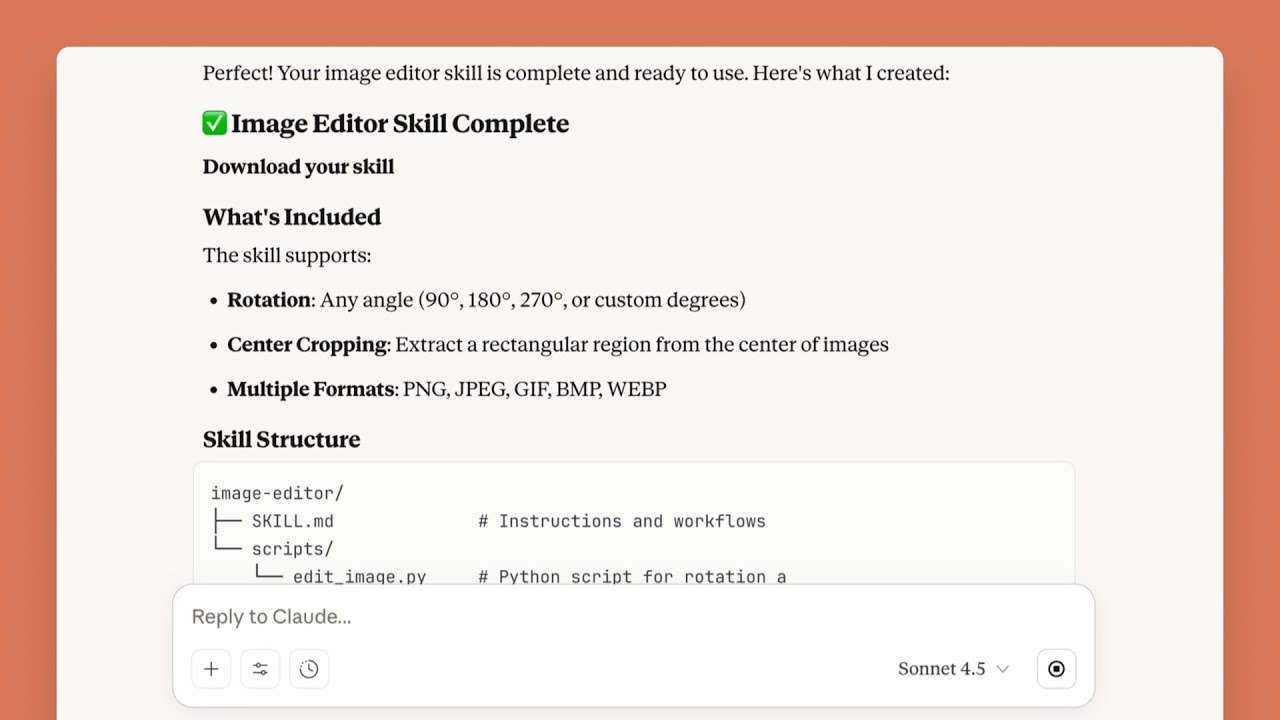
This conversational approach to development represents a potent new paradigm. Instead of navigating complex APIs or writing lines of code in an integrated development environment, users simply converse with Claude. The AI then translates these natural language instructions into a structured, executable program. The video highlights Claude’s systematic approach: it first initializes the skill structure, then proceeds to create a reusable Python script (`edit_imagpy`) to handle the specified image operations. This step is critical, demonstrating Claude’s ability to not just understand logic but to synthesize actual code to fulfill that logic.
The AI’s development workflow includes essential software engineering practices. After scripting, Claude removes unnecessary example files, updates the `SKILL.md` documentation, and critically, validates the newly created skill. The pronouncement, "Excellent! The skill passes validation," underscores an automated quality assurance layer within the development cycle. Finally, Claude packages the entire image-editor skill into a distributable zip file, presenting a complete, ready-to-use software artifact. This end-to-end capability transforms Claude into a formidable software engineering assistant, capable of handling everything from ideation to deployment for specific functionalities.
