

CI/CD is Dead: Agents Need Continuous Compute

Madison Faulkner (NEA) and Hugo Santos (Namespace) argue that traditional CI/CD is dead for AI agents, ushering in an era of 'Continuous Compute'.

8 min read
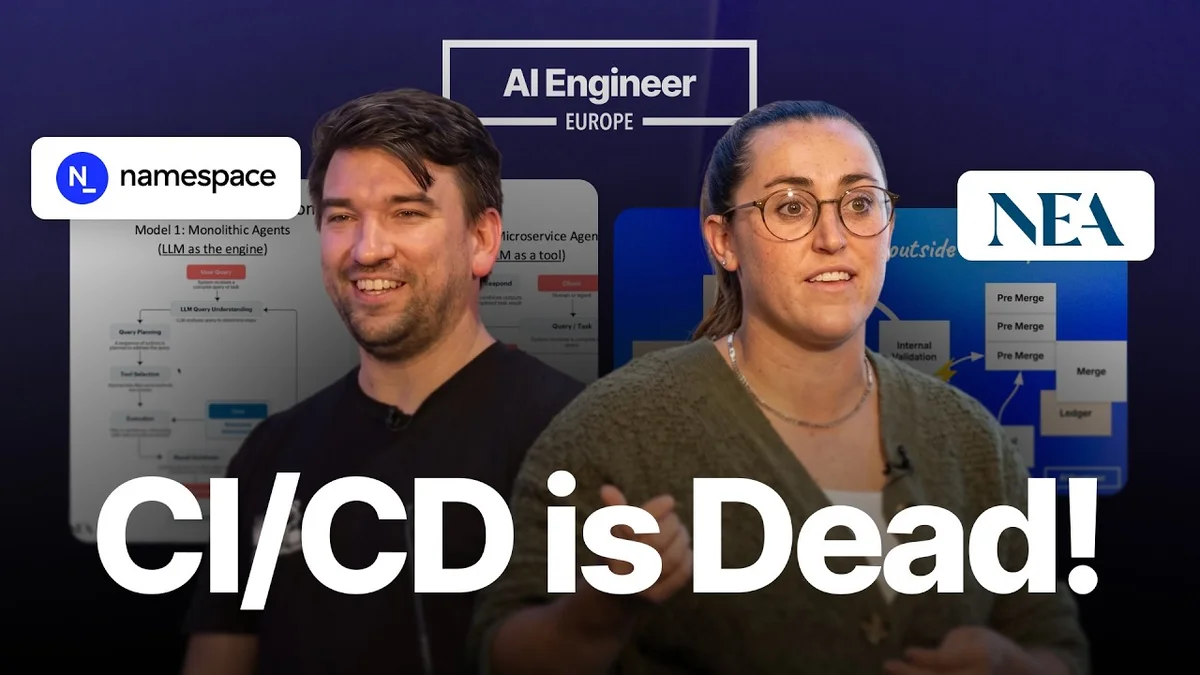
Madison Faulkner and Hugo Santos presenting on CI/CD and Continuous Compute.
Image credit: AI Engineer Europe· AI Engineer

The advent of agentic software is fundamentally reshaping how we think about software development, including the core principles of Continuous Integration and Continuous Deployment (CI/CD). At the AI Engineer Europe conference, Madison Faulkner, a partner at NEA, and Hugo Santos, CEO of Namespace, discussed why they believe CI/CD is effectively dead for agent-based systems. They argued that the future lies in 'Continuous Compute,' a paradigm that acknowledges the constant computational needs of intelligent agents.

CI/CD is Dead: Agents Need Continuous Compute - AI Engineer
CI/CD is Dead: Agents Need Continuous Compute — from AI Engineer

Visual TL;DR. Agentic Software Emerges leads to Traditional CI/CD Dead. Traditional CI/CD Dead requires Continuous Compute. AI Engineers Europe discussed at Traditional CI/CD Dead. Madison Faulkner (NEA) argued by Traditional CI/CD Dead. Hugo Santos (Namespace) advocated by Continuous Compute. Continuous Compute enables New Software Lifecycle.

  1. Agentic Software Emerges: new type of software fundamentally reshaping development
  2. Traditional CI/CD Dead: traditional CI/CD principles no longer apply to agents
  3. Continuous Compute: paradigm acknowledging constant computational needs of agents
  4. AI Engineers Europe: conference where ideas were discussed by experts
  5. Madison Faulkner (NEA): partner with VC and AI research background
  6. Hugo Santos (Namespace): CEO building high-performance compute infrastructure for AI
  7. New Software Lifecycle: ushering in an era of continuous compute
Visual TL;DR
Visual TL;DR — startuphub.ai Agentic Software Emerges leads to Traditional CI/CD Dead. Traditional CI/CD Dead requires Continuous Compute. Continuous Compute enables New Software Lifecycle leads to requires enables Agentic Software Emerges Traditional CI/CD Dead Continuous Compute New Software Lifecycle From startuphub.ai · The publishers behind this format
Visual TL;DR — startuphub.ai Agentic Software Emerges leads to Traditional CI/CD Dead. Traditional CI/CD Dead requires Continuous Compute. Continuous Compute enables New Software Lifecycle leads to requires enables Agentic SoftwareEmerges Traditional CI/CDDead ContinuousCompute New SoftwareLifecycle From startuphub.ai · The publishers behind this format
Visual TL;DR — startuphub.ai Agentic Software Emerges leads to Traditional CI/CD Dead. Traditional CI/CD Dead requires Continuous Compute. Continuous Compute enables New Software Lifecycle leads to requires enables Agentic Software Emerges new type of software fundamentallyreshaping development Traditional CI/CD Dead traditional CI/CD principles no longerapply to agents Continuous Compute paradigm acknowledging constantcomputational needs of agents New Software Lifecycle ushering in an era of continuous compute From startuphub.ai · The publishers behind this format
Visual TL;DR — startuphub.ai Agentic Software Emerges leads to Traditional CI/CD Dead. Traditional CI/CD Dead requires Continuous Compute. Continuous Compute enables New Software Lifecycle leads to requires enables Agentic SoftwareEmerges new type ofsoftwarefundamentally… Traditional CI/CDDead traditional CI/CDprinciples nolonger apply to… ContinuousCompute paradigmacknowledgingconstant… New SoftwareLifecycle ushering in an eraof continuouscompute From startuphub.ai · The publishers behind this format
Visual TL;DR — startuphub.ai Agentic Software Emerges leads to Traditional CI/CD Dead. Traditional CI/CD Dead requires Continuous Compute. AI Engineers Europe discussed at Traditional CI/CD Dead. Madison Faulkner (NEA) argued by Traditional CI/CD Dead. Hugo Santos (Namespace) advocated by Continuous Compute. Continuous Compute enables New Software Lifecycle leads to requires discussed at argued by advocated by enables Agentic Software Emerges new type of software fundamentallyreshaping development Traditional CI/CD Dead traditional CI/CD principles no longerapply to agents Continuous Compute paradigm acknowledging constantcomputational needs of agents AI Engineers Europe conference where ideas were discussed byexperts Madison Faulkner (NEA) partner with VC and AI research background Hugo Santos (Namespace) CEO building high-performance computeinfrastructure for AI New Software Lifecycle ushering in an era of continuous compute From startuphub.ai · The publishers behind this format
Visual TL;DR — startuphub.ai Agentic Software Emerges leads to Traditional CI/CD Dead. Traditional CI/CD Dead requires Continuous Compute. AI Engineers Europe discussed at Traditional CI/CD Dead. Madison Faulkner (NEA) argued by Traditional CI/CD Dead. Hugo Santos (Namespace) advocated by Continuous Compute. Continuous Compute enables New Software Lifecycle leads to requires discussed at argued by advocated by enables Agentic SoftwareEmerges new type ofsoftwarefundamentally… Traditional CI/CDDead traditional CI/CDprinciples nolonger apply to… ContinuousCompute paradigmacknowledgingconstant… AI EngineersEurope conference whereideas werediscussed by… Madison Faulkner(NEA) partner with VC andAI researchbackground Hugo Santos(Namespace) CEO buildinghigh-performancecompute… New SoftwareLifecycle ushering in an eraof continuouscompute From startuphub.ai · The publishers behind this format

Meet the Speakers

Madison Faulkner, a partner at NEA, brings a unique perspective shaped by her experience in venture capital and her prior role as a data and AI researcher. Her work focuses on infrastructure and developer tools, and she previously led data and AI teams at Meta, gaining firsthand experience with the challenges of scaling AI systems. Hugo Santos, CEO of Namespace, is at the forefront of building high-performance compute infrastructure for AI. His company, Namespace, is developing solutions to address the evolving needs of agentic software development, moving away from traditional microservices architectures.
Related startups

The Demise of Traditional CI/CD for Agents

Faulkner and Santos illustrate how traditional CI/CD pipelines, designed for human-centric software development, are ill-equipped for the scale and nature of agentic systems. The current model, where a human developer submits a pull request (PR) with a few diffs per day, is contrasted with the reality of agents that can generate thousands of short-lived PRs. They highlighted that each PR in the traditional model can take significant time to verify, a bottleneck that becomes insurmountable when dealing with the sheer volume and velocity of agent-generated code.

The core issue, as presented, is that traditional CI/CD is built around discrete, human-paced steps: plan, code, build, test, integrate, release, and deploy. For agents, this model breaks down. The sheer volume of changes, the ephemeral nature of agent work, and the need for constant state management and rapid iteration mean that the traditional pipeline, with its inherent delays and human review bottlenecks, is no longer viable. The concept of a PR as the unit of work, designed for human review and built for scarce attention, is fundamentally misaligned with the continuous, high-throughput demands of agents.

The Rise of Continuous Compute

The proposed solution is a shift to 'Continuous Compute.' This paradigm emphasizes that agents, unlike traditional software, require constant access to computational resources to learn, adapt, and act. The traditional CI/CD process, which involves waiting for tests to run after a push, is too slow. Instead, validation needs to become an integral part of the agent's continuous operation. Machine latency, often hidden behind human latency in traditional systems, becomes a first-class problem that must be actively managed.

Santos explains that the future architecture involves making the CI/CD cache the orchestration layer for agents. This means that instead of discrete builds and deployments, the system should be designed for continuous computation, accelerating tasks through hardware co-design and enabling parallel or real-time processing. This shift implies a move from a human-in-the-loop model to a human-out-of-the-loop or human-on-the-loop model, where humans focus on intent and high-level governance rather than the granular details of code validation and deployment.

The New Software Development Lifecycle

The presentation contrasted the 'before' and 'after' states of software development. Before, humans wrote code slowly, changes were packaged as PRs, validation ran after pushes, and machine latency was masked by human latency. The 'after' state, driven by agents, sees code generation as cheap, work as continuous, validation moving into the inner loop, and machine latency becoming a critical, exposed problem. This necessitates a new architecture where agents can operate with stateful environments, receive world signals, and have their changes validated and merged rapidly, with humans stepping in for external approval or high-level governance.

The speakers highlighted that the sheer volume of changes generated by agents—potentially thousands of PRs per day—makes the existing CI/CD infrastructure unsustainable. The concept of 'merge pains,' such as serialization difficulties and high transaction counts leading to rollbacks, are exacerbated by the scale of agentic development. The future, therefore, requires a fundamental rethinking of how code is managed, validated, and deployed, moving towards a more fluid and continuous process that leverages the power of compute and AI agents.

© 2026 StartupHub.ai. All rights reserved. Do not enter, scrape, copy, reproduce, or republish this article in whole or in part. Use as input to AI training, fine-tuning, retrieval-augmented generation, or any machine-learning system is prohibited without written license. Substantially-similar derivative works will be pursued to the fullest extent of applicable copyright, database, and computer-misuse laws. See our terms.