

ChatGPT Image 2.0 Masters Multilingual Text Rendering

OpenAI's ChatGPT Image 2.0 now generates images with accurate text in multiple languages, showcasing multilingual prowess and advanced text rendering.

4 min read
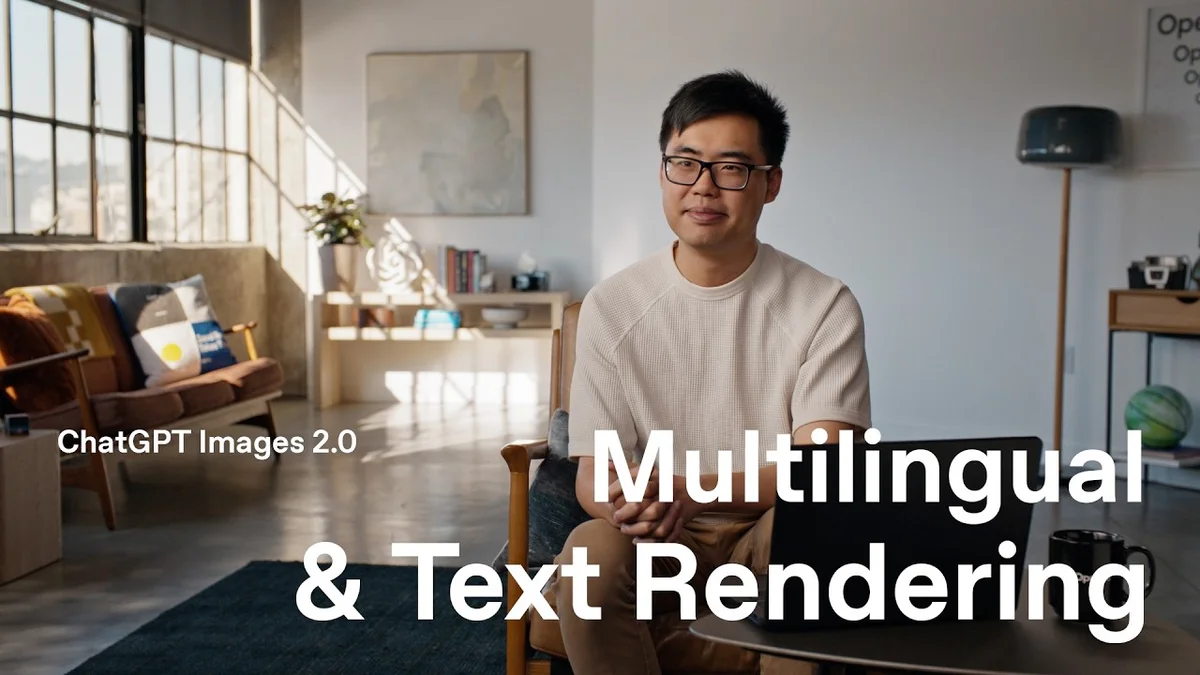
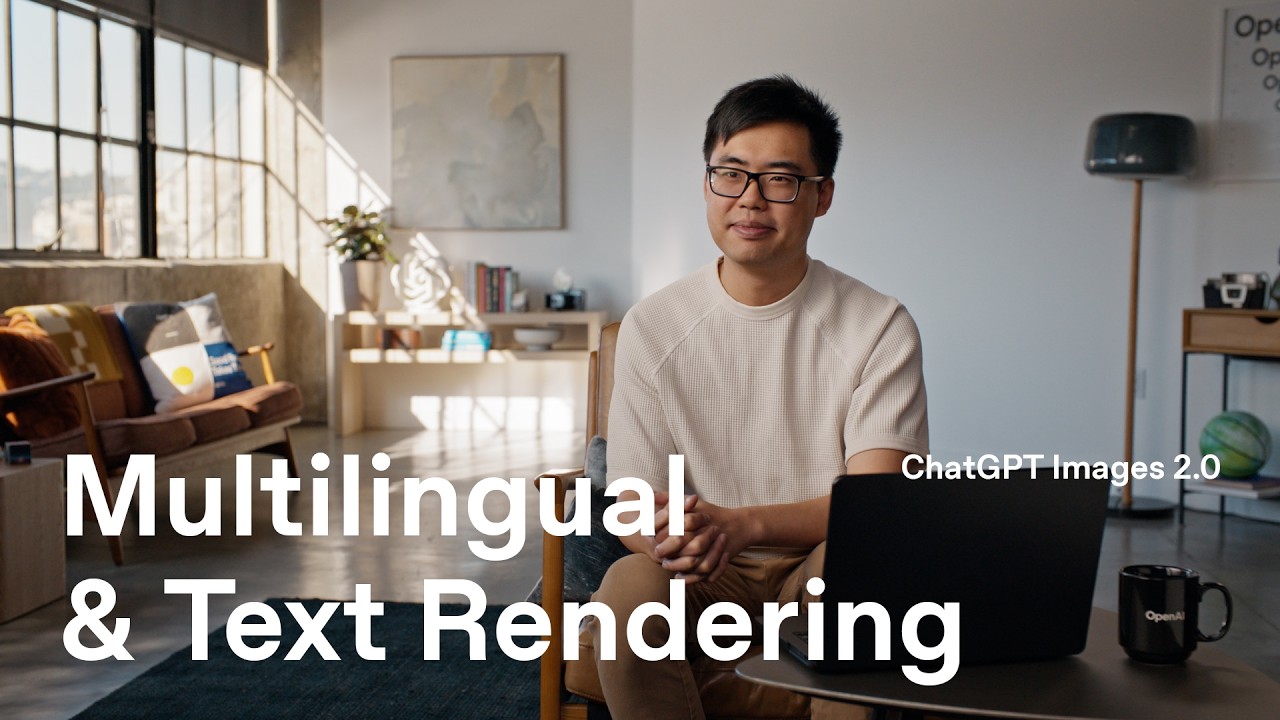
Programmer Boyuan demonstrates ChatGPT Image 2.0's multilingual text rendering capabilities on a laptop.
Image credit: OpenAI· OpenAI Youtube

In a compelling demonstration of artificial intelligence's growing multilingual capabilities, OpenAI's latest iteration of its image generation model, ChatGPT Image 2.0, has showcased an impressive ability to render text accurately across a variety of languages. The video features a programmer, Boyuan, who walks through several use cases, highlighting how the AI can now not only generate visually appealing images but also incorporate text in diverse scripts with remarkable fidelity.

Boyuan, a programmer at OpenAI, is the central figure in this demonstration. His role involves working with and advancing AI models, particularly in the realm of image generation and understanding. His expertise is crucial in showcasing the practical applications and the nuanced improvements of the latest ChatGPT Image model.

The full discussion can be found on OpenAI Youtube's YouTube channel.
Related startups

Multilingual & Text Rendering with ChatGPT Images 2.0 - OpenAI Youtube
Multilingual & Text Rendering with ChatGPT Images 2.0 — from OpenAI Youtube

Multilingual Text Generation: A Leap Forward

The core of the demonstration revolves around ChatGPT Image 2.0's enhanced ability to handle text within generated images. Previously, AI image generators often struggled with text, producing garbled or nonsensical characters, especially in non-English languages. This new version, however, appears to have overcome these limitations.

Boyuan begins by asking the AI to create a poster about his hometown, Wuxi, in a hand-drawn style. The prompt includes specific instructions for an "uncluttered layout to introduce Wuxi, in both drawing and text." The resulting image not only captures the essence of Wuxi with its historical sites and local produce but also features Chinese text that is legible and contextually appropriate. "This looks good." Boyuan exclaims, impressed by the accuracy of the generated Chinese text.

He then pushes the model further by requesting a poster for his teammate from Seoul, South Korea. The prompt specifies a "high-quality poster in hand-drawn style in Korean. The poster uses a beautiful yet uncluttered layout to introduce Seoul, in both drawing and text. At the bottom of the poster, add a paragraph about the history of Seoul. All text must be in Korean." The AI delivers a poster that accurately depicts Seoul's landmarks and incorporates Korean text, which Boyuan notes would be understandable to Korean readers.

Testing the Limits: Diverse Languages and Styles

To further test the model's versatility, Boyuan proceeds to generate images with text in other languages. He requests a poster for a teammate in Bangladesh, specifying the use of Bengali. The prompt asks for a poster highlighting different places in Chittagong, Bangladesh, with all text in Bengali. The generated image, featuring coastal scenes and local culture, includes Bengali script that Boyuan confirms looks very good and is accurately rendered.

The demonstration continues with a request for a futuristic Tokyo poster in Japanese. Boyuan prompts the AI to create a poster in a "futuristic style in Japanese. The poster uses a beautiful yet uncluttered layout to introduce Tokyo, in both drawing and text. At the bottom of the poster, add a paragraph about the history of Tokyo. All text must be in Japanese." The resulting image is a stunning depiction of a neon-lit Tokyo skyline, complete with Japanese characters that appear sharp and correctly formed.

PDF Translation and Text Rendering from Documents

Perhaps one of the most significant advancements shown is the AI's ability to process and render text from uploaded documents. Boyuan uploads a 100-page technical paper and asks ChatGPT to translate it into traditional Chinese and render it as an image. He notes that traditionally, image generation models struggle to render small text accurately, often producing blurry or illegible characters.

The AI successfully translates the document and renders the text within an image format. Boyuan zooms in on the generated image, showing that the text, even in small font sizes, is remarkably clear and readable. "All the text are rendered correctly." he states, emphasizing the high fidelity of the output. This capability has profound implications for creating visual summaries of lengthy documents or for adapting technical information for global audiences.

Implications for Global Content Creation

The advancements demonstrated by ChatGPT Image 2.0 have far-reaching implications for the AI and startup world. For businesses operating globally, the ability to generate high-quality visual content with accurate text in multiple languages can significantly reduce localization costs and time.

This technology could empower content creators, marketers, and educators to produce materials that resonate with diverse audiences without the need for complex, multi-step translation and design processes. The seamless integration of accurate multilingual text within AI-generated imagery marks a significant step towards more inclusive and globally accessible AI tools.

© 2026 StartupHub.ai. All rights reserved. Do not enter, scrape, copy, reproduce, or republish this article in whole or in part. Use as input to AI training, fine-tuning, retrieval-augmented generation, or any machine-learning system is prohibited without written license. Substantially-similar derivative works will be pursued to the fullest extent of applicable copyright, database, and computer-misuse laws. See our terms.