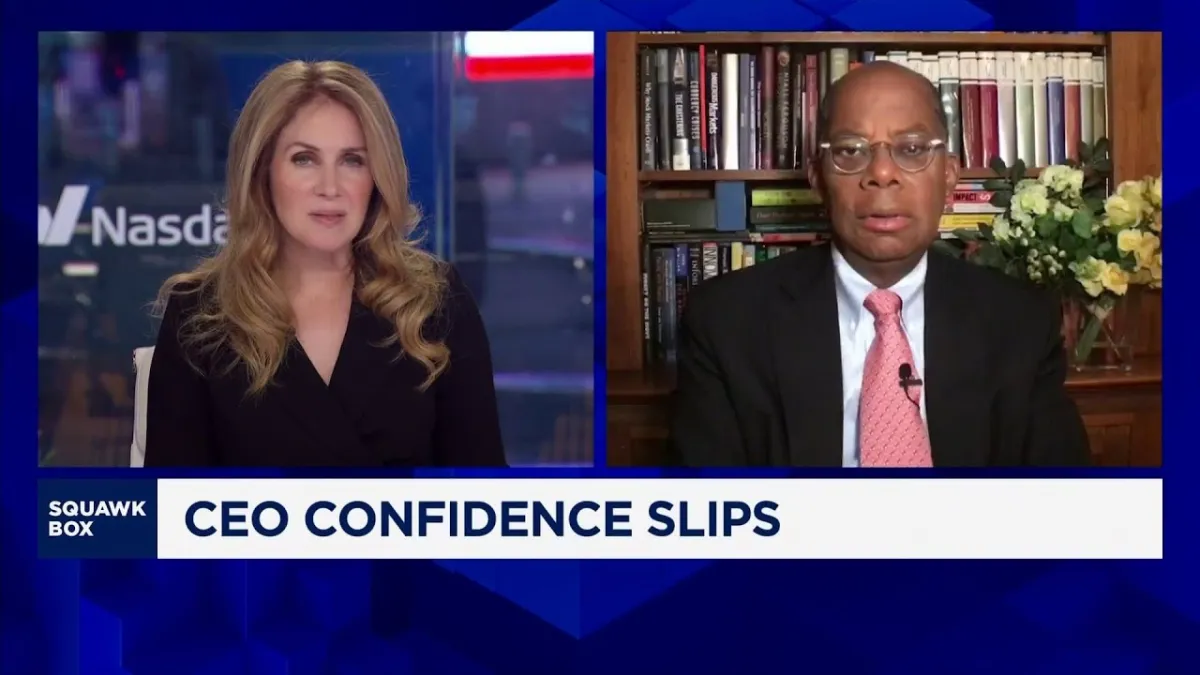
Artificial intelligence is poised to trigger a "major transformation of jobs" within the next four to five years, according to a significant majority of CEOs. This insight, shared by Roger Ferguson, Vice Chairman of The Business Council and Trustee of The Conference Board, on CNBC's Squawk Box, highlights a profound shift in corporate strategy and workforce planning. Ferguson, a former Federal Reserve Vice Chairman, discussed the latest CEO confidence survey findings, offering a nuanced perspective on the economic landscape, the state of the labor market, and the accelerating impact of AI on industries.
The Conference Board's recent survey of 130 CEOs, conducted in late September and early October, revealed a slight dip in overall CEO confidence, with the index falling to 48 from 49. As Ferguson explained, "anything below 50 is thought to be negative," suggesting a prevailing sentiment of caution. However, this dip does not signal an impending dramatic downturn. Instead, the consensus points towards a "mild economic slowdown" over the next 12 to 18 months, with 64% of surveyed CEOs anticipating such a scenario. This outlook suggests an environment characterized by inflation still above trend and growth potentially slowing below trend, a state Ferguson termed "slight stagflation." Only a small fraction of CEOs foresee negative economic growth, and a quarter expect solid, trend-level growth, indicating a collective mood that, while not exuberant, is far from pessimistic regarding a severe recession.
This measured economic outlook provides the backdrop for the more profound shifts anticipated in the realm of employment. The most striking finding from the survey, as Ferguson underscored, pertains to the expectations surrounding artificial intelligence. "A large majority expect major transformation of jobs in the next four or five years," he stated, referring to a rapid and fundamental reshaping of roles across industries.
This transformation is not a distant concern; it is already underway or imminent for many. The survey data revealed that 9% of CEOs reported AI already impacting job structures, 25% expect it within two years, and a substantial 47% anticipate major changes within three to five years. This means a staggering 72% of business leaders foresee significant AI-driven job shifts within half a decade.
The primary drivers behind this rapid integration of AI are clear: efficiency and cost-cutting. Over half of the surveyed CEOs, roughly 52%, indicated these as their main motivations for adopting AI. While a portion also aims to enhance and expand services, the core impetus remains optimizing operations. This focus implies that the transformation will involve streamlining existing processes and automating repetitive tasks, thereby altering the nature of many current jobs. It is less about wholesale elimination of positions and more about evolving responsibilities, demanding new skill sets, and potentially creating entirely new categories of employment, though the immediate focus is on efficiency.